.png?width=2240&height=1260&name=Office%20Supplies%20Inventory%20Management%20(9).png)
Table of Contents:
- Introduction
- Ranked Overview: The 6 Best Rithum Alternatives in 2026
- Key Evaluation Criteria for Multi-Source Order Management Software
- Why SMB and Mid-Market Retailers Are Replacing Rithum in 2026
- The 4 recurring pain points driving Rithum exits
- Flxpoint vs Rithum head-to-head comparison
- The 5 core advantages of Flxpoint
- Flxpoint proven enterprise and mid-market results
- Migration blueprint: moving from Rithum without disruption
- Frequently asked questions
Introduction
While Rithum (formerly ChannelAdvisor / CommerceHub) remains a legacy platform for $50M+ enterprise retailers seeking marketplace syndication and retail-media advertising, modern multi-channel brands are switching to Flxpoint.
The primary drivers for migration are Rithum’s 1.3%–3% GMV revenue-share fee, slow 6–9 month implementation timelines, rigid supplier onboarding, and lack of dynamic multi-supplier order routing.
Flxpoint provides an enterprise Inventory & Distributed Order Management System (I/OMS) with flat subscription pricing, multi-distributor product deduplication, flexible vendor onboarding (API, EDI, FTP, Shopify-to-Shopify, and Vendor Portal), and automated cost-optimized order routing.
Ranked Overview: The 6 Best Rithum Alternatives in 2026
When evaluating platforms to replace Rithum (formerly ChannelAdvisor and CommerceHub), different software options excel at different operational models. Here is how the top six alternatives rank for growing retailers:
- Flxpoint (Top Pick for Multi-Supplier Retailers & Hybrid Dropshippers): Best for mid-market retailers, hybrid fulfillment operators, and multi-vendor marketplaces that need dynamic multi-source order routing, product overlap deduplication, and zero GMV revenue share.
- Linnworks: Best for high-volume, multi-warehouse operators focusing primarily on standard warehouse picking, packing, and carrier label generation.
- Sellercloud: Best for enterprise operations requiring extensive ERP-style customization and native physical warehouse scanning systems (Skustack).
- Zentail: Best for first-party brands and private-label sellers seeking automated marketplace catalog mapping (SMART Types) across Amazon, Walmart, and Target Plus.
- Extensiv (formerly Skubana): Best for 3PL networks and brands with multi-facility inventory allocation requiring deep 3PL Warehouse Manager integration.
- Cin7 Core (formerly DEAR Systems): Best for product companies that manage light manufacturing, B2B wholesale portals, and point-of-sale inventory tracking.
Key Evaluation Criteria for Multi-Source Order Management Software
So, how should SMB and mid-market retail operators assess alternatives to Rithum?
Choosing software for multi-source order routing and retail order fulfillment is not just about counting channel logos. To select a platform that protects profit margins while scaling operations, evaluate solutions against these five fundamental criteria:
- Predictable Pricing vs. Revenue Share: High-growth retailers must avoid platforms that take a percentage of gross merchandise volume (GMV). Look for flat or order-volume-tiered pricing where your software invoice does not inflate as sales increase.
- Dynamic Multi-Source Order Routing: The routing engine must evaluate incoming orders at the line-item level, calculating real-time inventory availability, true landed wholesale costs, shipping thresholds, and split-order logic across warehouses and dropshippers.
- Universal Supplier Ingestion: The software must connect to diverse fulfillment endpoints (direct Shopify-to-Shopify API, native EDI over SFTP, scheduled FTP/CSV, and self-service vendor portals) without requiring expensive custom development.
- Master Catalog Deduplication & Overlap Management: When multiple distributors supply the same manufacturer part number (MPN), the system must deduplicate listings, pool live stock, and enforce MAP price guardrails automatically.
- ERP and Accounting Compatibility: The platform must provide bi-directional synchronization with your system of record (NetSuite, QuickBooks Online, Infor XA, SAP, or Sage) without forcing you to re-architect your core financial workflows.
Why SMB and Mid-Market Retailers Are Replacing Rithum in 2026
For over two decades, ChannelAdvisor was the default platform for syndicating product feeds across Amazon, eBay, and global marketplaces.
However, following its acquisition by CommerceHub and subsequent rebrand to Rithum, merchant requirements have evolved beyond generic data feed management.
The 4 Recurring Pain Points Driving Rithum Exits
1. The "Growth Tax" (Revenue-Share Pricing)
Rithum typically charges a base monthly subscription ($2,000+/month) layered with a 1.3% to 3.0% take-rate on gross merchandise volume (GMV).
- On $5,000,000 in online sales, a 2% take-rate costs $100,000/year in platform fees alone; on top of base subscriptions and integration setup costs.
- If your marketing team optimizes conversion rates and your gross sales scale from $5M to $20M, your software costs skyrocket without delivering a single additional unit of platform value or compute efficiency. Why should your technology vendor take a cut of your top-line revenue? Modern retailers require predictable operational budgets where profit margins compound internally.
2. The Legacy "Feed Forwarder" Limitation
Rithum acts as a listing and syndication conduit, but it was not engineered to be the single source of truth for distributed inventory. It struggles to reconcile duplicate SKUs across multiple suppliers, calculate true multi-warehouse available-to-promise inventory, or execute dynamic margin-based repricing across overlapping distributor feeds.
3. High Friction for Supplier Onboarding
If your suppliers and brand partners do not operate on standard EDI or standardized CSVs, onboarding them into Rithum requires custom development, third-party middleware, or manual labor. This severely restricts catalog expansion.
4. Post-Merger Operational Drag
Across major software review platforms (G2, Capterra, Trustpilot), user feedback consistently highlights steep annual price increases (often cited at 4%–7% annually or multiple-fold post-merger), auto-renewing 12–24 month contracts with narrow cancellation windows, and ticket-based support delays during peak selling seasons like Black Friday and Cyber Monday.
Flxpoint vs. Rithum Head-to-Head Comparison
|
Capability |
Rithum (ChannelAdvisor) |
Flxpoint |
|
Pricing Model |
Base Fee + 1.3%–3% Revenue Share |
Flat / Order-Volume Tiered Pricing (0% GMV Cut) |
|
Contract Terms |
12–24 Month Commitments (Auto-Renewing) |
Monthly and annual plans |
|
Catalog Overlap Merging |
Basic rule mapping; duplicate listings common |
Advanced Multi-Supplier Deduplication on UPC, MPN, or Brand/AAIA plus MPN RefID |
|
Order Routing Intelligence |
Basic rules / static preferred vendor |
Dynamic Multi-Variable Routing (Lowest Cost, In-Stock, Proximity, Fewest Packages) |
|
Vendor Onboarding Diversity |
Rigid (EDI / standard FTP); high barrier to entry |
Universal Ingestion (Shopify, BigCommerce, WooCommerce, Magento, EDI, FTP, CSV, API, Vendor Portal) |
|
Hybrid Fulfillment (Own + Dropship) |
Requires external WMS/OMS add-ons |
Native Hybrid Fulfillment (Warehouse-first, 3PL, Dropship Fallback, Cross-docking) |
|
ERP / NetSuite Integration |
Heavy custom middleware required |
Deep Bi-Directional NetSuite & ERP Connectors |
|
Regulated & Complex Verticals |
Generic ecommerce features only |
Vertical-Specific Logic (Firearms FFL/State Compliance, Automotive ACES/PIES, Industrial Million-SKU Pipelines) |
|
Time to Live / Implementation |
3 to 9 Months (Professional Services) |
30 to 90 Days (Guided Onboarding) |
The 5 Core Advantages of Flxpoint
1. Zero Revenue Share: Retain 100% of Your Margins
The revenue share is the number that catches teams off guard, because it scales automatically. A flat plan charges the same whether you sell $2M or $50M, so every extra dollar of growth stays in your margin.
Here is a like-for-like comparison at $10,000,000 in annual online GMV, using Rithum figures reported by third-party pricing analyses and Flxpoint's published flat pricing:
|
Cost element |
Rithum (reported) |
Flxpoint (published) |
|
Base platform fee |
~$2,500/mo = $30,000/yr |
Flat plan from $699/mo annual |
|
Revenue share on $10M GMV |
~2% = $200,000/yr |
0% (no revenue share) |
|
Indicative annual total |
~$230,000/yr |
Flat-tier subscription, no GMV cut |
The point is not the exact dollar figure, which varies by contract. It is the model: Rithum's cost rises with your top line, and Flxpoint's does not. For the line-by-line pricing, contract, and support comparison, see the Flxpoint vs Rithum comparison page.
2. Vertical-Specific Breakdown
Firearms & Tactical (2A Compliance)
Rithum rarely competes in the 2A space and carries little compliance depth. Flxpoint is a leading e-commerce automation platform for the industry, used by brands including Palmetto State Armory.
- FFL order handling: identifies serialized items, captures FFL license data via API (GunBroker and Master FFL), and transmits required credentials to distributor endpoints such as RSR, Lipsey's, Sports South, Davidson's, and Zanders.
- Restricted-state routing: automated import holds for California CFLC, Illinois FOID checks, and state magazine capacity caps.
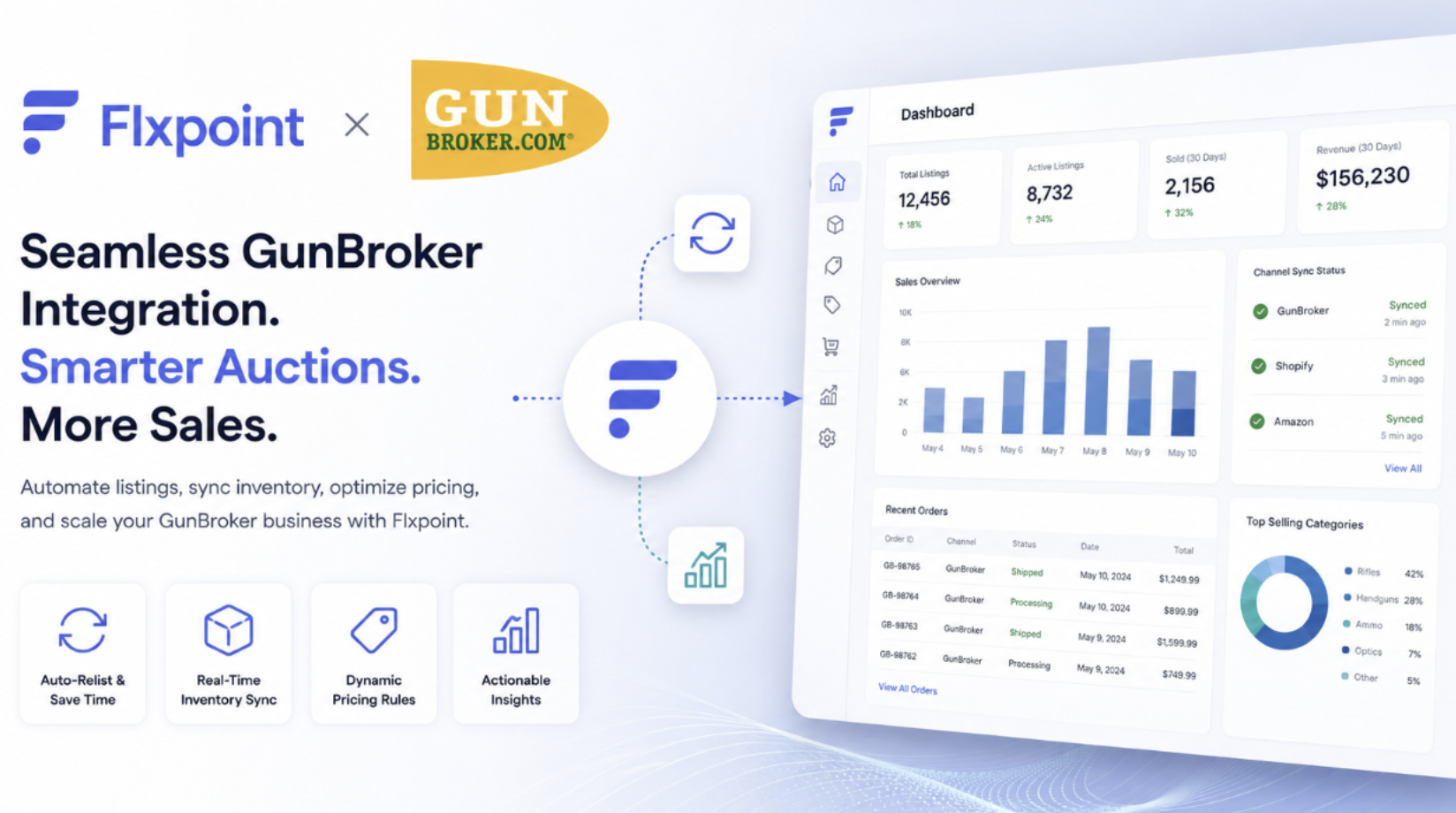
- GunBroker category AI: zero-shot category mapping that cuts listing prep time by about 90%.
Automotive & Tires Aftermarket
Rithum works mainly as an enterprise listing feed and lacks specialized high-SKU catalog hygiene and fitment tooling. Flxpoint handles high-SKU distributor feeds from Turn 14, Keystone, Meyer, WPS, and ATD.
- Data-hygiene architecture: resolves feed anomalies, such as American Tire Distributors' invalid UPCs, by building unique RefIDs off Brand/AAIA plus MPN.
- ACES and PIES fitment stack: ingests PIES product data via SEMA Data and passes ACES fitment parameters directly to storefront Year/Make/Model search tools like Convermax.
B2B Industrial, HVAC & Tool Supply
Rithum is strong on enterprise EDI connections but introduces long setup cycles and high costs for mid-market suppliers. Flxpoint handles multi-million SKU catalogs across diverse supplier stacks including Orgill, ORS Nasco, and Essendant.
- High-volume API infrastructure: supports near-continuous catalog updates, which cuts oversells and stockouts.
- NetSuite orchestration: sits between NetSuite ERP and external supplier feeds and automates multi-source PO creation without custom ERP re-architecture.
Multi-Vendor Marketplaces (MVM)
Rithum connects enterprise retailers to existing brand networks but is costly and rigid for curated, independent marketplaces. Flxpoint powers both fast-onboarding platforms like Tall Size and standardized marketplaces.
- Zero-friction brand onboarding: five-minute Shopify API connections let marketplaces add vendors without engineering overhead.
- Vendor SLAs and shipping management: automated late-order tracking queues and bulk vendor nudges keep marketplace fulfillment reliable.
3. Universal Vendor Integration ("Integrate Any Supplier")
Scaling an online catalog requires meeting vendors where they operate:
- Direct Storefront-to-Storefront: Connect directly to vendor Shopify, BigCommerce, WooCommerce, or Magento stores via 5-minute API handoffs.
- Enterprise Protocols: Native EDI (846 inventory, 850 PO, 856 ASN, 810 invoice over SFTP) and REST API.
- File Automation: Automated scheduled ingestion via FTP, SFTP, CSV, XML, or Google Sheets.
- No-Tech Vendor Portal: A hosted, dedicated portal for boutique suppliers or custom manufacturers to manage orders, confirm inventory, and download packing slips/shipping labels.
4. Source Inventory Layer & Product Overlap Deduplication
When five distributors carry the same manufacturer part number (MPN), basic listing software creates duplicate SKUs or constantly overwrites prices with inaccurate data. Flxpoint’s Source Inventory Layer:
- Ingests and normalizes raw catalog feeds independently.
- Merges overlapping SKUs into a single catalog listing using Brand/AAIA + MPN RefIDs or UPCs.
- Assigns per-field source priorities (e.g., product titles from Supplier A, high-res images from Supplier B, and pricing from Supplier C).
- Enforces MAP floor protections and dynamically reprices based on the lowest in-stock supplier.
5. Intelligent Multi-Source Order Routing
Instead of static dropship routing, Flxpoint evaluates incoming line items in real time:
- Cost Optimization: Identifies the lowest-cost in-stock vendor including item cost, estimated shipping, and dropship fees.
- Split-Order Execution: Automatically splits mixed carts (e.g., sends warehouse items to internal pick-and-pack and dropship items to external vendors simultaneously).
- Proximity & Packaging: Consolidates multi-line orders to minimize split packages and selects fulfillment centers closest to the customer.
Flxpoint Proven Enterprise & Mid-Market Results
- Palmetto State Armory (Enterprise Manufacturer & Retailer): Transitioned away from rigid, legacy EDI connections to Flxpoint’s multi-supplier orchestration engine, automating over 3,000 dropship orders daily across NetSuite ERP, Magento V2, and Deposco WMS environments while scaling dropship volume 2–3x without expanding ops headcount.
- Kenneth Cole (Global Fashion Brand): Replaced manual operations and heavy legacy software overhead with Flxpoint, achieving an approximate 90% reduction in operating costs.
- Leading HVAC Supply Retailer (High-SKU Industrial): Automated millions of SKUs from dozens of disparate distributor feeds using Flxpoint’s high-volume API tier, achieving an 80–99% reduction in overselling.
- Tall Size (Curated Multi-Vendor Marketplace): Eliminated manual spreadsheet management by utilizing 5-minute Shopify vendor connections, scaling brand onboarding without adding back-office overhead.
- Realtree (Outdoor & Camo Marketplace): Accelerated partner onboarding by 90% (bringing Shopify suppliers live in 3 days) and drove a +58% increase in dropship revenue using Flxpoint alongside NetSuite and BigCommerce.
Migration Blueprint: Moving from Rithum Without Disruption
Migrating from an enterprise platform should not involve a high-risk cutover. Flxpoint employs a "Right-to-Left" Migration Strategy to ensure continuous operations:
Week 1 to 2: catalog ingestion. Pull existing live channel listings from Shopify, Amazon, BigCommerce, WooCommerce, and Magento directly into Flxpoint to set the catalog baseline.
Week 2 to 4: supplier connection and normalization. Connect distributor feeds by API, EDI, FTP, and portal, then configure master SKU linking, overlap deduplication, and MAP rules.
Week 4 to 6: parallel run and validation. Run Flxpoint alongside Rithum. Validate inventory sync frequency, test order routing logic, and verify ERP and accounting payloads.
Week 6 to 8: live cutover. Switch live channel fulfillment to Flxpoint and deactivate legacy Rithum connectors with zero marketplace downtime.
Ready to move off Rithum's revenue share?
See how Flxpoint handles multi-supplier ingestion, catalog deduplication, and cost-based order routing on a flat plan with no percentage of your sales. Book a personalized demo, or compare the platforms line by line on the Flxpoint vs Rithum page.
-
Transparent Pricing: Explore Flxpoint Subscription Plans
-
Real Customer Results: Browse Verified Case Studies
-
Talk to an Architect: Schedule Your Live Flxpoint Demo
Frequently Asked Questions
Is there a cheaper alternative to Rithum for multi-source order routing?
Yes. Flxpoint is a significantly cheaper alternative to Rithum for multi-source order routing. While Rithum charges base subscriptions ($24,000 to $50,000+ per year) plus a 1.3% to 3.0% GMV revenue share, Flxpoint provides enterprise-grade order management software on transparent, flat-rate subscription plans with 0% revenue share. This allows SMB and mid-market retail platforms to automate retail order fulfillment across internal warehouses, 3PLs, and dropship suppliers at a fraction of the cost.
How does Flxpoint compare to Linnworks as a Rithum alternative?
While Linnworks focuses on basic warehouse picking, packing, and carrier label generation, Flxpoint provides deeper multi-supplier dropship automation, advanced catalog deduplication (merging overlapping distributor SKUs on MPN/RefID), and flexible vendor onboarding (including direct 5-minute Shopify-to-Shopify integrations and self-service vendor portals) that Linnworks lacks.
Is Flxpoint a direct replacement for Rithum (ChannelAdvisor)?
Yes. Flxpoint replaces Rithum's core multi-channel listing, inventory synchronization, and distributed order management capabilities. Unlike Rithum, Flxpoint focuses on multi-supplier automation, catalog overlap deduplication, vendor portal accessibility, and dynamic margin-based routing without charging a percentage of revenue.
How does Flxpoint's pricing compare to Rithum?
Rithum charges a base fee plus a 1.3% to 3% GMV revenue cut, leading to annual costs between $30,000 and $100,000+ for growing brands. Flxpoint offers flat, predictable subscription tiers based on feature set, connector count, and order throughput with 0% revenue share.
Can Flxpoint integrate with our existing NetSuite ERP?
Yes. NetSuite is Flxpoint’s most established ERP integration. Flxpoint acts as the agile commerce orchestration layer between NetSuite, external sales channels, and diverse supplier networks, automating multi-source PO creation and inventory sync without requiring complex ERP customization.
How long does implementation take?
While Rithum implementations often take 6 to 9 months, standard Flxpoint onboarding is completed within 30 to 90 days, supported by a dedicated Project Manager.