Chapter 8 Multi-Supplier EDI: Running Orders Across Many Suppliers at Once
EDI gets harder with every supplier you add, and the difficulty is not technical. One EDI connection is a project. Twenty EDI connections is an operation, because each partner brings its own document set, identifiers, file conventions, and failure patterns.
This chapter is about what changes at that scale, and about the decision EDI does not make for you: which supplier should receive the order in the first place.
Why is EDI harder with multiple suppliers?
Because the standard is shared but the implementations are not. Two suppliers can both send a purchase order acknowledgement and still require completely different handling.
The differences show up in specific places. Identifier qualifiers sit in different positions. One partner requires a field another treats as optional. One sends inventory hourly, another nightly. One cancels items through an order status report, another through the acknowledgement. Some run custom parsers with their own status codes, which is why certain pharmaceutical distributors accept acknowledgement codes that a general parser does not recognize.
None of that is unreasonable on its own. It compounds. Twenty partners with small variations is twenty specifications to maintain, and no single person holds them all in their head.
How does order routing fit with EDI?
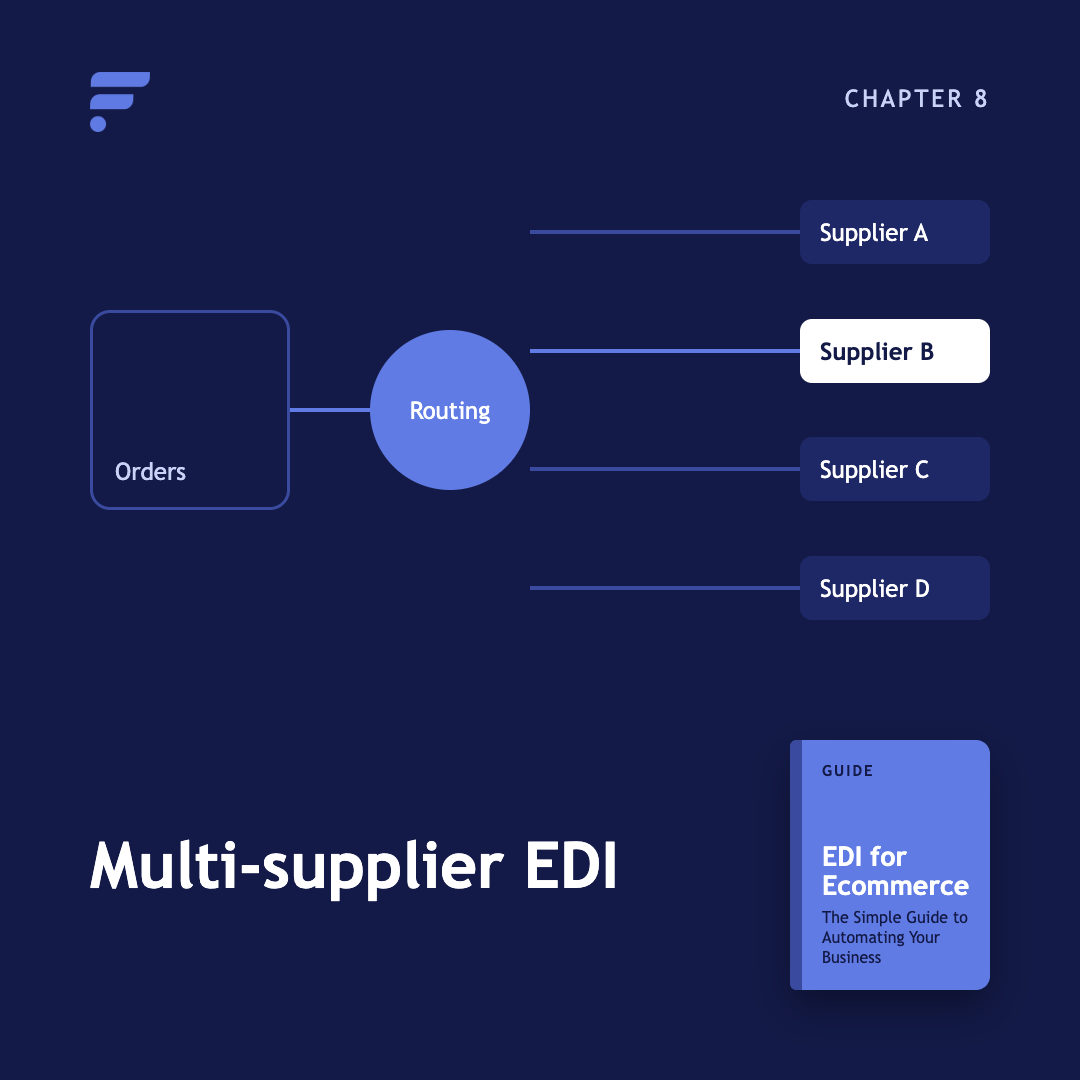
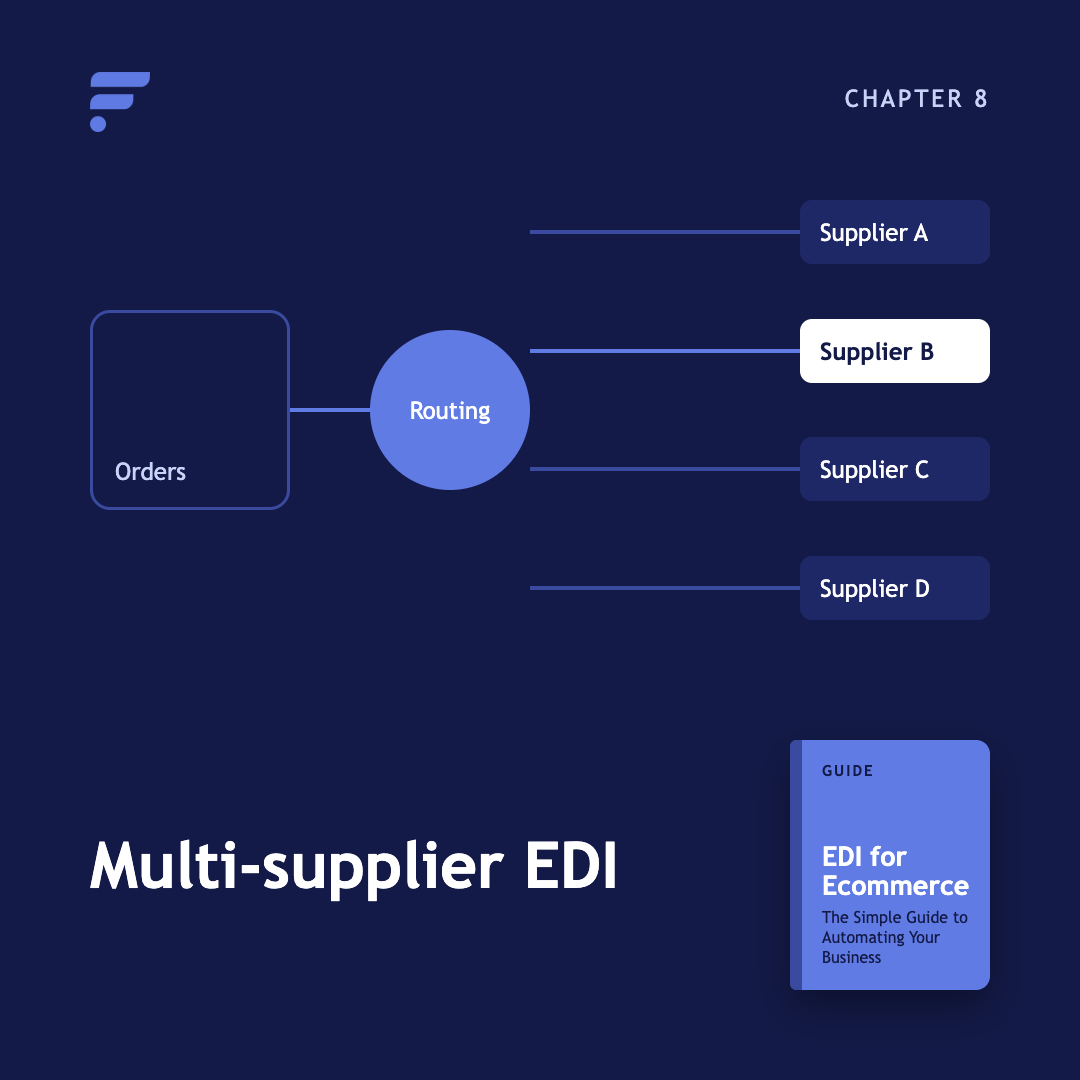
Routing decides which supplier receives the order. EDI transmits the result. Keeping those two jobs separate is the single most useful idea in this chapter.
A routing decision weighs several things: which sources have the item in stock, which is cheapest, whether one source is preferred or exclusive, what shipping policy applies, and which source sits closest to the customer. Only after that decision is made does a purchase order get generated and sent, through whatever method that particular supplier uses.
Teams that treat EDI as the routing layer end up hard-coding supplier choice into connection logic, which means changing a sourcing rule becomes an integration project. Keep the decision in order management and let the connection be interchangeable.
How do you keep supplier inventory aligned across a large catalog?
Supplier inventory has to be collected, matched to the right products, normalized, and then applied to availability rules before it means anything to a storefront.
Four questions decide whether that works:
- Which supplier owns this quantity, and does another supplier also stock the item?
- Which identifier connects the supplier's line to your catalog entry?
- How old is this data, and what do you do when a file is late?
- What happens to items that stopped appearing in the feed entirely?
That last one catches people. A supplier who drops an item from their file has not told you it is out of stock, and treating a missing line as zero is a policy decision you should make deliberately.
Unique identifiers at the variant level matter more than anything else here. Duplicate identifiers in one inventory file cause the later quantity to silently overwrite the earlier one, which produces overselling that is very hard to trace backwards.
What happens when two suppliers stock the same product?
You need one catalog entry with multiple sources behind it, and a rule that picks between them.
Without that, the same physical item appears as separate products from separate feeds, your available quantity is wrong in both directions, and orders route by accident rather than by rule. Matching overlapping items to a single record, then prioritizing sources by cost, stock position, or preference, is what makes a multi-supplier catalog behave.
This is the work that sits above EDI and has nothing to do with X12. It is also the work that decides whether a multi-supplier operation is profitable.
Can EDI support dropshipping and owned inventory together?
Yes. A hybrid model where you fulfill from your own warehouse first and fall back to distributors is common, and EDI handles the supplier-facing half of it.
What the hybrid model needs is one consistent view of availability and order status across every fulfillment source, whether that source is your warehouse, a third-party logistics provider, or a distributor connected through EDI. The customer experience should not reveal which one handled the order.
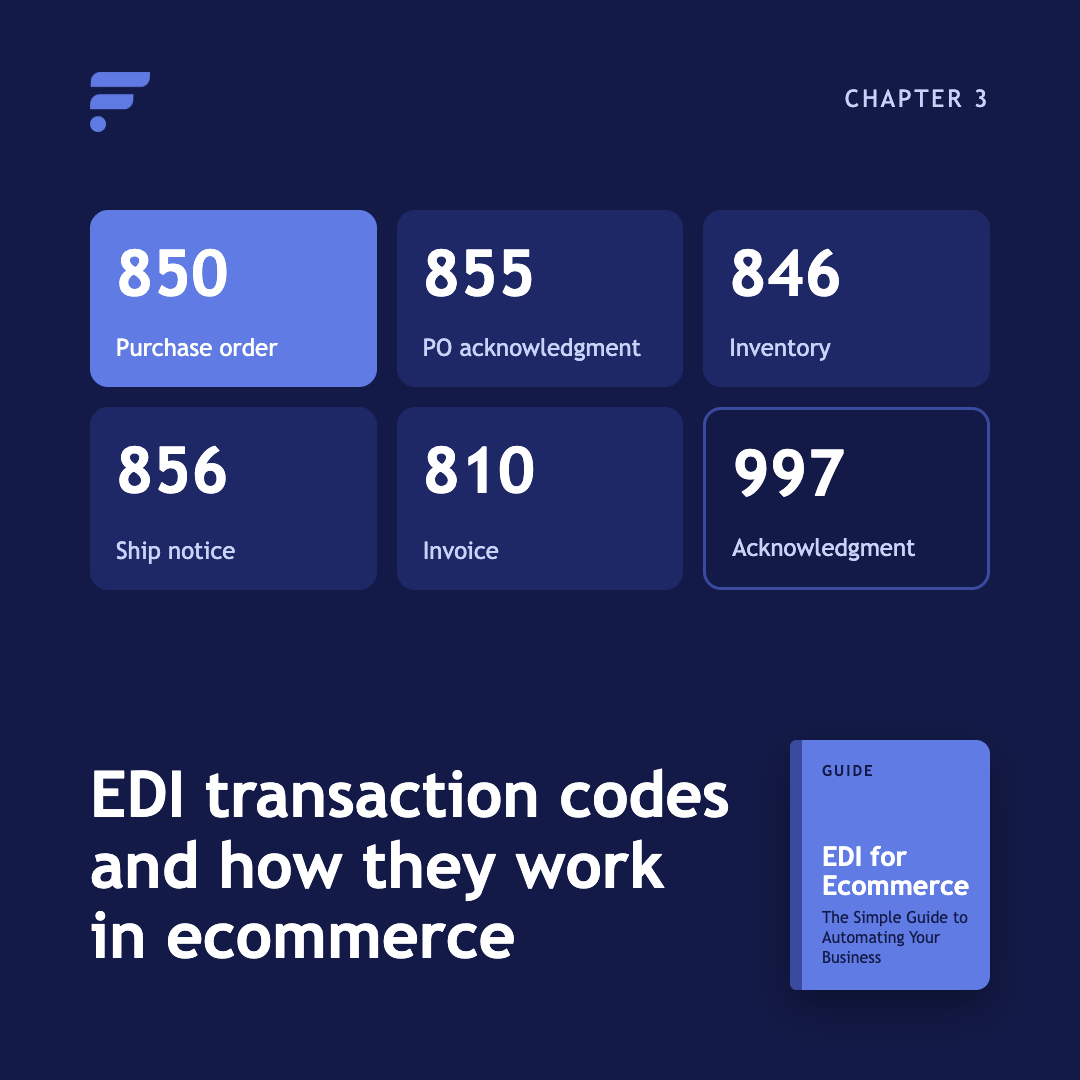
For dropship-heavy operations, the EDI documents map cleanly onto the workflow: an order out, an acknowledgement back, a ship notice with tracking, an invoice to reconcile. Chapter 3 covers each of those documents in detail.
What if some suppliers cannot support EDI?
Then connect them another way, and stop treating it as a problem. In a supplier base of any size, some partners will not have EDI capability and will not build it for you.
The practical options are an API where the supplier has built one, a file feed over SFTP, a scheduled spreadsheet, or a vendor portal where the supplier logs in to see and confirm orders. A small supplier who fulfills reliably through a portal is more valuable than a large one who cannot ship on time.
What should stay constant is everything after the connection. Routing rules, inventory logic, order status, and customer communication should not change based on how a supplier receives their orders. Our supplier integration approach is built on that principle, and our distributor solution covers the distributor side specifically.
What should you do next?
For the transaction-level detail, read EDI transaction codes. For setting up a new partner, read how to set up EDI. For the layer that makes multi-supplier work, see order management and inventory management.
Frequently asked questions
Can different suppliers use different connection methods?
Yes, and in most operations they do. Some partners connect through EDI, others through APIs, file feeds, or a vendor portal. What matters is that your internal workflow behaves the same way regardless.
Does EDI decide which supplier fulfills an order?
No. EDI transmits the purchase order after the decision is made. Routing rules based on stock, cost, preference, or location make the decision.
How do you handle suppliers who use different item identifiers?
Map each supplier's identifier to a single catalog record so one product can have several sources behind it. Without that mapping, overlapping items appear as separate products and availability becomes unreliable.
Is EDI good for dropshipping?
It works well where the supplier already runs EDI, since the order, acknowledgement, ship notice, and invoice map directly onto a dropship workflow. For suppliers without EDI, other connection methods serve the same workflow.
How many EDI connections is too many?
There is no fixed limit, but the constraint is maintenance rather than volume. Each partner's specification needs an owner, and the number becomes a problem when partner changes start arriving faster than your team can absorb them.
Guide Chapters
- Chapter 1: What is EDI?
- Chapter 2: How EDI Helps Ecommerce Businesses
- Chapter 3: Everyday Uses of EDI in Ecommerce
- Chapter 4: How to Start Using EDI
- Chapter 5: Why EDI is Better Than Manual Work
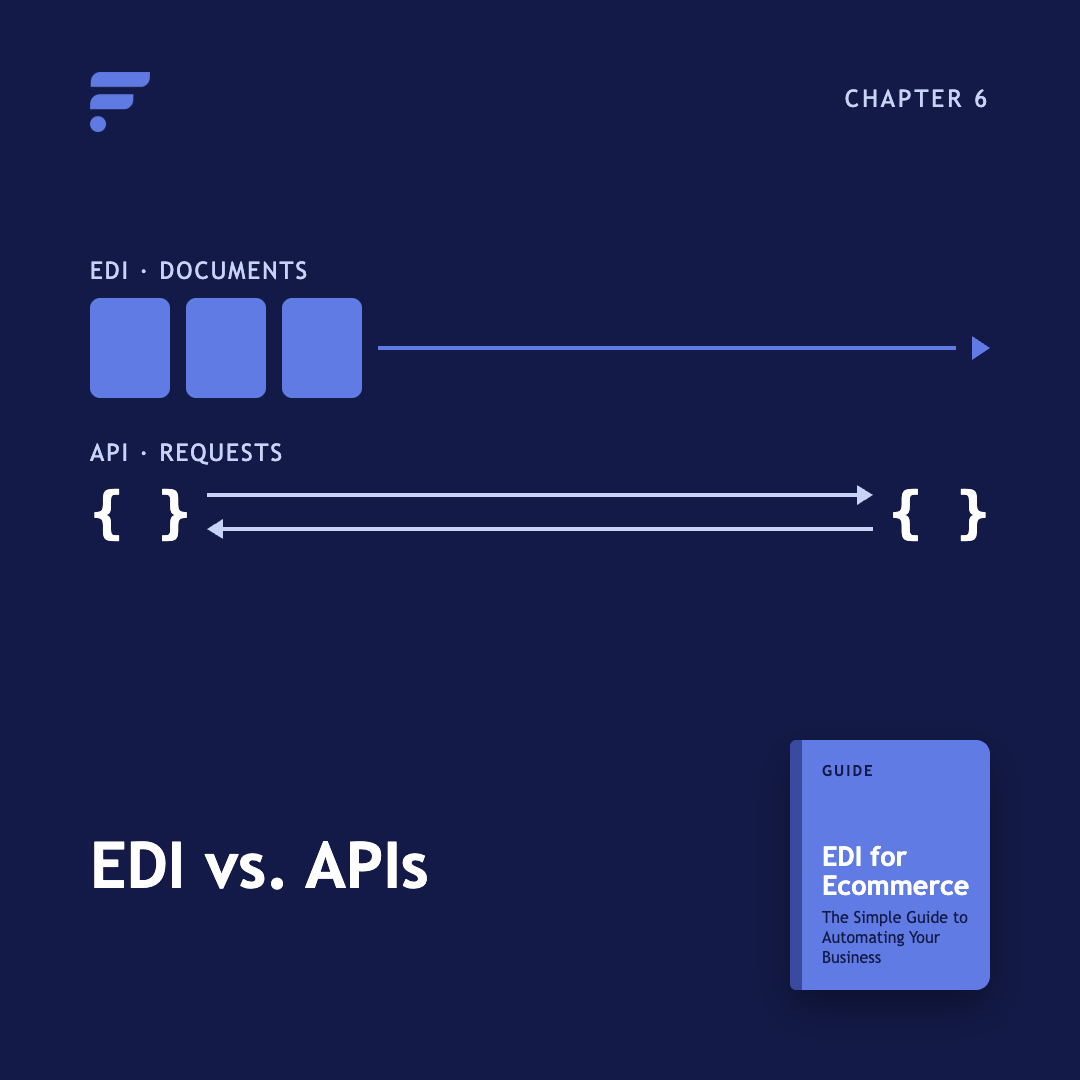
- Chapter 6: EDI vs. APIs: What's the Difference?
- Chapter 7: The Future of EDI in Ecommerce
- Chapter 8: Your First Steps with EDI
- Chapter 9: EDI is the Future of Ecommerce
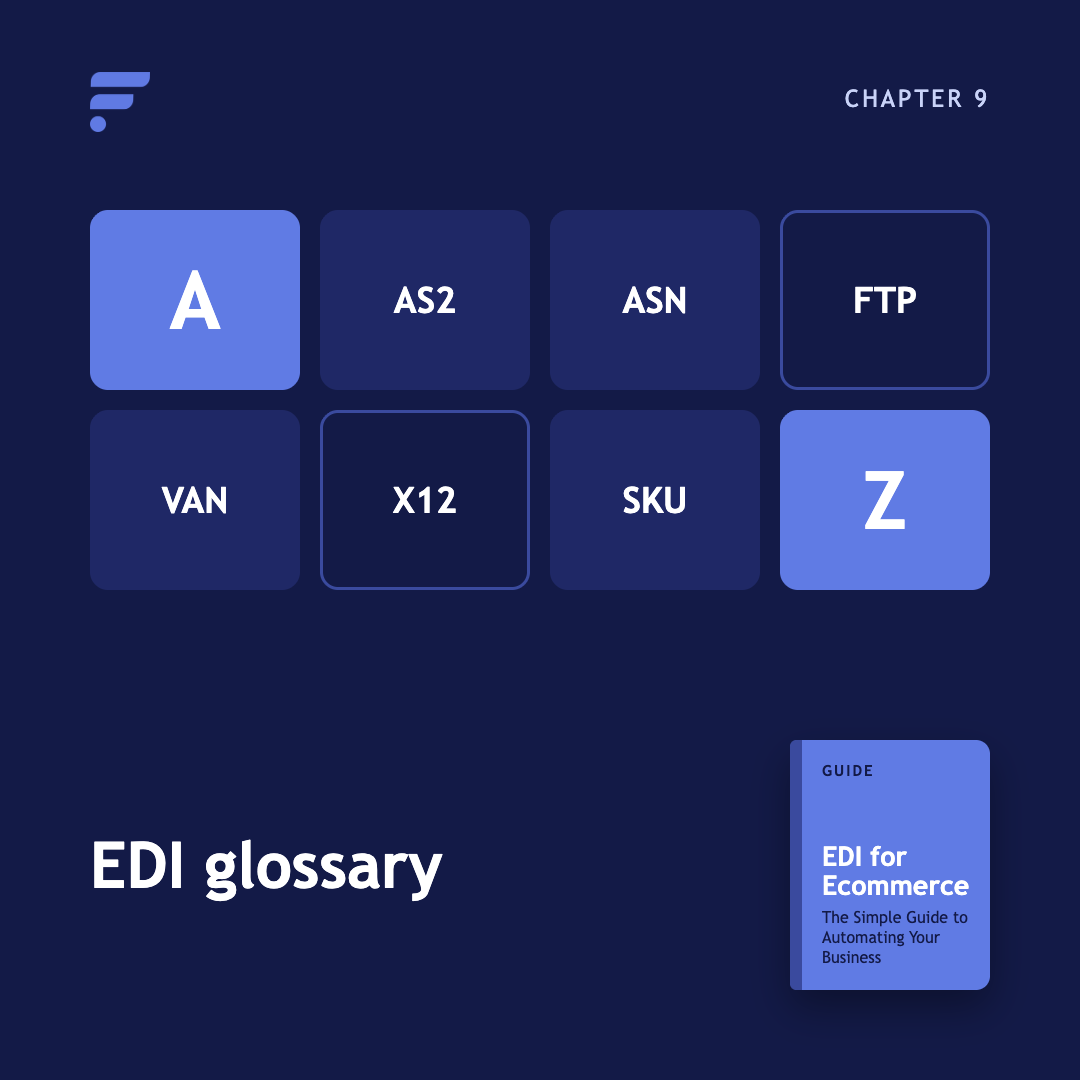
- Chapter 10: Quick Glossary of EDI terms
- Chapter 11: Checklist to Prepare for EDI Setup
All Chapters in This Guide
Start with the essentials. This chapter breaks down what EDI is, how it works, and why it’s a critical tool for modern ecommerce businesses. We simplify the technical jargon so you can clearly understand how EDI automates the exchange of business documents with your suppliers, warehouses, and trading partners.
Explore the powerful benefits EDI brings to your ecommerce operations. From faster communication and fewer errors to cost savings and improved accuracy, this chapter shows how EDI makes your business leaner, smarter, and more competitive.
See how EDI shows up in real day-to-day workflows. This chapter highlights common applications like order placement, shipping confirmations, inventory updates, and invoicing—so you can understand the practical ways EDI supports smooth operations.
Ready to get started? This chapter walks you through the process of adopting EDI, including evaluating your current tech stack, selecting the right partners, and integrating EDI into your existing systems. No technical background required—we make it approachable.
If you're still relying on spreadsheets, emails, or manual uploads to exchange data, this chapter is a game-changer. Learn how EDI eliminates human error, speeds up workflows, and allows your business to scale without adding more headcount.
Wondering when to use EDI or APIs? We break down the differences between these two powerful tools, when each makes the most sense, and how they can work together in a well-rounded ecommerce tech stack.
EDI is evolving rapidly. In this chapter, we explore upcoming innovations—like machine learning, tighter integrations with fulfillment partners, and greater automation. Discover how to stay ahead of the curve and be ready for what’s next.
It’s time to take action. This chapter provides a hands-on guide to assessing your business readiness, aligning with trading partners, and identifying the tools you need to implement EDI smoothly and successfully.
This isn’t just a short-term solution—it’s a long-term strategy. Learn why businesses adopting EDI today are better positioned to grow, adapt to change, and lead in a digitally connected ecommerce world.
EDI doesn’t have to be intimidating. We’ve created a glossary of key terms and acronyms to make the language of EDI more accessible, so you can communicate confidently with partners and providers.
Make sure you’re truly ready. This checklist walks through everything you’ll need to set up EDI the right way—from choosing the right platform to aligning your workflows and evaluating technical requirements. Consider this your pre-launch playbook.
Kenneth Cole's Smart Savings With Shopify EDI Connections
"They had never used Flxpoint before. But working with [the Flxpoint] team, they learned it and we're about to onboard our newest footwear partner, and you know that's big business for us.”
Mitul PatelKenneth Cole

How Flxpoint Helped Rifle Supply Automate & Grow
“I went line by line… whatever the inventory number was and cost value was, I calculated it and was blown away by how much that was worth— $300 million worth of product that I added to our web store.”
Chris MekdaraRifle Supply
The Ecommerce Automation Behind Screen Skinz
"Automation is the key to maximizing your volume. [Flxpoint] comes right into our flow — everything's automated. We want it to be quick and efficient. So that's what we love about Flxpoint."
Shaun Brown & Clay CanningScreenSkinz

How Inhaven Transformed Vendor Management with Flxpoint
"We ended up switching to Flxpoint, and it has been a much smoother process. Where it took us six months to get onboarded with the other company, we were up and running in a week or two with Flxpoint."
Ashley ChingInhaven

How Black Patch Performance Scaled Smarter with Flxpoint
"The only way to actually scale was to go through Flxpoint… You can’t even come close to hiring someone to do what Flxpoint does for the price."
Jonathan WilliamsBlack Patch Performance