| Who it’s for | Apparel, footwear and accessories brands selling direct, on marketplaces and through retail partners by EDI |
| Coming from | SPS Commerce, TrueCommerce, a retailer’s dropship hub (Rithum/CommerceHub, Dsco), or EDI handled in an ERP |
| ✕ Today | ✓ On Flxpoint |
| Re-key department store POs every morning | Partner POs land in your warehouse on their own |
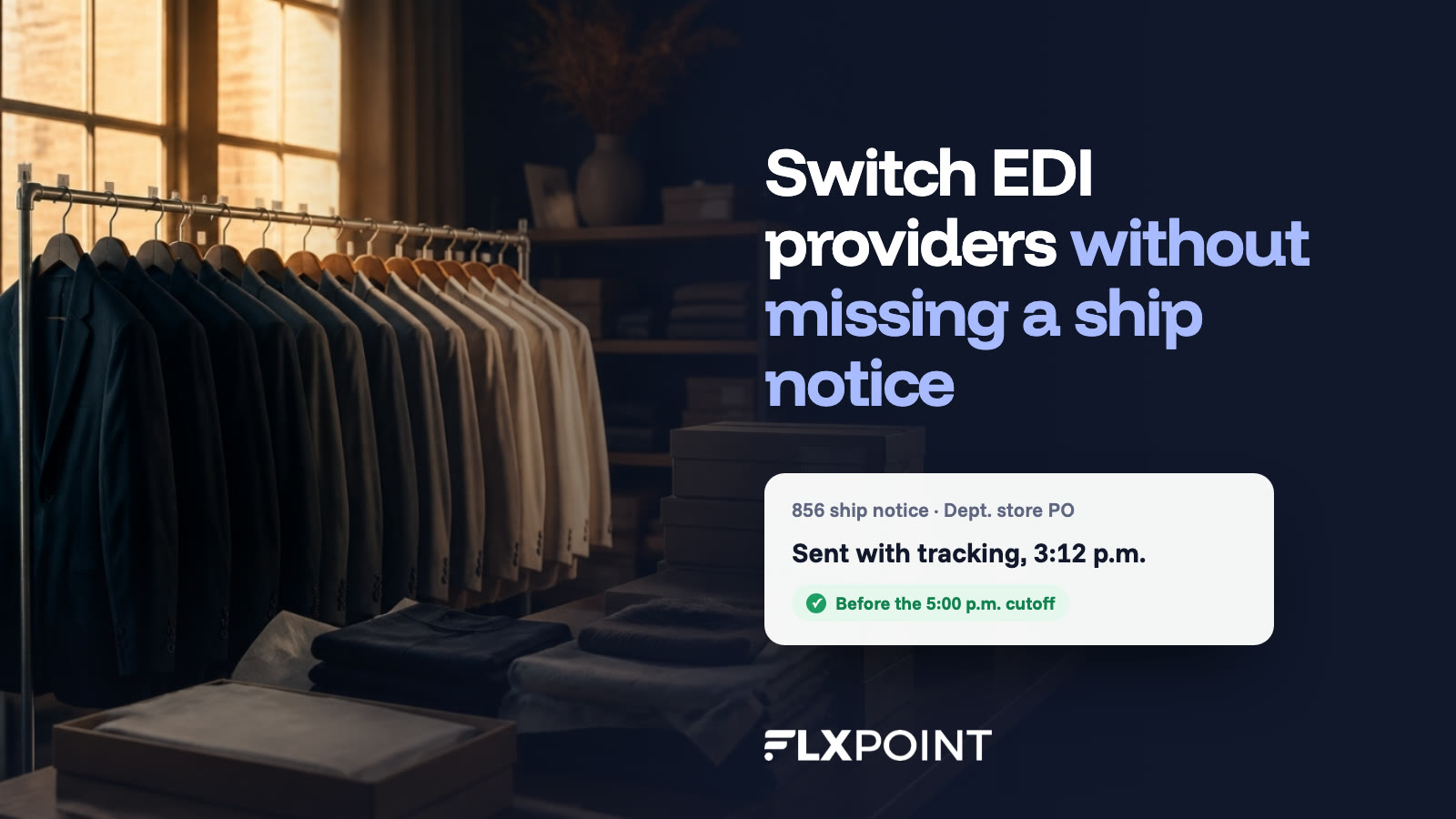
| Race the 856 cutoff by hand | Ship notices go back with tracking the same day |
| Update size stock channel by channel | One number per size, on every channel |
| Pay per document as partners grow | EDI included on every plan, builds priced up front |
Why brands move their EDI to Flxpoint
Most brands didn’t choose their EDI setup so much as inherit it from the first retail partner who asked for it. It works until the partner list grows, and then three problems show up together.
The bill grows with every partner and every document
Per-document and per-partner fees are the most common complaint about EDI networks; SPS Commerce reviews carry a “High and confusing pricing” theme (Capterra), and cost is the most discussed negative theme in TrueCommerce reviews (Capterra). Every Flxpoint plan includes EDI and API access, and custom or EDI builds are scoped and priced up front by complexity (pricing).
Partner orders still get re-keyed
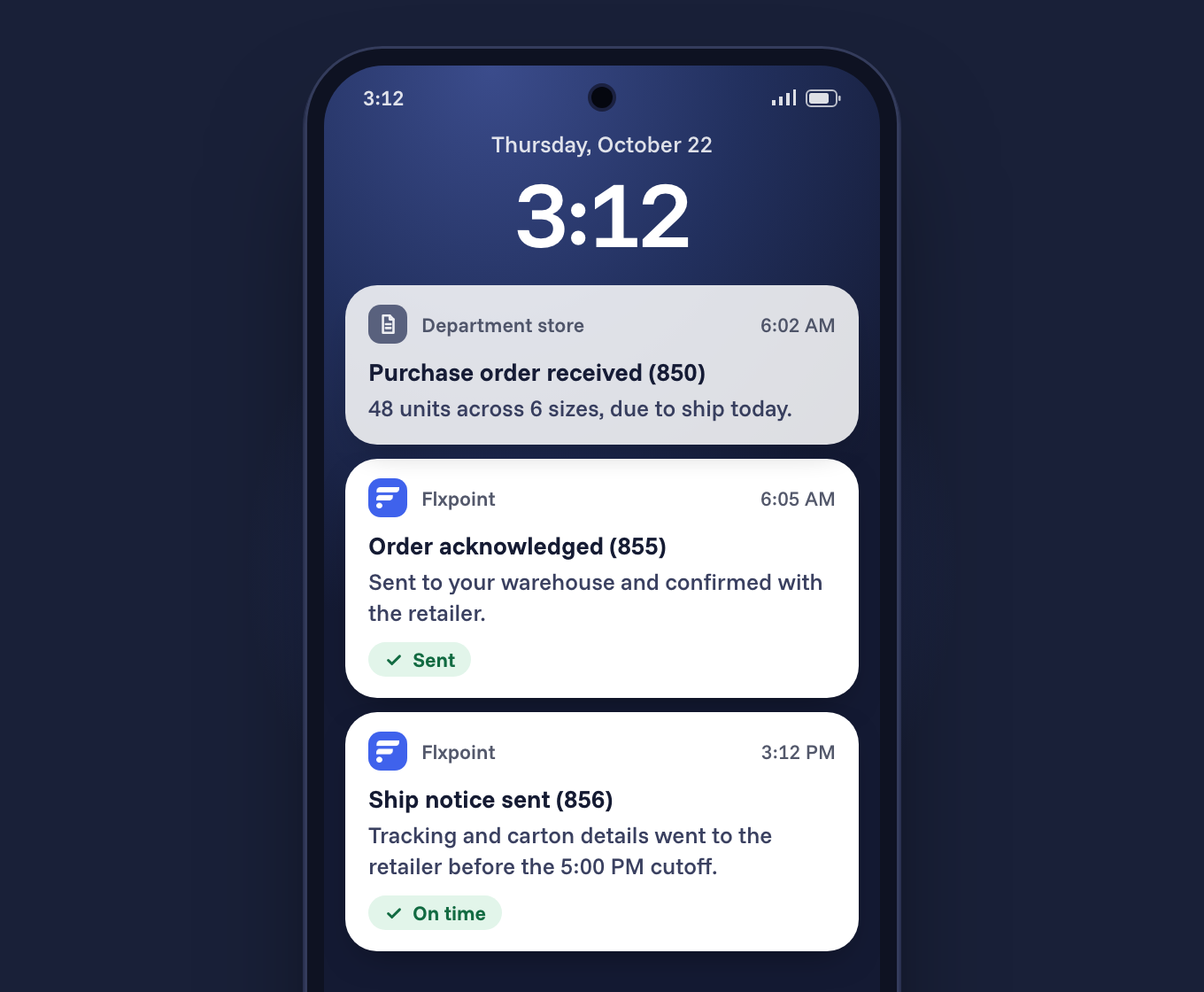
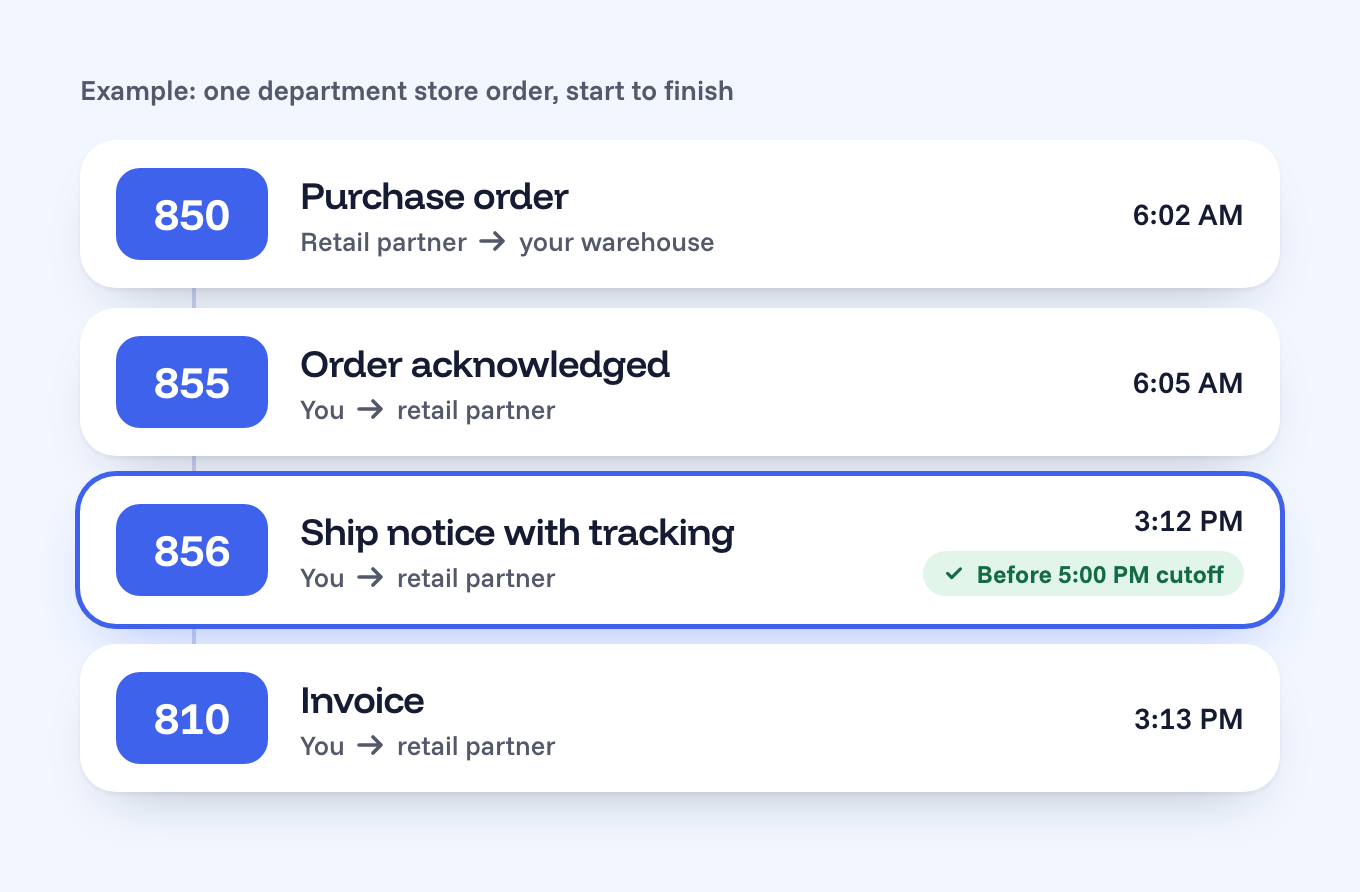
In many setups the 850 lands in an EDI portal and someone types it into the warehouse system or Shopify. With Flxpoint the partner’s purchase order goes straight to your warehouse or 3PL, and the acknowledgment, ship notice with tracking and invoice go back to the partner on their own.
One number per size, on every channel
A brand sells the same size M jacket on its own site, on marketplaces and through retail partners. Flxpoint keeps one stock number per size and sends it to every channel and partner, so the last unit comes off everywhere when it sells instead of overselling on the slowest channel.
Licensees and makers who will never run EDI
Licensees and smaller makers send spreadsheets or nothing at all. They can work in the Flxpoint Vendor Portal or send files we map once, while your big partners stay on EDI, all in the same system.
“
The Flxpoint team has been able to assess and execute the best solutions, from complex EDI integrations to utilizing the Flxpoint Vendor Portal for onboarding new vendors quicker and with less work involved.
Laurie Mucciolo, JessicaSimpson.com · 20+ brands under one umbrella, managed via Flxpoint
Kenneth Cole saw a 90% reduction in costs after moving to Flxpoint (case study).
Brands that already moved
From a third-party ecommerce company and legacy EDI→✓ Flxpoint
“We were with a third-party ecommerce company for a few years, and you tend to lose that brand control.”
Mitul Patel, Head of DTC Ecommerce and Marketplace Partners, Kenneth Cole · case study
From outdated systems→✓ Flxpoint
“They’ve gone above and beyond to make sure we’re getting the most out of the platform.”
Herschel Thompson, VP of Ecommerce, Stetson, which got more onboarding support from Flxpoint than from any platform it had used before · case study
The documents you’ll move
Moving providers means moving these conversations with each partner. Most retail partners use the same core set, and each one publishes a vendor guide with its own rules for versions, labels and timing.
| Document | What it is | Who sends it |
|---|---|---|
| 850 | Purchase order | Retail partner → you |
| 855 | Purchase order acknowledgment | You → retail partner |
| 856 | Ship notice (ASN) | You → retail partner |
| 810 | Invoice | You → retail partner |
| 846 | Inventory update | You → retail partner |
| 997 | Functional acknowledgment (receipt) | Both ways |
The set changes by program. Nordstrom’s dropship program (run through Rithum’s Dsco) requires the 850, 856, 810 and 997, with the 855 and 846 optional, while Dick’s Sporting Goods dropship (through CommerceHub) exchanges the 850, 846, 856 and 810 (Nordstrom, Dick’s). Check every partner’s current guide before you plan.
How the switch works, partner by partner
The safe way to switch EDI providers is one partner at a time, with the old connection live until the new one has passed the partner’s testing. Our integration team builds and tests the maps; you keep shipping.
| 1 | List every trading partner Who: You, with our team For each partner, note the program (bulk or dropship), the documents and versions, how they connect (AS2, VAN, SFTP or API) and their shipping-label spec (GS1-128 / UCC-128). This list becomes the project plan. |
| 2 | Pull the vendor guides and recent history Who: You Download each partner’s current vendor guide and export a few weeks of real documents from your current provider. Real history is how we prove the new maps match what each partner already accepts. |
| 3 | We build and test the maps Who: Our integration team We build the maps for every document and partner, then book each retail partner’s testing window early, because the retailer controls the test calendar. |
| 4 | Pilot one or two partners Who: You and our team Move one or two partners first and run them in parallel with your old provider until their orders, ship notices and invoices match. |
| 5 | Move the rest, then watch chargebacks Who: Our team Move the remaining partners one by one, check your old contract’s end date and notice terms, and watch chargebacks closely for the first 30 to 60 days. |
Why partner by partner
Many retailers require re-testing when a brand changes EDI providers, and partner testing is usually the slowest step (switching guide). Moving one partner at a time keeps every other partner on a connection that already works.
The pre-switch checklist
Print this before your first call
Tick each one off as you go.
When staying put is the right call
If you sell to one retail partner, exchange a handful of documents a month and your provider handles it without re-keying, a switch can wait. It starts paying off when partners multiply, when the same people re-key orders every morning, or when size-level stock has to match across your own site, marketplaces and every partner.
Talk to the team that builds the EDI for you.
Bring your partner list and your channels, and we’ll show you what connecting them looks like, partner by partner.
Talk to our integration teamQuestions brands ask
Will my retail partners have to re-test?
Often, yes. Many retailers re-test when a brand changes EDI providers, which is why we book testing windows early and move one partner at a time.
Who builds the EDI maps?
Our integration team. We build, test and monitor the documents with each partner, and you stay on your current provider until each partner passes.
Can licensees who don’t use EDI connect too?
Yes. They can use the Flxpoint Vendor Portal or send files we map once, alongside partners on EDI.
Does Flxpoint connect to my ERP or NetSuite?
Yes. NetSuite is one of Flxpoint’s strongest integrations, and our team builds other ERP connections when you need them.
Sources (checked October 2026)