Table of Contents
- What separates an HVAC marketplace from a standard ecommerce store?
- Why does catalog management collapse at a million SKUs?
- How does distributed order management route orders across hundreds of suppliers?
- What does real-time inventory accuracy actually require?
- How do HVAC operators send purchase orders to suppliers with different systems?
- Why do operators choose a unified platform instead of building their own?
- FAQs
A contractor in Phoenix orders a condenser fan motor mid-job. He needs it today. Your storefront says it's in stock. Behind that promise sits a supplier network spanning hundreds of fulfillment points, real-time inventory feeds, and automated routing logic that decides in seconds where that motor ships from.
Get it right, and you keep a contractor. Get it wrong, and he calls your competitor.
This is what running a modern HVAC marketplace actually looks like. The public-facing experience is a clean Shopify storefront. The operational reality underneath is a distributed order management system stitching together hundreds of supplier relationships, a million-plus SKU catalog, and three completely different buyer types simultaneously.
This post breaks down the infrastructure decisions behind that operation and why operators at this scale stopped treating them as a tech problem and started treating them as a business strategy decision.
What separates an HVAC marketplace from a standard ecommerce store?
An HVAC marketplace is a digitally native, multi-category distributor that sells HVAC equipment, replacement parts, and industrial supplies through an online storefront to contractors, institutional procurement teams, and homeowners simultaneously.
Unlike general ecommerce stores, it operates across 500,000 to 1M+ SKUs with high freight complexity, EPA-regulated product categories, and professional buyers who cannot tolerate fulfillment errors.
Three buyer types define the challenge. Licensed HVAC contractors place repeat orders mid-job and need same-day shipping. Facility procurement teams at universities, hospitals, and federal agencies buy in volume on negotiated net terms and want to spend on analytics. DIY homeowners buy single equipment units and price-shop.
The same storefront serves all three. That creates real operational tension around pricing tiers, freight quoting, tax handling, and customer support. A wrong routing decision affects each buyer differently: a contractor loses a day of labor, an institution flags a compliance issue, a homeowner requests a refund.
Running an HVAC marketplace at scale means solving for all three simultaneously, not picking the easiest segment and building around it.
Why does catalog management collapse at a million SKUs?
The core catalog problem in an HVAC marketplace is that the same physical part arrives in supplier feeds under different identifiers, different titles, and different attribute formats from every source that carries it. Without a normalization layer, the storefront either duplicates listings or loses multi-supplier routing capability entirely.
Here is what that looks like in practice:
- Identifier fragmentation: A capacitor might carry one part number from the manufacturer, a re-prefixed SKU from a master distributor, and an internal stock number from a regional warehouse. UPCs are missing or wrong on a meaningful percentage of legacy SKUs, particularly motors, control boards, and TXVs.
- Title and attribute inconsistency: One supplier's title for a condenser fan motor is clean and searchable. Another's is truncated. A third's is in all caps with internal warehouse codes appended. The storefront can't surface the same product coherently across all three without resolving the conflict.
- Compatibility data gaps: What filter fits which air handler, what TXV matches which condenser: this information lives in PDFs, spreadsheets, and tribal knowledge. It does not arrive clean in a supplier feed.
The platform resolves this through a layered identification model. Every item ingested from any supplier gets normalized against a Master SKU. A secondary identifier, typically a UPC or manufacturer part number, links the same physical product across multiple supplier records.
Five suppliers carrying the same motor collapse into one product listing with five fulfillment sources behind it. The storefront sees one clean record. The routing engine sees five options.
When supplier feeds disagree on attributes, operator-defined priority rules decide whose title, description, and images populate the master record. Lower-priority suppliers contribute inventory and pricing signals without overwriting content the operator has already tuned.
How does distributed order management route orders across hundreds of suppliers?
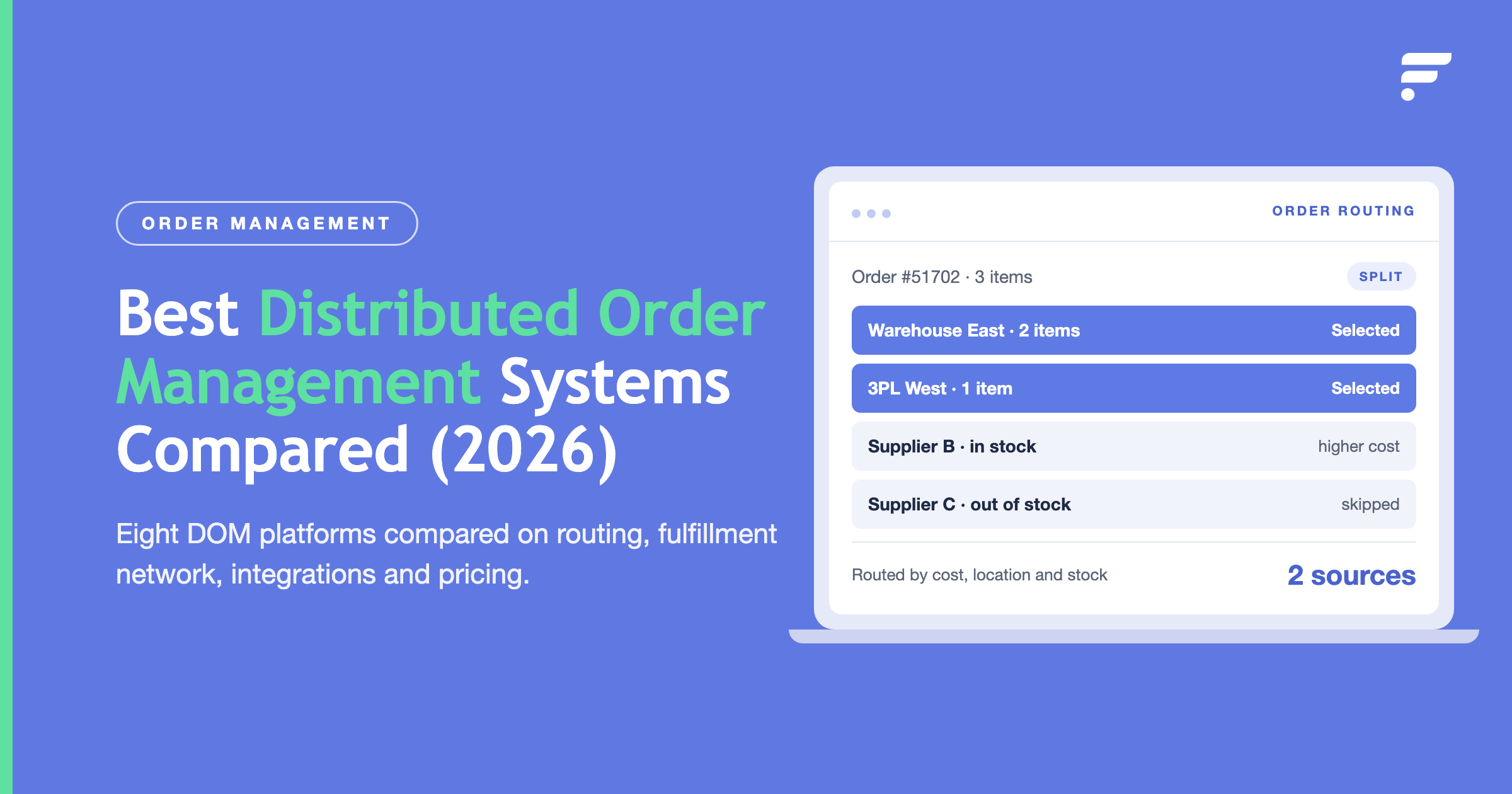
Distributed order management is an operational layer that automatically assigns each line item on an incoming order to the supplier best positioned to fulfill it, based on rules the operator configures: stock availability, proximity to the customer, landed cost, shipping method eligibility, and supplier reliability. It replaces manual routing decisions that break down past a few hundred daily orders.
For an HVAC marketplace running hundreds of supplier relationships, routing is where margin leaks or holds. Here is how the decision gets made:
- Order arrives. The storefront platform handles checkout and payment. The order imports into the operational backbone.
- Line-by-line evaluation. For each line item, the platform checks which suppliers have stock, which are geographically closest to the shipping destination, and which carry the best landed cost after freight.
- Routing mode applies. Operators run two modes in parallel: preferred-source routing for strategic categories with volume rebate commitments, and lowest-cost routing for the commodity long tail where margin optimization drives selection.
- Fulfillment request generates. The platform creates a purchase order for the assigned supplier. If the operator has enabled auto-process for that supplier, the PO transmits without human review.
- Order splits when needed. If the cart contains an evaporator coil available at one supplier and refrigerant available at a dozen others, the platform splits fulfillment across sources and generates separate POs. The customer receives multiple tracking events, exactly as they would on a multi-shipment national retailer order.
For high-AOV equipment orders or newly onboarded suppliers, operators hold orders for manual review before transmission. Trusted suppliers auto-process. The routing layer isn't a binary switch: it's a configurable set of per-supplier, per-category rules.
Running a multi-supplier HVAC operation and routing orders by hand? We built the infrastructure to automate this. Book a 20-minute walkthrough and see how the routing engine works against your actual supplier mix.
What does real-time inventory accuracy actually require?
Real-time inventory accuracy in an HVAC marketplace means the availability shown on the storefront reflects the actual stock status at every connected supplier at the moment a buyer is looking. It requires ingesting, normalizing, and publishing inventory updates from feeds that arrive in completely different formats and on completely different schedules.
Every HVAC supplier publishes inventory differently:
|
Feed Type |
Sync Cadence |
Reliability |
|
REST API with polling |
Every few minutes |
High |
|
SFTP flat-file drop |
Nightly or twice daily |
Medium |
|
Manual CSV/portal download |
On demand |
Variable |
|
EDI 846 inventory advice |
Scheduled per agreement |
High if maintained |
|
Email with attachment |
Irregular |
Low |
The platform treats each supplier as a fulfillment source and schedules imports per source at the cadence that source supports. A supplier with a real-time API gets polled frequently. A nightly SFTP supplier syncs once per night. A manual-upload supplier runs when the operator triggers it.
Items that disappear from a supplier feed for a defined window get archived automatically. They fall off the storefront rather than remaining as phantom listings. Backorder handling is configurable per source: internal warehouse stock can allow oversell on restocking SKUs, while dropship suppliers hold at zero-or-positive.
Our seamless supplier integrations with Johnson Supply, ORS Nasco, F.W. Webb, Neuco, and Cregger connect directly into this inventory sync layer, cutting setup time for those specific relationships.
How do HVAC operators send purchase orders to suppliers with different systems?
Once routing assigns a supplier to a line item, the operator has to transmit the purchase order in the format that supplier accepts. This is the part of an HVAC marketplace operation that breaks most often on manual stacks, and the part that bounds growth when it isn't automated.
Q: What transmission formats do HVAC suppliers actually use? REST APIs with JSON payloads for modern distributors. EDI 850 over AS2 or VAN for institutional distributors. CSV-via-SFTP for legacy regional warehouses. Web portal entry for the holdouts. Not one format across a typical supplier network. All four, sometimes five.
Q: What does building this in-house actually cost? A per-supplier integration for every connection, maintained by an engineering team in perpetuity. Every API change becomes a ticket. Every new supplier onboarded is a multi-week project. The HVAC marketplace growth rate becomes bounded by the integrations backlog, not by supplier availability or go-to-market capacity.
Q: How does the platform handle it instead? Order transmission is a configurable integration on each fulfillment source. The operator maps required fields (customer name, shipping address, ship method, PO number format), and the platform handles the protocol. REST, EDI, SFTP, or file drop: the operator's surface area is one consistent configuration screen regardless of what runs underneath. Adding a new supplier becomes a configuration task measured in hours, not weeks.
Why do operators choose a unified platform instead of building their own?
The build-vs-buy decision for an HVAC marketplace at scale comes down to where the operator wants their engineering effort to compound. The commoditized layer covering supplier connectivity, inventory normalization, routing, order transmission, and tracking ingestion is expensive to build and even more expensive to maintain against a supplier landscape that changes constantly.
|
Approach |
Core Cost |
Where It Breaks |
|
Build in-house |
Engineering team in perpetuity |
Every supplier API change, every new EDI partner, every feed format update becomes a ticket. The team maintains integration toil instead of building the catalog AI and merchandising that actually differentiates the operator. |
|
Point-tool stack |
Multiple vendor relationships and brittle data handoffs |
A failure in any one tool breaks the entire order flow. The operator becomes the integrator between their own integrations. |
|
Ecommerce platform apps |
Fast to start |
These apps assume one or two suppliers. They don't support multi-source consolidation at 500,000-plus SKUs. Operators outgrow them fast. |
|
Stay manual |
No infrastructure cost |
Growth ceiling hits at a few hundred daily orders. The team becomes the bottleneck on routing, supplier expansion, and tracking reconciliation. |
|
Unified multi-source platform |
Monthly platform cost |
None of the above failure modes apply. The vendor maintains the supplier connectivity layer, not the operator's engineering team. |
The operators who win in this category put engineering effort into proprietary catalog intelligence and the buyer experience. They buy the commoditized operational layer. That calculus drives the infrastructure decision more than any feature comparison.
For more on how the full HVAC distribution stack works, see our complete guide to HVAC parts dropshipping. For category context on the supply side, the HVAC supply overview covers the distributor landscape in depth.
FAQs
What is a multi-source distributed order management system?
A multi-source distributed order management system is an operational layer that connects a storefront to multiple supplier fulfillment sources, normalizes catalog and inventory data across all of them, routes each order line to the best available source, and transmits purchase orders in whatever format each supplier requires. It replaces the combination of manual routing, spreadsheets, and point-tool integrations that operators start with and outgrow fast.
How many suppliers can an HVAC marketplace manage on a single platform?
The platform supports hundreds of fulfillment sources. Each source connects via its native protocol: API, EDI, SFTP, flat-file upload, or webhook. Each runs its own import and export jobs on independent schedules. Operators have scaled to supplier networks that were previously unmanageable without a dedicated integrations team.
What happens when a supplier runs out of stock after an order is placed?
When no eligible source has stock, the platform places the order on hold rather than canceling it. The recommended behavior is to hold and route to the next eligible supplier when stock returns, preserving the order and the customer relationship while the inventory gap resolves.
How does order routing handle LTL shipments versus parcel?
The routing engine accounts for shipping method eligibility per supplier. A supplier that handles LTL drop-ship for large equipment is flagged as eligible for those SKUs; a supplier that ships parcel only is excluded from equipment routing automatically. Operators configure these constraints per fulfillment source.
What is the difference between preferred-source routing and lowest-cost routing?
Preferred-source routing orders suppliers by priority and routes each line to the top-ranked eligible supplier. Lowest-cost routing calculates landed cost across eligible suppliers and selects the cheapest. Operators typically run both in parallel: preferred-source for strategic categories with volume rebate commitments, lowest-cost for the commodity long tail where margin optimization takes priority.
How long does it take to onboard a new supplier?
For suppliers in the pre-configured directory, setup takes hours rather than weeks. For suppliers not in the directory, the operator configures field mappings against a standard template. The transmission method (API, EDI, SFTP) determines most of the setup complexity, not the supplier relationship itself.
Does the platform handle returns and RMAs on drop-shipped orders?
Drop-ship returns involve three parties: the customer, the operator, and the supplier. The platform tracks the state of each RMA across all three so the support team has a single view of where a return stands, rather than reconciling across supplier portals, carrier tracking systems, and the storefront separately.
How does the platform enforce MAP pricing across a large SKU catalog?
MAP enforcement works by clamping the computed storefront price to a floor for affected SKUs. If the operator's pricing rule would compute a price below the manufacturer's minimum advertised price, the platform raises it to MAP automatically. The margin compression is flagged or allowed depending on operator preference, but the storefront never lists below MAP without an explicit override.