Table of Contents
- What is HVAC parts dropshipping?
- How big is the HVAC parts ecommerce market in 2026?
- Who are the key players in HVAC parts dropshipping?
- Which HVAC parts are best for dropshipping?
- How do I find reliable HVAC parts suppliers?
- What are the top HVAC dropship suppliers in 2026?
- How do I set up an HVAC parts ecommerce store?
- How do I optimize an HVAC parts store for conversions?
- How do I sell HVAC parts on Amazon, eBay, and other marketplaces?
- How do I manage HVAC product data across multiple suppliers?
- What HVAC ecommerce marketing strategies actually work in 2026?
- How do I scale an HVAC parts dropshipping business?
- What are the most common HVAC parts dropshipping challenges?
- How does HVAC inventory management software solve multi-supplier complexity?
- HVAC parts dropshipping FAQs
What is HVAC parts dropshipping?
HVAC parts dropshipping is a fulfillment model where a retailer sells heating, ventilation, and air conditioning parts online without holding inventory. When a customer places an order, the retailer routes it to a supplier, who ships directly to the customer under the retailer's brand. The retailer keeps the margin between wholesale and retail price.
It is not the same as selling phone cases or yoga mats. HVAC parts carry compatibility requirements, EPA regulations, freight complexity, and warranty conditions that general ecommerce categories never deal with.
A customer receiving the wrong TXV valve or an unqualified buyer purchasing regulated refrigerant creates real legal and financial exposure for the seller.
The opportunity is real all the same. HVAC parts ecommerce is one of the fastest-growing parts verticals because the installed base of equipment keeps failing, and most of the supply chain still runs on phone calls and PDF catalogs.
Three operator models work in this space:
- Pure-play dropshipper. Holds no inventory. Routes every order to a supplier. Lives or dies on catalog sync quality. Most new operators start here.
- Hybrid fulfillment operator. Stocks fast-moving SKUs locally, dropships the long tail. Most growing stores evolve into this model.
- Established distributor adding a digital channel. Uses dropship to extend reach beyond physical branches, or to offer complete HVAC systems without warehousing every condenser and furnace.
How big is the HVAC parts ecommerce market in 2026?
Demand in HVAC parts comes from one structural fact: existing equipment keeps failing.
The US has tens of millions of installed residential and light-commercial HVAC systems, and they generate non-discretionary replacement spend regardless of new construction cycles.
Mordor Intelligence reports that retrofit buildings contributed 58.49% of HVAC services revenue in 2025, and maintenance and repair retained the largest service share at 46.15%. Translation: the installed base, not new builds, is the engine. That's the demand pool a parts retailer fishes in.
Residential is the segment to start with. The report shows residential accounted for 55.48% of 2025 demand, and cooling parts (capacitors, contactors, condenser fan motors) drive the biggest seasonal peak, with cooling services dominating at 42.58% of revenue.
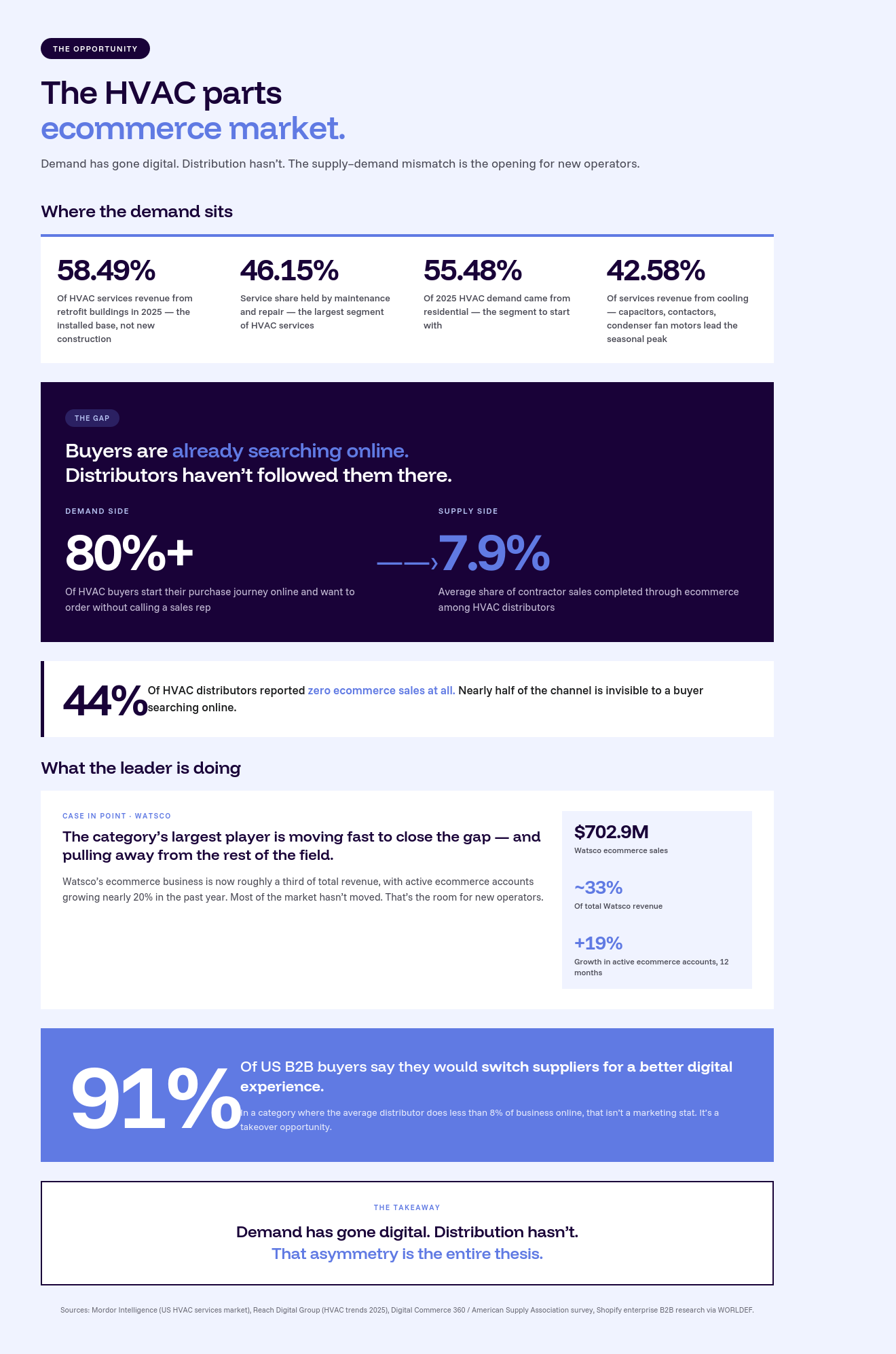
Now the demand-side validation. Reach Digital Group's 2025 HVAC trends report found that more than 80% of HVAC buyers start their purchase journey online. Buyers are already searching. They want to order without calling a sales rep.
The supply side hasn't caught up, and that's the opening. Digital Commerce 360, reporting on the American Supply Association survey, found that only 7.9% of contractor sales among HVAC distributors were completed through ecommerce on average.
Even more telling: 44% of distributors reported zero ecommerce sales at all.
This is the gap. Demand has gone digital, distribution hasn't. The largest player in the category is moving fast to close it. Watsco's ecommerce sales reached roughly $702.9 million, about a third of total revenue, and active ecommerce accounts grew 19% in twelve months. But most of the market hasn't moved. That's the room for new operators.
The takeaway: demand is steady, replacement cycles are non-discretionary, and the digital layer is far behind other verticals. That's the gap online retailers fill.
Who are the key players in HVAC parts dropshipping?
The HVAC supply chain has four layers, and not every layer is accessible to a new dropship operator. Understanding which layer to source from determines whether you spend three months getting accounts or three years.
|
Layer |
Examples |
Accessible to dropshippers? |
|
OEMs (Manufacturers) |
Carrier, Goodman, Lennox, Rheem, Daikin, Mitsubishi |
No. They sell through authorized distributors only. |
|
Two-step distributors |
Watsco branches (Carrier Enterprise, Gemaire, Baker), Ferguson, Johnstone Supply, Winsupply, HD Supply, Graybar, F.W. Webb |
Sometimes. Requires established commercial accounts, LLC, EIN, resale certificate, and account history. |
|
Dropship-ready wholesalers |
Alpinehomeair, Ferguson Plc, Johnstone Supply, HVACDirect |
Yes. Built for online resellers. Blind shipping supported. |
|
Parts aggregators |
Encompass, Marcone |
Yes. Consolidate SKUs from multiple OEMs into a single feed. |
OEMs sell through authorized distributors as a rule. Approaching them directly without a real business setup will get you rejected. Two-step distributors protect the contractor-distributor relationship and require credibility before they open dropship terms.
Dropship-ready wholesalers are where most new operators start. They expect to ship blind, they support reseller workflows, and they do not require contractor licensing to open an account. Parts aggregators reduce the supplier-management burden for operators growing catalog breadth across small parts and accessories.
Licensing and regulatory reality
Selling replacement parts online generally does not require an HVAC contractor license at the product level. Installation work does, and licensing rules vary by state.
Refrigerants are the exception. EPA Section 608 certification under 40 CFR Part 82 is required for any technician who handles regulated refrigerants, and sellers must verify that buyers of regulated refrigerants hold valid certification before completing a sale.
The EPA's AIM Act and its Technology Transitions Rule restricted new residential and light commercial HVAC equipment to refrigerants with a GWP below 700 starting January 1, 2025, effectively ending new R-410A system manufacturing. The industry has since moved to the A2L refrigerants R-454B and R-32.
This regulatory shift created a multi-year parts replacement cycle around A2L-rated TXVs, leak detection sensors (required under UL 60335-2-40), and A2L-compatible recovery and service tools.
For parts retailers, this is a structural tailwind: every new A2L install creates a long-tail service parts demand curve that didn't exist in the R-410A inventory base.
Which HVAC parts are best for dropshipping?
The best HVAC parts for dropshipping are small, dry, electrical replacement components with high reorder velocity and broad model fitment. Capacitors, contactors, ignitors, and control boards consistently top the list because they ship ground, carry no hazmat restrictions, and have predictable failure cycles.
|
Category |
Why it works |
Watch out for |
|
Capacitors, contactors, relays |
Small, light, high reorder velocity, universal cross-reference |
Commoditized pricing on Amazon |
|
Ignitors, flame sensors, thermocouples |
Technician favorites, low return rate |
Seasonal demand peaks October–February |
|
Control boards (universal and OEM) |
Higher average ticket, strong margin |
Fitment-sensitive, electrical returns often final-sale |
|
ECM and PSC blower motors |
Strong demand, replacement cycle predictable |
Heavier shipping, occasional freight surcharges |
|
Mini-split parts (boards, sensors, remotes) |
Growing category as ductless adoption rises |
OEM-specific fitment, sparse cross-reference data |
|
Filters and IAQ accessories |
Year-round demand, subscription-friendly |
Heavy competition from Amazon private label |
|
Hard-start kits, surge protectors, condensate pumps |
Strong accessory attach to equipment sales |
None significant |
|
Refrigerants |
High demand, mandatory replacement |
EPA 608 sales restrictions, hazmat shipping |
|
Condensing units, furnaces |
High ticket |
LTL freight, warranty transfer issues, OEM gating |
|
Sheet metal, ductwork |
Niche demand |
Oversized freight, high damage rates |
The pattern is simple. Small, dry, model-locked electrical replacement parts are where margin lives. Equipment and refrigerants are where margin gets eaten by freight, returns, and compliance overhead.
How to identify winning products
- Search volume by part number. OEM part numbers with steady Google search volume indicate technician demand.
- Cross-reference breadth. Parts that fit many models, like universal capacitors, have lower return risk.
- Reorder frequency. Consumables and failure-prone components get reordered seasonally.
- Freight profile. Under 5 lbs, ships ground, no hazmat, no LTL is ideal.
- MAP compliance. Strong MAP enforcement means predictable margins and no race to zero.
- Aftermarket availability. Parts available from multiple aftermarket brands give you sourcing flexibility.
How do I find reliable HVAC parts suppliers?
Here is the foundational truth about HVAC supplier sourcing: the major generic dropship aggregators do not carry a meaningful HVAC parts catalog. They have a handful of consumer-adjacent accessories. For a real HVAC catalog, you need direct dealer relationships.
Supplier evaluation checklist
- Do they offer dropship fulfillment, or only stocking dealer accounts?
- Do they support API or EDI integration, or only CSV/manual feeds?
- How frequently does their inventory feed update?
- What are their packing and blind-shipping policies?
- Do they have multiple warehouses for regional fulfillment?
- What's the return policy on electrical and fitment-sensitive parts?
- Are there MAP pricing rules you need to follow?
- Do they require minimum monthly volume or annual commitments?
- What payment terms do they offer once your account has aged?
The supplier evaluation conversation is also where you find out whether they will treat your business as a real partner or as an afterthought. A supplier whose dropship program is six pages of PDF and a contact form is not built for serious operators.
What are the top HVAC dropship suppliers in 2026?
The top HVAC dropship suppliers in 2026 fall into three operational buckets: full-line distributors with deep catalogs, equipment-focused dropship retailers, and parts aggregators that consolidate multi-OEM inventory.
The table below shows pre-built supplier integrations that Flxpoint already supports, which means data mapping is done and you can go live in weeks instead of quarters.
|
Supplier |
Website |
Product Niche |
Headquarters |
Integration |
|
Johnson Supply |
johnsonsupply.com |
HVAC/R equipment, parts, and supplies |
Houston, TX |
EDI |
|
ORS Nasco |
orsnasco.com |
Industrial, welding, safety, janitorial, HVAC |
Muskogee, OK |
EDI + API |
|
F.W. Webb |
fwwebb.com |
Plumbing, heating, HVAC, PVF, industrial |
Bedford, MA |
EDI |
|
Neuco |
neuco.com |
HVAC, refrigeration, and appliance parts |
Norwood, MA |
API |
|
Cregger Company |
creggercompany.com |
Plumbing, HVAC, and waterworks supply |
Columbia, SC |
CSV |
(Disclaimer – while every effort has been made to provide accurate information, the responsibility for verifying the information lies solely with you. Do interact with the service providers before making any decisions.)
Choosing a supplier is not only about the catalog. It is about integration depth. A supplier on daily CSV is fundamentally different from a supplier on real-time API, and the difference shows up in oversold orders, customer complaints, and chargebacks.
How do I set up an dropship parts ecommerce store?
Setting up an HVAC parts ecommerce store starts with picking a platform that handles catalog depth, B2B workflows, and supplier integration. The three platforms that fit are Shopify Plus, BigCommerce Enterprise, and Adobe Commerce. Each has tradeoffs.
|
Platform |
Catalog capacity |
B2B features |
Cost profile |
Best for |
|
Shopify Plus |
Handles large catalogs (millions of SKUs) with careful taxonomy and a third-party search provider |
Native Shopify B2B with company accounts, NET terms, customer-specific pricing, and quote-to-order |
Mid-tier monthly; no transaction fees on Shopify Payments |
DTC equipment retailers and parts specialists |
|
BigCommerce Enterprise |
Strong at high SKU counts |
B2B Edition with NET terms, customer-group pricing, and quote-to-order |
Mid-tier monthly; no transaction fees on any plan |
Operators with established contractor accounts |
|
Adobe Commerce |
Very deep catalogs with complex pricing rules |
Highly customizable, full B2B feature set |
Heavy development and licensing cost |
Enterprise distributors with custom requirements |
Most new HVAC dropshippers start on Shopify Plus or BigCommerce because the time-to-launch is measured in months rather than quarters. Adobe Commerce is the right answer when you have a development team and pricing rules that no off-the-shelf platform can handle.
Once the platform is picked, the store needs to ship with mobile-first design, model-number search with fuzzy matching, compatibility filters, clear return policies on electrical parts, NET term payment options for verified business accounts, and a tax-exempt certificate workflow for commercial buyers.
How do I optimize an HVAC parts store for conversions?
HVAC buyers are not casual shoppers. They arrive with a part number, a model number, or a symptom. Your store's navigation and search need to accommodate all three entry points.
Compatibility filtering is non-negotiable. Cross-reference data that maps OEM part numbers to compatible unit models is what separates professional HVAC parts stores from general marketplaces.
Operators like SupplyHouse.com built significant organic traffic on part number search alone.
Trust signals specific to HVAC include: clear return policies on uninstalled parts, explicit callouts of which parts require licensed installation, warranty information displayed at the SKU level, and phone support availability during business hours.
Contractors buying parts for a job-site emergency need to know they can reach a person.
Mobile experience matters more than you might expect. A technician in a crawl space searching for a part on a phone is your customer. The buying experience has to work on a 375px screen with one thumb.
Technical specifications need to be complete and accurate. HVAC buyers compare CFM ratings, SEER ratings, tonnage, refrigerant type, voltage, and phase. Missing specifications mean the buyer leaves to find them somewhere else, usually a competitor with better data.
Want to see how top-performing HVAC stores structure their catalog, pricing, and supplier sync? Book a 20-minute walkthrough with the Flxpoint team.
How do I sell HVAC parts on Amazon, eBay, and other marketplaces?
Selling HVAC parts on marketplaces requires a different playbook for each channel. Amazon has the largest B2B buyer base but the heaviest gating restrictions. eBay rewards obsolete and discontinued parts inventory. Walmart and Home Depot Marketplace are growing channels for accessories and commodity parts.
|
Marketplace |
Best for |
Watch out for |
|
Amazon Business |
Aftermarket components, filters, tools, IAQ accessories |
Heavy brand restrictions across Honeywell/Resideo, Ecobee, Nest/Google, Carrier, and Trane. New-in-box OEM equipment typically requires authorized seller status. Refrigerants are prohibited. |
|
eBay |
Obsolete and discontinued parts, hard-to-find SKUs |
Margin pressure from low-MAP-compliance sellers and gray-market competition on OEM parts. |
|
Walmart Marketplace |
Commodity parts and accessories at scale |
Strict seller performance metrics and lower HVAC category authority than Amazon. |
|
Home Depot Marketplace |
DIY and small Pro buyers in Home Depot's ecosystem |
Selective seller approval process and a smaller third-party HVAC catalog than Amazon or Walmart. |
The real complexity in marketplace selling is not the channel rules. It is keeping inventory accurate across all of them at once. When a supplier SKU goes to zero and your Amazon, eBay, and website listings still show in-stock hours later because the next feed sync hasn't run, you generate oversold orders across every channel simultaneously.
That is the operational problem that pushes multi-channel HVAC operators toward HVAC inventory management software built for real-time sync, not daily CSV batches.
How do I manage HVAC product data across multiple suppliers?
Managing HVAC product data across multiple suppliers requires a normalization layer that translates each supplier's schema into a unified catalog. There is no central public database equivalent to automotive's ACES/PIES, and cross-reference tables between OEM and aftermarket parts are scattered across distributor catalogs, manufacturer PDFs, and proprietary technician tools.
A workable HVAC SKU structure tracks:
- OEM part number (the manufacturer's official number)
- Aftermarket equivalent numbers (Mars, Packard, ICM, Supco, Diversitech cross-references)
- Superseded part numbers (when an OEM replaces a part, the old number should still resolve)
- Model number compatibility (which equipment models this part fits)
- Specifications (voltage, capacity, dimensions, connection type)
- Manufacturer warranty terms
- Hazmat and shipping classification
- Image and exploded diagram references
At scale, operators build internal model-number-to-SKU compatibility graphs. This is a moat. Cheap competitors do not have it, and their site search reflects that.
For multi-supplier operators, the harder problem is data normalization across feeds. Ferguson sends data one way. Johnstone sends it another. HD Supply has yet another schema. Graybar's portal output looks nothing like Goodman's API response.
Without a normalization layer handling transformation automatically, this becomes permanent full-time work and catalog growth stalls while the team drowns in data hygiene.
This is where operators usually start looking at HVAC inventory management software. The ones who build a reliable data layer early are the ones who can add suppliers and channels without proportionally adding headcount.
What HVAC ecommerce marketing strategies actually work in 2026?
SEO and programmatic content are the highest-ROI channels in HVAC parts because technicians search by model and part number, not by broad head terms. The long-tail is enormous and underserved. Build landing pages for:
- {OEM model number} parts (e.g., "Goodman GMP100-4 parts")
- {OEM part number} replacement (e.g., "Honeywell SV9501M2528 replacement")
- {symptom} {brand} (e.g., "Carrier furnace ignitor not glowing")
- {component} compatible with {model series}
Paid search CPCs on service-intent HVAC queries like "HVAC repair near me" or "AC installation" are among the highest in the U.S. Do not compete there. Long-tail part-number queries are dramatically cheaper because the advertiser pool is thin.
Troubleshooting and how-to content earn the problem-aware buyer
How-to tutorials and troubleshooting guides attract the technician and DIY homeowner at the problem-awareness stage, and they build the model-number coverage that generates organic impressions. A guide titled "How to replace the capacitor on a Goodman GSX130241" ranks for a specific model-number query with consistent search volume and essentially no competitive content.
YouTube is underused in HVAC parts ecommerce
How-to repair videos that naturally feature the parts you sell are a durable acquisition channel that compounds over time. Channels like Ingrams Water & Air demonstrate how far strong video content can carry a brand in this space.
Email and SMS retention is high-value and underused
Contractors who buy from you once are the most valuable acquisition channel you have. Set up automated sequences: order confirmation, shipping notification, 30-day follow-up with related accessories, seasonal maintenance reminder, and a reorder nudge timed to their typical purchasing cycle.
Before committing a content budget, know who you are ranking against. Across the 14 HVAC supply domains tracked by Flxpoint analysts, the category leader captures roughly 46% of total traffic, but the mid-tier and the sub-2% challengers are where the contestable SEO real estate sits.
📊 We broke down the full competitive map, growth quadrants, and traffic-cost dynamics in the HVAC Supply E-Commerce 2026 Industry Report. Request your copy here →
How do I scale an HVAC parts dropshipping business?
The operators who scale in HVAC parts share a few patterns that smaller operators don't.
Redundant supplier coverage on top-velocity SKUs. If your only source for Carrier capacitors goes short in July, you stop selling Carrier capacitors in July. Operators at scale maintain two or three sources for the SKUs that drive 60% to 70% of revenue.
B2B contractor accounts. The residential DIY buyer is real, but the contractor who reorders the same 40 SKUs every month is the customer who makes the business predictable. Building a B2B portal with NET-30 terms and reorder functionality is what turns seasonal volatility into consistent revenue. According to Shopify's B2B research, 67% of B2B buyers have switched suppliers because of a poor digital buying experience. That number matters for HVAC distributors treating their online channel as secondary.
Logistics infrastructure. Parts Town's 2024 results show what operational investment looks like at scale. The company expanded same-day delivery coverage from 20 to 50 miles across 130 locations, and same-day delivery orders grew 355% between January 2024 and January 2025. Their HVAC segment grew 55% year over year. That is not marketing. That is logistics infrastructure and supplier integration working together.
Adding channels without adding headcount. If every new supplier requires a new employee to manage the feed, and every new channel requires a new process to maintain, the margin erodes faster than the revenue grows. The operational test of whether a business is scaling or just growing is whether new revenue requires proportional new headcount.
What are the most common HVAC parts dropshipping challenges?
The most common HVAC parts dropshipping challenges are wrong-part returns, supplier feed lag and overselling, catalog data normalization at scale, multi-warehouse routing errors, freight damage on heavy items, slow supplier onboarding, and custom integrations breaking. Each one is invisible to new operators until they hit it in production.
|
Challenge |
What happens |
Cost if ignored |
|
Wrong-part returns |
Customers order the wrong part because OEM cross-references are inconsistent |
Repeat-buyer churn, return processing labor |
|
Supplier feed lag |
Daily CSV feeds lag real availability by hours, leading to oversold orders |
1% to 5% overselling rate, chargebacks, marketplace strikes |
|
Catalog data normalization |
Every supplier sends data differently. Schemas never match |
Permanent full-time hire on data hygiene |
|
Multi-warehouse routing errors |
East Coast order ships from West Coast warehouse |
Freight cost eats margin on individual orders |
|
Freight damage on heavy items |
Condensing units, furnaces, sheet metal damage in LTL transit |
Chargebacks, replacement cost, one-star reviews |
|
Slow supplier onboarding |
Manual or custom integrations take three to six months per supplier |
Missed seasonal launches, six-figure revenue gaps |
|
Custom integrations breaking |
A developer leaves, the code breaks every few weeks |
Margin events that take days to untangle |
The pattern across all seven challenges is the same. The problems are operational, not strategic. The fix is not a better marketing plan. The fix is infrastructure that handles supplier sync, order routing, and catalog normalization without manual intervention.
How does HVAC inventory management software solve multi-supplier complexity?
HVAC inventory management software solves multi-supplier complexity by sitting between your suppliers, warehouses, sales channels, and ERP as a single source of truth for orders, inventory, and product data. Instead of five disconnected tools held together by spreadsheets and one developer who quit eight months ago, the operational stack runs through one platform.
Flxpoint is built for exactly this scale. Multi-source, multi-channel HVAC ecommerce where the breaking point is data sync between suppliers and sales channels, not lack of demand.
Supplier integration without custom code. Connect to your suppliers (Johnson Supply, ORS Nasco, F.W. Webb, Neuco, and Cregger) through seamless integrations. New supplier onboarding drops from quarters to weeks because the data mapping, schema translation, and feed ingestion logic is already configured.
Distributed order fulfillment. When a customer orders, Flxpoint routes the order to the optimal source. That could be your warehouse, a regional supplier dropship location, or a backup supplier, depending on landed cost, inventory availability, and ship-to location. This is the multi warehouse ecommerce logic that prevents Florida orders from shipping out of Pennsylvania warehouses at double the freight cost.
Inventory and pricing sync across channels. Stock changes at a supplier propagate to your Shopify store, Amazon listings, eBay listings, and Walmart Marketplace in near real time. Overselling drops sharply because the sync layer is no longer a daily CSV batch.
Product information management. Centralize your SKU master, cross-references, specifications, and channel-specific listing data in one place. Push different versions of a listing to different channels without maintaining four parallel catalogs.
One stack instead of five. Orders, inventory, suppliers, channels, and warehouses operate from a single source of truth, not five disconnected tools held together by spreadsheets and a developer who quit eight months ago.
For operators running either business model, broad-catalog online distributor-retailer or specialized equipment e-retailer, Flxpoint sits between the ERP, the suppliers, the warehouses, and the sales channels. It's HVAC inventory management software designed for the multi-source, multi-channel reality this category demands.
Ready to see how it works on your supplier stack? Book a demo with Flxpoint and walk through your exact catalog, channels, and routing logic with the team.
HVAC parts dropshipping FAQs
Why does our inventory keep going out of sync between suppliers and our sales channels?
Most HVAC suppliers send inventory through CSV feeds that update once a day. When a supplier changes their format or a feed fails overnight, your site shows stock that isn't there. Real-time API or EDI connections through Flxpoint replace daily batch syncs and cut overselling sharply.
How long should it take to onboard a new HVAC supplier?Onboarding through manual data mapping or custom scripts typically takes three to six months per supplier. With seamless integrations to suppliers like Johnson Supply, ORS Nasco, F.W. Webb, Neuco, and Cregger, Flxpoint compresses that timeline to weeks.
We keep losing money on freight when orders ship from the wrong warehouse. How do we fix it?
This is a distributed order routing problem. When a Florida order ships from a Pennsylvania warehouse instead of a closer supplier dropship location, freight doubles. Flxpoint routes each order to the optimal source based on landed cost, inventory availability, and ship-to location automatically.
Our supplier integration was built by a developer who no longer works here. What are our options?
Custom integration code without an owner is a margin event waiting to happen. Replacing it with a platform like Flxpoint that maintains supplier connections, handles schema changes, and runs without engineering dependency removes the single point of failure and stops the every-other-week breakage cycle.
Why do we keep losing Buy Box on Amazon when supplier prices change?
Buy Box loss typically happens when supplier wholesale changes don't propagate to your channel listings within hours. Flxpoint syncs price and inventory updates across Shopify, Amazon, eBay, and Walmart in near real time, so pricing stays aligned with cost the moment a supplier feeds updates.
Can we run a hybrid fulfillment model where we stock fast-movers and dropship the long tail?
Yes. This is the standard pattern for HVAC parts retailers carrying broad catalogs and equipment specialists running accessory attachments. Flxpoint manages stocked inventory in your own warehouse alongside dropship inventory from multiple suppliers, with routing rules that prioritize the most profitable fulfillment path per order.
How do we handle product data when every supplier sends it in a different format?
Every supplier has their own schema, attribute structure, and update cadence. Flxpoint's product information management layer centralizes your SKU master, cross-references, and channel-specific listing data in one place, so you can push different versions of a listing to different channels without maintaining parallel catalogs.
What's the difference between an ERP and a platform like Flxpoint?
An ERP is the source of truth for accounting, inventory, and financials. It is not built for ecommerce operations like multi-supplier feed ingestion, channel listing management, or order routing. Flxpoint sits between the ERP, the suppliers, the warehouses, and the sales channels to handle the operational layer the ERP was never designed for.