Table of Contents
- The HVAC channel at the start of 2026
- How does the HVAC supply chain moves from manufacturer to contractor
- What B2B supply chain challenges are unique to HVAC?
- What does supply chain digitization look like for HVAC distributors?
- Where HVAC manufacturers and distributors are investing next
- The orchestration layer that connects every step
- Frequently asked questions
- Related reading
The HVAC channel at the start of 2026
The HVAC channel ended 2025 with revenue up but unit volume down. According to HARDI, distributor sales grew 2.8% for the year, but most of that growth came from price adjustments rather than units shipped. That gap, between dollars and units, is the strategic puzzle every senior leader is sitting with going into 2026.
At HARDI's 2025 Annual Conference in Las Vegas, the channel's response showed up in a $1.5 million reinvestment announced for Advocacy, Talent, and Market Intelligence. For anyone running point on a B2B supply chain across HVAC manufacturers and distributors, the framing was clear. 2025 was corrective. 2026 is supposed to be a resurgence. And the lever distributors are pulling is operational, not just commercial.
Industry size anchor: The U.S. HVAC systems market was estimated at USD 31,714.8 million in 2025, according to Grand View Research. It's projected to reach USD 54,021.0 million by 2033, growing at a CAGR of 6.9% from 2026 to 2033.
How does the HVAC supply chain moves from manufacturer to contractor?
The HVAC channel runs as a four-step relay from OEM to regional distributor to local branch to contractor. Each handoff carries its own commercial terms, data formats, and operational stakes.
Digital commerce has not replaced any of these steps. It has compressed the time between them through EDI feeds, supplier portals, and inventory APIs that did not exist at scale ten years ago.
Manufacturer. OEMs like Carrier, Lennox, Goodman, Trane, and Rheem build equipment and sell through authorized distribution. Dealer tiers are a margin lever, so pricing isn't public.
Regional distributor. Independent or OEM-owned distributors hold inventory across multiple branches. They set local contractor pricing, run promotional cycles tied to cooling season, and absorb most of the working capital risk in the channel.
Local branch. This is the physical point of contact for the contractor. It also acts as the fulfillment node when same-day equipment is needed for a service call.
Contractor or dealer. The contractor is the buyer, but the homeowner or facility manager is the demand source. Replacement-versus-repair decisions get made here.
A B2B supply chain across HVAC manufacturers and distributors now runs on EDI feeds, supplier portals, and inventory APIs. The handoffs are the same. The latency between them is not.
Three distributor archetypes operate inside this channel
Traditional multi-branch distributor. The Watsco model. Owns inventory at scale, runs dozens to hundreds of physical branches, and sells primarily to contractors through long-standing OEM authorization tiers.
Independent regional distributor. Single-state or multi-state, often family-owned, branch-based, with a tight contractor base built over decades of in-person relationships.
Digital-native marketplace distributor. Asset-light by design. No branches and minimal owned inventory. Sources from hundreds of supplier and manufacturer partners, routes orders algorithmically through an AI sourcing engine, and ships direct to the end buyer. Sells to a mixed audience that includes contractors, facility procurement teams, and homeowners.
Each archetype faces a different version of the same supply chain problem. The traditional distributor is digitizing what already exists. The independent is choosing how much to digitize without losing the relationship. The digital-native is building the channel itself from the data layer up.
What B2B supply chain challenges are unique to HVAC?
Three pressures define how the HVAC channel operates, and they explain why generic ecommerce playbooks stall here: tiered dealer pricing, EPA-regulated product transitions, and a steep seasonal demand swing. Each one breaks a default assumption that B2B platforms built for other categories carry into HVAC. Together they explain why category-specific operations tooling is a buying signal in 2026.
Tiered dealer pricing. OEMs run multi-tier dealer programs where the same SKU lists at different net prices depending on the buyer's authorization level. A platinum-tier contractor doesn't see the same number a homeowner does, and neither sees the cost the distributor pays.
Any storefront, dealer portal, or marketplace operating in HVAC has to expose the right price to the right buyer without leaking the rest. Most generic B2B catalog tools weren't built for that.
EPA-regulated product transitions. The shift from R-410A to A2L refrigerants in 2025 reshaped what's sellable, where, and to whom. State-level enforcement varies, so the same SKU is compliant in one state and restricted in another.
Inventory systems have to carry compliance metadata at the SKU level, or the distributor risks shipping non-compliant equipment into a market where it can't legally be installed.
Seasonal demand swing. HVAC volume runs four to six times higher in peak cooling months than in February. Most industrial supply categories don't move like that. A storefront that can absorb a 6x order spike without overselling, mis-routing, or breaking supplier feeds is doing real work. A storefront that can't, isn't.
HVAC distributors who copy a generic ecommerce playbook from another category tend to stall on at least one of these three. The category is not generic, and its operational risk profile rewards platforms built for it.
What does supply chain digitization look like for HVAC distributors?
Digitizing the B2B supply chain between HVAC manufacturers and distributors is an integration project, not a website project. Five layers carry the weight: EDI connections, supplier portals, automated purchase orders, dealer-facing ecommerce, and inventory APIs.
The hard part is getting them to speak to each other without a team writing custom code every time a supplier reformats a feed.
|
Layer |
What it does |
Who owns it |
|
EDI connections |
Sends 850 purchase orders, 856 ASNs, 810 invoices between distributor and OEM systems |
IT and operations jointly |
|
Supplier portals |
Lets dealers see real-time inventory, place orders, view invoices |
Manufacturer or distributor |
|
Automated POs |
Triggers replenishment based on stock thresholds, sell-through, or rules |
Distributor operations |
|
Dealer-facing ecommerce |
Counter-replacement self-service for contractors via web and mobile |
Distributor or branch |
|
Inventory APIs |
Pushes live stock from supplier into channel and storefront |
Middleware or platform team |
Each one is its own project. The integration burden is what makes purpose-built HVAC inventory management software different from generic B2B catalog tools. It has to hold all five layers together while supplier feeds change shape underneath it.
See it in your environment. Flxpoint connects EDI, supplier APIs, dealer portals, and storefronts in one orchestration layer purpose-built for HVAC distribution. Book a demo to map your current feeds against the five-layer model.
Where are HVAC manufacturers and distributors investing in 2026?
Distributor spend in 2026 is consolidating below the storefront. The capex thesis lives in inventory accuracy, supplier feed reliability, API-first connections, mobile contractor experiences, and order routing logic that respects dealer authorization tiers. The leader-to-mean gap inside the channel is wider than in most B2B categories, and that gap is the buying signal.
Watsco is the public proof point most senior leaders quote. Watsco generates roughly $2.5 billion in sales through digital channels, with some regions running as high as 80% of sales online. That's one company.
The 2023 Digital Commerce 360 and HARDI survey reported that 7.9% of contractor sales happen through ecommerce on average across HVAC distributors. The gap between leader and mean is the investment thesis for 2026.
It's also why distributor-side spend is consolidating into a tight set of priorities:
- Inventory accuracy and feed reliability before front-end UX
- API-first supplier connections that survive feed format changes
- Mobile-first contractor experiences for counter replacement
- Unified catalog and pricing data across branches
- Order routing logic that respects dealer tier and authorization rules
Nobody is rebuilding their storefront first. The money is going underneath the storefront, where HVAC ecommerce operations either hold together or fall apart in peak season.
Want the full benchmark set? Download the HVAC Supply E-Commerce 2026 Industry Report for distributor-level data on digital sales penetration, supplier integration patterns, and 2026 capex priorities across the channel.
The Automation layer that connects every step
Flxpoint sits between supplier feeds and the retailer or contractor-facing channels. The platform handles the integration work that keeps inventory, orders, and tracking data flowing across both directions of the channel.
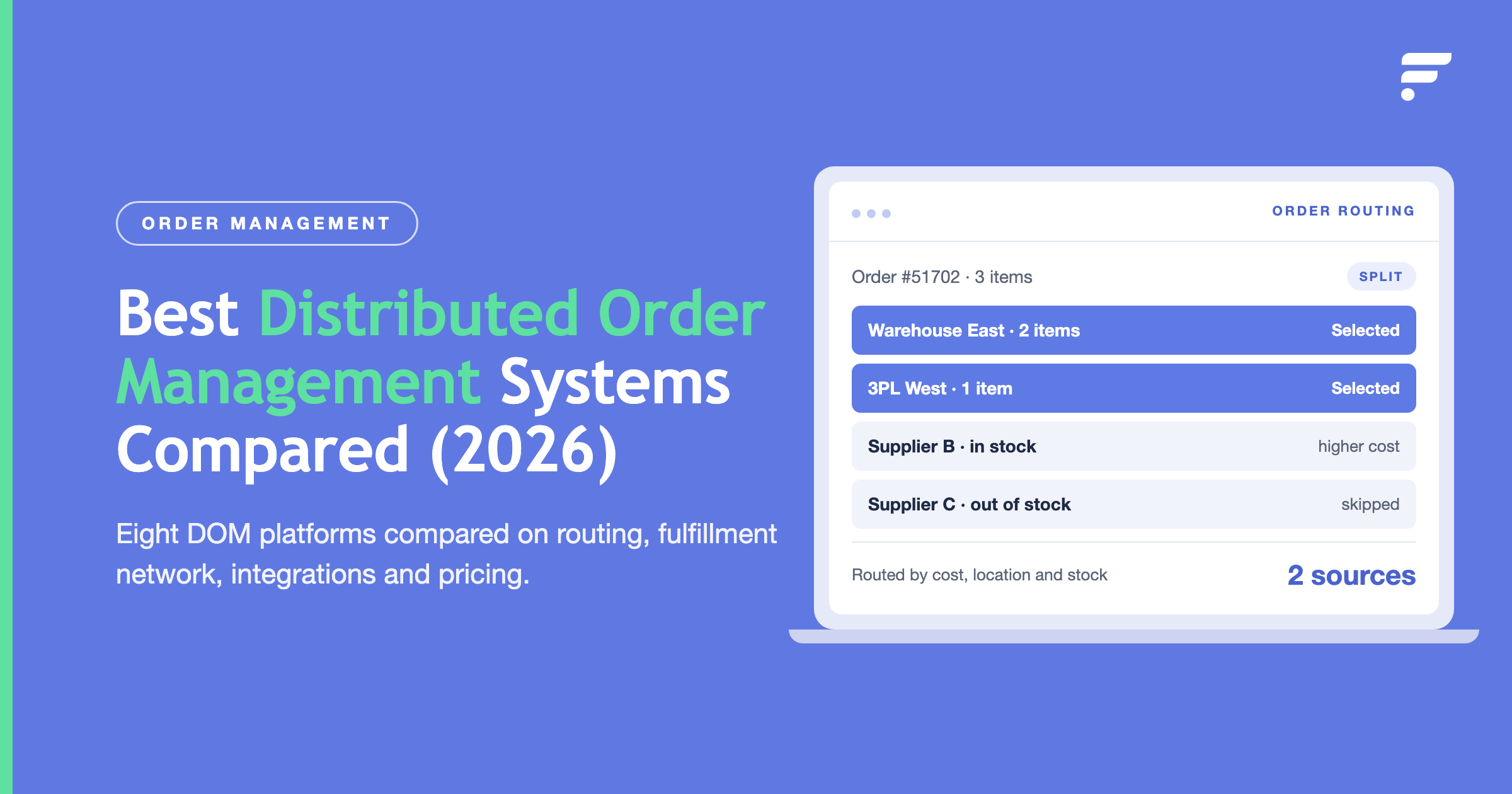
Flxpoint pulls inventory and product data through EDI, API, CSV, or SFTP. It routes orders to the right supplier based on cost, location, or stock rules, and it returns tracking and invoice data back to the ERP. The same connection logic supports NetSuite integration, Shopify, BigCommerce, Amazon, and Walmart in parallel, so a distributor doesn't have to trade one channel against another to keep the data accurate.
For an HVAC distributor weighing where to put the next digital dollar, this integration layer protects every other dollar already invested. Without unified inventory data, a new storefront oversells. Without automated POs, a new dealer portal creates more counter calls instead of fewer.
Flxpoint supports speedy supplier integrations for distributors including Johnson Supply, ORS Nasco, F.W. Webb, Neuco, and Cregger, with custom EDI and API mapping for any distributor that supports the standard. Pre-built integration work means the operator's team isn't writing connectors during peak season.
For a real implementation reference, see the HVAC Supply case study on the Flxpoint resources page. It walks through how a multi-supplier distributor consolidated supplier feeds and order routing on the platform
Frequently asked questions
What does a modern HVAC B2B supply chain look like?
A modern HVAC B2B supply chain runs on automated data flow between manufacturer, distributor, and retailer layers. Orders, inventory, pricing, and tracking move through EDI, API, or scheduled file feeds rather than email and spreadsheets. The retailer or contractor sees accurate stock in real time, orders route to the right fulfillment node automatically, and invoice and ASN data return to the ERP without manual entry. The result is fewer overselling incidents, faster supplier onboarding, and a channel that can absorb the four-to-six-times demand swing between February and July.
Why do HVAC distributors need different supply chain technology than general B2B distributors?
HVAC has three category-specific pressures that general B2B tools don't account for. Tiered dealer pricing varies by authorization level, so a generic catalog can't expose the right number to the right buyer. EPA-regulated product restrictions on R-410A and A2L equipment mean the same SKU is sellable under different rules state to state. And the seasonal demand curve in HVAC is steeper than almost any other industrial supply category. A platform that flattens these into one workflow either underserves the contractor or risks violating the manufacturer's channel rules.
Where should an HVAC distributor start with supply chain digitization?
Start with inventory accuracy. If your storefront and your warehouse don't agree on stock, no other digital investment compounds. Build the feed reliability layer first. Then layer in dealer portals, automated POs, and dealer-facing ecommerce on top of it. Most distributors who fail at digital fail in this order, not the other way around.
Related reading
- The Complete Guide to HVAC Parts Dropshipping in 2026
- How to connect HVAC wholesale distributors to your ecommerce platform
- Multi-supplier inventory management for HVAC distributors
Key takeaways
The U.S. HVAC systems market was valued at USD 31,714.8 million in 2025 and is projected to reach USD 54,021.0 million by 2033, growing at a 6.9% CAGR.
HARDI distributor sales grew 2.8% in 2025, with most of the lift coming from price, not unit volume.
Watsco generates roughly $2.5 billion in digital channel sales, with some regions running 80% of sales online.
Across the broader distributor base, only 7.9% of contractor sales happen through ecommerce on average, leaving most of the channel under-digitized.
Distributor capex in 2026 is moving below the storefront: EDI, supplier feeds, inventory APIs, and dealer-tier pricing logic.