.svg)


.svg)

.png?width=40&height=40&name=Untitled%20design%20(53).png)


What Is Dropshipping Inventory Management?
Dropshipping inventory management is the process of tracking, syncing, and controlling stock availability across third-party suppliers in real time — so that your online store always reflects accurate product availability without holding physical inventory yourself.
Unlike traditional retail, dropshippers don't store the products they sell. Instead, a customer places an order on your store, and your supplier ships the product directly to them. This means your "inventory" is actually your suppliers' inventory; and that creates a unique challenge: you have no direct control over stock levels.
If a supplier sells out of a product but your store still lists it as available, you'll oversell — processing orders you can't fulfil. That leads to cancellations, refund requests, and damaged customer trust. Effective dropshipping inventory management prevents this by keeping your listings in sync with live supplier data at all times.
Dropship Inventory Management vs Traditional Inventory Management
The key difference between dropship inventory management and traditional inventory management comes down to control and location. In a traditional retail model, you own your stock, it sits in your warehouse, and you can count it yourself. In dropshipping, stock lives with your suppliers — and your job is to stay in sync with their data.
|
Factor |
Manual dropship inventory management |
Flxpoint automated inventory management |
|
Stock accuracy |
Updates lag by hours or days — high error rate |
Real-time sync — always reflects live supplier data |
|
Update frequency |
Manual exports/imports, often once daily |
Continuous automated sync via API and EDI |
|
Overselling risk |
High — stock changes faster than manual updates |
Near-zero — listings pause automatically when stock hits zero |
|
Team time required |
Hours per week on spreadsheets and data entry |
Near-zero manual effort once integrations are set up |
|
Scalability |
Breaks down quickly beyond 3–5 suppliers |
Handles 500+ suppliers and thousands of SKUs seamlessly |
|
Cost per error |
Refunds, cancellations, negative reviews per incident |
Errors prevented before they reach customers |
The comparison makes it clear: manual dropship inventory management is viable when you're managing one or two suppliers and a small product catalogue. The moment you scale — more suppliers, more SKUs, more channels — automation isn't optional, it's essential.
Managing Real-Time Stock Availability
Real-time stock availability provides up-to-the-minute insights into inventory levels. For dropshipping inventory management, this is the foundation everything else is built on — if your stock data is stale, every other process downstream is compromised.
When inventory sync for dropshipping operates in real time, customers only ever see products that are genuinely available. This directly protects your revenue and your brand — because the cost of getting it wrong is steep: according to research citing IHL Group data, 40% of customers who experience an order cancellation due to overselling never purchase from that brand again. A single stockout incident doesn't just cost you one sale — it permanently removes a customer from your audience.
How real-time inventory sync works
Flxpoint connects your store directly to your suppliers through API or EDI integrations. Whenever a supplier's stock changes — whether a product sells out, gets restocked, or has its quantity adjusted — that change is instantly reflected in your store's product listings. There's no delay, no manual export, and no opportunity for the gap between "what the supplier has" and "what your store shows" to cause a problem.
This kind of inventory sync for dropshipping is especially critical when you work with multiple suppliers per product category. If Supplier A runs out of a product, Flxpoint can automatically route orders to Supplier B — keeping fulfilment running without any manual intervention.
Dropshipping Inventory Tracking Software: What to Look For
Not all dropshipping inventory tracking software is built for the complexity of multi-supplier operations. A basic stock counter works fine for a single-warehouse business — it will not hold up when you're pulling inventory data from a dozen different suppliers across different systems and formats.
Here's what to look for when evaluating dropshipping inventory tracking software for a serious dropship operation:
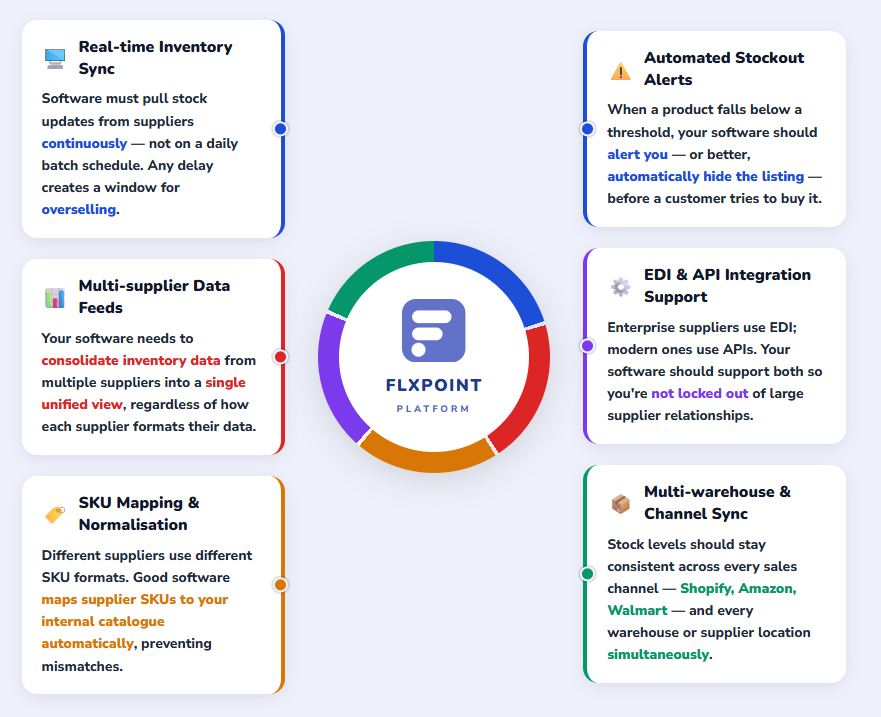
Flxpoint is built specifically for this level of complexity. It handles multi-supplier feeds, SKU mapping, real-time sync, and automated alerts out of the box — making it the most capable dropshipping inventory tracking software for businesses operating at scale.
How to Set Up Automatic Inventory Sync Across Multiple Suppliers
Automatic inventory management for dropshipping doesn't require a technical background — but it does require the right setup. Here's the step-by-step process Flxpoint customers follow to go from manual stock checks to fully automated inventory sync.
- Connect your suppliers via API or EDI
In Flxpoint, each supplier gets their own integration. If your supplier has an API, Flxpoint connects directly to it and pulls inventory data automatically. If they use EDI, Flxpoint handles the file exchange in the background. For suppliers without either, Flxpoint can process scheduled CSV feeds.
Flxpoint dashboard → Suppliers → Add Supplier → Select integration type (API / EDI / FTP)
- Map supplier SKUs to your product catalogue
Every supplier names products differently. Flxpoint's SKU mapping tool matches supplier product IDs to your internal SKUs automatically — or flags conflicts for you to resolve manually. This step ensures that when Supplier A's stock changes, the right product on your store is updated.
Flxpoint dashboard → Products → SKU Mapping → Auto-match or manual assignment
- Set inventory rules and buffer quantities
Decide how aggressively to protect against stockouts. You can set a buffer — for example, treat "5 units" as zero, so your listing goes offline before a supplier actually runs dry. You can also configure which supplier gets priority when multiple suppliers carry the same product.
Flxpoint dashboard → Inventory Rules → Set buffer quantities and supplier priority order
- Sync inventory across your sales channels
Once your suppliers are connected, Flxpoint pushes stock updates to every connected sales channel simultaneously — Shopify, BigCommerce, Amazon, Walmart, and more. One supplier change triggers an immediate cascade update across all your storefronts.
Flxpoint dashboard → Channels → Select channels → Enable real-time inventory push
- Set up automated alerts and reporting
Configure low-stock alerts so you're notified before products run out completely. Set up supplier performance reports to track which suppliers have the most stockout incidents or the slowest data feeds — and use that data to make smarter sourcing decisions over time.
Flxpoint dashboard → Alerts → Low stock threshold → Notification method (email / Slack)
Key Metrics for Optimising Dropshipping Inventory Levels
Tracking the right metrics turns dropshipping inventory management from reactive guesswork into a data-driven process. These are the four numbers that matter most:
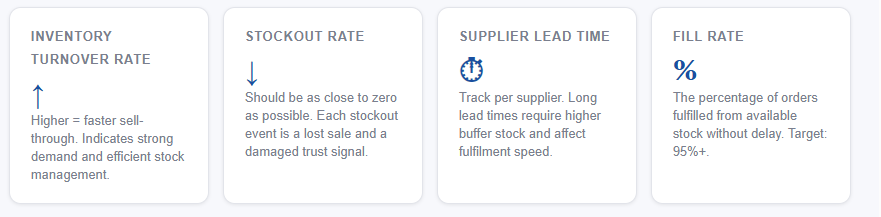
Inventory Turnover Rate
Measures how often your entire product catalogue sells and is replaced over a given period. A high turnover rate in dropshipping is a strong indicator that your supplier relationships are healthy — they can replenish fast enough to meet demand. A low turnover rate often signals that products are listed but rarely purchased, which is worth investigating.
Stockout Rate
This is the percentage of orders that couldn't be fulfilled due to unavailable stock. Industry benchmarks set the target stockout rate below 2–3% for healthy ecommerce operations — yet the industry average sits around 8%, according to Opensend research.
High stockout rates consistently lead to negative reviews, increased customer service costs, and reduced repeat purchase rates. Real-time dropshipping inventory management is the most direct lever for reducing this metric.
Supplier Lead Time
Lead time — the gap between placing a supplier order and the product being ready to ship — directly affects how much buffer stock you should maintain. Suppliers with long or unpredictable lead times require higher safety buffers. Flxpoint tracks supplier performance over time so you can identify and deprioritise unreliable partners.
Fill Rate
Fill rate is the percentage of customer orders fulfilled completely from available stock on the first shipment attempt — without backorders, delays, or partial fulfilment. It is calculated by dividing the number of orders shipped in full by the total number of orders placed, then multiplying by 100.
Dropshipping Inventory Management Best Practices
These practices are drawn from how high-performing dropshipping operations use Flxpoint to maintain stock accuracy at scale.
- Assign multiple suppliers to every core product. If your best-selling product relies on a single supplier and they run out, you have no backup. Connecting two or three suppliers to the same SKU means Flxpoint can route orders automatically when primary stock dries up.
- Set conservative stock buffers, not zero thresholds. Don't wait until a supplier hits zero to pull a listing. Configure Flxpoint to treat "5 units remaining" as your effective zero — giving you a window to react before a customer hits an oversell situation.
- Review supplier performance reports monthly. Not all suppliers update their inventory data with the same frequency. Suppliers who push updates every hour are far more reliable than those pushing daily CSV exports. Use Flxpoint's performance reporting to hold suppliers accountable or restructure your source mix.
- Use API integration wherever possible over EDI or FTP. API connections enable continuous real-time data exchange. EDI and FTP are scheduled — they introduce lag. For high-velocity products, even a few hours of lag can cause overselling.
- Audit your SKU mapping quarterly. Suppliers change product codes, discontinue SKUs, and introduce variants. An unmapped SKU means Flxpoint can't sync that product's stock. A quarterly mapping audit catches these gaps before they cause customer-facing problems.
AI Inventory Management for Dropshipping
AI inventory management for dropshipping is no longer a future concept — it's actively reshaping how operations teams manage stock decisions today. The core shift is from reactive management (responding to stockouts after they happen) to predictive management (preventing stockouts before they occur).
How AI changes the equation
Traditional dropshipping inventory management sets static rules: "alert me when stock hits 10 units." AI-powered systems learn from historical order velocity, seasonal patterns, and supplier reliability data to dynamically adjust these thresholds — automatically lowering the buffer when demand is slow and raising it when a demand spike is predicted.
What AI inventory management does in practice
Demand forecasting: AI analyses historical sales data, seasonal trends, and external signals to predict how much of each product you'll need and when. This prevents both overstocking (which increases supplier dependency risk) and understocking (which causes lost sales).
Dynamic reorder triggers: Rather than fixed reorder points, AI systems calculate optimal reorder timing per-product based on current supplier lead times, predicted demand, and your target fill rate.
Supplier reliability scoring: AI tracks which suppliers consistently deliver accurate inventory data and on-time fulfilment — and can automatically deprioritise underperformers in your routing rules without manual intervention.
Flxpoint's automation engine lays the infrastructure for dropshipping inventory management — with real-time data feeds, rule-based routing, and performance tracking that AI decision layers can plug directly into as the technology matures.
Scalability with advanced tools
As your dropshipping business grows, your inventory management system must grow with it. Flxpoint is built to handle thousands of SKUs across hundreds of suppliers without degradation in sync speed or data accuracy — so your operational infrastructure never becomes the bottleneck that limits your growth.
Frequently Asked Questions
Question: Does Dropshipping require inventory management?
Answer: Yes. Even though dropshippers don't hold physical stock, they still need to track supplier inventory levels in real time. Without proper dropshipping inventory management, you risk overselling items that are out of stock — leading to cancelled orders, refund requests, and damaged customer trust. Automated tools like Flxpoint eliminate this risk by continuously syncing supplier stock data to your listings.
Question: How do I manage inventory automatically for dropshipping?
Answer: Use a dropshipping inventory management platform like Flxpoint that connects directly to your suppliers via API or EDI. It syncs stock levels across all your sales channels automatically, so your listings always reflect real availability. Setup involves connecting each supplier, mapping SKUs to your catalogue, setting buffer quantities, and enabling channel sync — after that, the system runs automatically.
Question: How does dropshipping affect inventory management?
Answer: Dropshipping makes inventory management more complex because you don't own or control the stock you're selling. Your inventory data depends entirely on third-party suppliers — and any lag in that data creates a window for overselling. This is why real-time inventory sync tools are critical for dropshipping in a way that they simply aren't for traditional retail.
Question: What is the difference between Wholesale and dropship inventory management?
Answer: In wholesale, you purchase and store your own inventory, giving you complete visibility and control. In dropshipping, suppliers hold the stock, so inventory management is entirely dependent on real-time data feeds from external parties. Wholesale inventory management can be handled with a basic WMS; dropshipping inventory management requires automated sync tools that stay connected to multiple supplier systems simultaneously.
Question: What are the best practices for Dropship inventory management?
Answer: The most effective best practices include: using real-time inventory sync software, assigning multiple suppliers per product as a backup, setting conservative stock buffer quantities, monitoring supplier performance and data feed frequency, using API integrations over EDI where possible, and auditing SKU mappings quarterly to catch discontinued or renamed products before they cause overselling issues.
Ready to automate your dropshipping inventory management?
Stop relying on manual spreadsheets and batch updates. See how Flxpoint syncs inventory across all your suppliers in real time — and eliminates overselling for good. Book a demo here
Flxpoint – Powerful Dropship and Ecommerce Automation Platform
Unpack the evolution of dropshipping and why it’s still one of the most effective ecommerce models. Learn how the modern approach is different from outdated methods, what’s fueling its explosive growth, and what it takes to succeed in today’s competitive market.
Get step-by-step guidance on building a strong foundation. From choosing your niche and validating your business idea to setting up your brand and making it legit—this chapter gives you the tools to confidently launch with clarity and purpose.

Struggling with product selection? Discover how to find winning products that sell. We cover techniques for identifying trends, analyzing competition, using supplier insights, and narrowing down product ideas that fit your niche and audience.
Not all suppliers are created equal. This chapter shows you how to source high-quality products and onboard suppliers the smart way. Learn how to vet vendors, avoid bad partnerships, and set up seamless integrations that keep your fulfillment running like clockwork.
Say goodbye to stockouts and overselling. Learn how to keep your inventory accurate and your customers happy with real-time updates, smart syncing, and automated stock management across all your channels and vendors.
Pricing isn’t just numbers—it’s strategy. Dive into methods like cost-plus, value-based, and psychological pricing to find the sweet spot between profitability and competitiveness. You'll also learn how to handle MAP policies and dynamic pricing changes.

Manual processes holding you back? Discover how to automate your order routing, fulfillment, and vendor communication. Whether you’re dropshipping from a single source or juggling multiple suppliers, we’ll show you how to build a fulfillment engine that scales effortlessly.

The best of both worlds. Learn how to blend dropshipping with traditional wholesale to create a hybrid fulfillment model. Diversify your supply chain, increase margins, and reduce risk—all while maintaining flexibility and speed.

Protect your business (and your sanity). This chapter highlights red flags to watch for when sourcing suppliers, how to avoid fake vendors, and what to do if something seems off. Learn to build a trustworthy and secure supply chain from day one.

Tech made simple. Understand how using EDI and API integrations can automate communication with suppliers, speed up order processing, and reduce costly errors. Whether you're tech-savvy or not, this chapter makes complex systems feel doable.
Smart businesses run on data. Learn how to track key ecommerce metrics, monitor supplier performance, and analyze product performance to make confident, data-driven decisions that boost sales and efficiency.
Unlock time-saving workflows that work while you sleep. This chapter breaks down how to automate inventory syncing, order routing, vendor communication, and customer updates to run your business like a well-oiled machine.

Ready to expand beyond one platform? Learn how to integrate and manage listings, inventory, and orders across multiple sales channels—like Shopify, BigCommerce, Amazon, Walmart, and more—without doubling your workload or making costly mistakes.
When it’s time to grow, this chapter shows you how. From onboarding new suppliers and expanding product lines to optimizing your tech stack and improving operations, get a roadmap for scaling sustainably and profitably.
Every business runs into roadblocks—what matters is how you respond. Learn how to tackle issues like supplier delays, low inventory, and customer service hiccups using smart tools, real-time alerts, and proactive troubleshooting strategies.
What’s next for dropshipping? Explore emerging trends like AI-powered automation, predictive inventory, autonomous fulfillment, and more. Stay ahead of the curve and future-proof your business with the latest innovations.
Kenneth Cole's Smart Savings With Shopify EDI Connections
"They had never used Flxpoint before. But working with [the Flxpoint] team, they learned it and we're about to onboard our newest footwear partner, and you know that's big business for us.”
Mitul PatelKenneth Cole


How Flxpoint Helped Rifle Supply Automate & Grow
“I went line by line… whatever the inventory number was and cost value was, I calculated it and was blown away by how much that was worth— $300 million worth of product that I added to our web store.”
Chris MekdaraRifle Supply


The Ecommerce Automation Behind Screen Skinz
"Automation is the key to maximizing your volume. [Flxpoint] comes right into our flow — everything's automated. We want it to be quick and efficient. So that's what we love about Flxpoint."
Shaun Brown & Clay CanningScreenSkinz


How Inhaven Transformed Vendor Management with Flxpoint
"We ended up switching to Flxpoint, and it has been a much smoother process. Where it took us six months to get onboarded with the other company, we were up and running in a week or two with Flxpoint."
Ashley ChingInhaven


How Black Patch Performance Scaled Smarter with Flxpoint
"The only way to actually scale was to go through Flxpoint… You can’t even come close to hiring someone to do what Flxpoint does for the price."
Jonathan WilliamsBlack Patch Performance