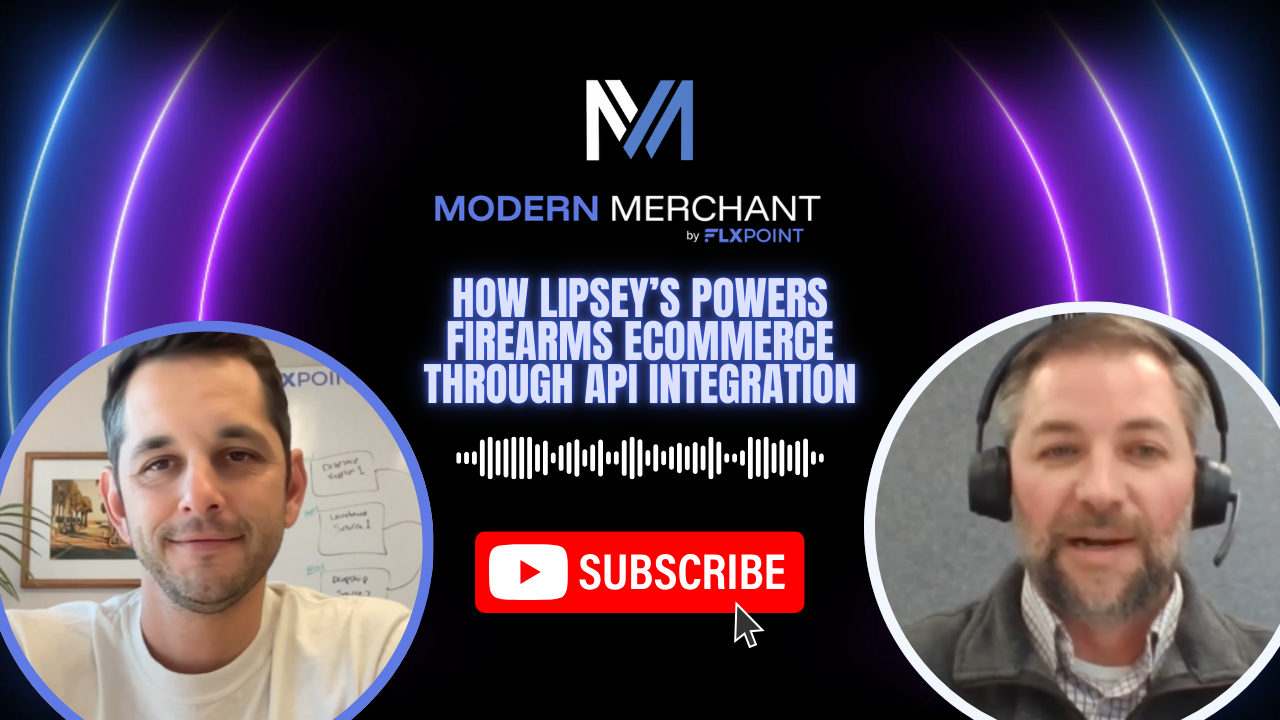
In the latest episode of the Modern Merchant Podcast, Travis Mariea sat down with Aaron Keating, CIO and VP of Technology at Lipsey’s, to talk about what it really takes to scale in the firearms ecommerce space.
The conversation went beyond surface-level ecommerce advice. It focused on operations, integration, and the systems retailers need in place if they want to grow without creating chaos behind the scenes.
Here are the key takeaways.
1. Integration Is No Longer Optional
Retailers today cannot rely on manual processes if they want to scale. Inventory changes constantly. Pricing updates daily. Orders move fast.
As Aaron put it:
“Sooner or later, if you're real and you're trying to do real business or you just want to be hyper efficient, you're going to have to get tools in place.”
Aaron Keating, Lipsey’s
For retailers working with distributors like Lipsey’s, integration unlocks:
- Real-time inventory visibility
- Up-to-date pricing and MAP data
- Automated order submission
- Tracking and acknowledgement automation
- Invoice reconciliation
Without it, growth eventually stalls.
2. API vs EDI: Why It Matters
One of the most direct moments in the episode came when Aaron summarized the difference between API and EDI:
“Fast and easy versus slow and expensive.”
Aaron Keating, Lipsey’s
EDI has been around for decades and still exists largely because of legacy systems. But modern retailers benefit from API-driven integrations that allow:
- Faster response times
- Real-time acknowledgements
- Simpler implementation
- Lower maintenance
For retailers just starting or upgrading their stack, API-first infrastructure gives you flexibility and speed that older systems cannot match.
3. Dropshipping Changes the Game
Dropshipping adds opportunity, but it also introduces complexity.
Every customer order becomes:
Sales order → Purchase order → Order acknowledgement → Shipment → Invoice → Reconciliation
That workflow has to be accurate and fast. If it’s not automated, it becomes difficult to manage as volume increases.
Margin visibility becomes especially important in dropshipping. You must account for:
- Cost of goods
- Shipping charges
- MAP compliance
- Promotional pricing changes
As Aaron emphasized:
“Margin calculation for online businesses is vital.”
Aaron Keating, Lipsey’s
Automation isn’t about convenience. It’s about protecting profitability.
4. The “Endless Aisle” Advantage
Even brick-and-mortar retailers benefit from integration.
Instead of turning customers away when an item is not in stock, you can leverage distributor inventory as an extension of your store.
Integration allows you to:
- Offer more products without holding inventory
- Capture special orders
- Increase customer loyalty
- Keep traffic flowing through your business
You do not have to be a massive online retailer to benefit from this model.
5. Common Mistakes Retailers Make
Aaron shared several patterns he sees with new or expanding ecommerce retailers:
Hiring the wrong development team
A visually appealing website does not mean it can handle multi-distributor catalog integration or real-time inventory.
Trying to build everything in-house
Combining multiple distributors’ catalogs into a single clean data set is more complex than most realize.
Underestimating customer service
Dropshipping requires fast communication, tracking visibility, and clean workflows. If support is not ready, problems surface quickly.
Not thinking through accounting
Without automated invoice handling and reconciliation, scaling becomes painful.
6. MAP Compliance and Data Accuracy Matter
In the firearms industry, MAP pricing is critical. Selling below MAP can result in manufacturer restrictions or no-sale lists.
Lipsey’s works closely with manufacturers to maintain accurate MAP data within their catalog feeds. When that data is integrated properly, retailers can:
- Stay compliant
- Automate pricing rules
- Avoid costly violations
In a competitive online environment, clean data is not a luxury. It is foundational.
7. Compliance and Regulatory Considerations
The episode also touched briefly on evolving state regulations, including recent laws in California that have added complexity around shipping and ID verification.
Regulatory shifts continue to shape how distributors and retailers operate. Staying adaptable and building systems that can handle change is increasingly important.
Final Thoughts
The overarching theme of the episode was simple: operational maturity determines whether you scale or stall.
Traffic and marketing matter. But without the right systems in place, growth creates friction instead of profit.
API-driven integrations, automated acknowledgements, invoice reconciliation, and real-time data are not just technical upgrades. They are business multipliers.
If you are selling firearms or accessories online, this episode offers practical insights from a distributor that works with thousands of retailers every day.
Listen to the full episode of the Modern Merchant Podcast here.
If you’d like to learn more about how Lipsey’s integrates with Flxpoint, reach out and we’ll walk you through it.