
.svg)


.svg)

.png?width=40&height=40&name=Untitled%20design%20(53).png)


Table of contents
- What you can automate, and what still needs a human
- When two distributors carry the same SKU
- EDI suppliers, API suppliers, one workflow
- How orders get routed to the right distributor
- What is the order volume where spreadsheets give up
Introduction
It’s 7 a.m. on a Tuesday and your Essendant catalog just refreshed. Somewhere in those thousands of rows, a few hundred quantities changed overnight, and you won’t know which ones until something oversells on Amazon and a buyer leaves a one-star review. That gap, between when a supplier’s stock changes and when your sales channels find out, is where office supply dropshippers quietly lose money every single day.
Automation isn’t a growth hack you bolt on once things get busy. For a catalog fed by more than one distributor, it’s the floor you build the business on. So here’s the honest split: what a platform like Flxpoint takes off your week, and where you still want eyes on the work.
What you can automate, and what still needs a humanWhat you can automate, and what still needs a human
Not every part of school supplies inventory management belongs on autopilot. The skill is knowing where the line sits.
Runs fully automated |
Stays your call |
|
Pulling and refreshing supplier feeds (Essendant quantity hourly, SP Richards XML, Educators Resource FTP) |
Choosing which suppliers and categories to carry |
|
Deduping the same SKU across multiple distributors |
Setting the routing rules that define your "best source" |
|
Pushing price, quantity, and status to Amazon, Walmart, Shopify, and WooCommerce |
Approving margins and pricing strategy |
|
Generating and sending purchase orders by EDI or FTP to the right distributor |
Handling supplier disputes and odd exceptions |
|
Pulling tracking and invoices back, then syncing to QuickBooks |
Deciding when to add a new channel or distributor |
For office supply dropshippers, the feed updates and the PO entry are the hours you get back. The judgment calls stay with you, where they belong.
When two distributors carry the same SKUWhen two distributors carry the same SKU
Most office supply dropshippers carry the same item from more than one source. A pack of pencils might sit in your own warehouse, on Essendant's feed, and on SP Richards' feed at three different costs and three different stock levels. Sell it blind and you'll oversell, or you'll route the order to the pricier source and watch your margin shrink.
Flxpoint builds one master record for that item and shows every source behind it: cost, quantity, and location across your warehouse, your 3PL, and each distributor. When an order comes in, it reads that overlap view and sends the order to the source you told it to prefer.
EDI suppliers, API suppliers, one workflowEDI suppliers, API suppliers, one workflow
Can the same workflow handle an EDI distributor like Essendant and an API or file-based one? Yes. Flxpoint reads each supplier in whatever format it speaks. Essendant and SP Richards order over EDI, Educators Resource runs its EDI over FTP, and an API or XML supplier connects through its own feed.
You don’t run a separate process per format. They all land in the same catalog and the same order flow, which is the whole point for office supply dropshippers juggling a national distributor and a niche supplier inside one cart.
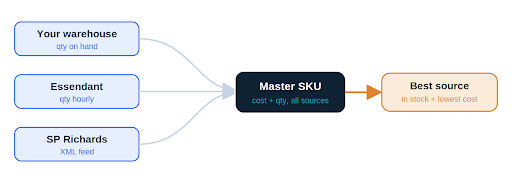
Whether a distributor speaks EDI, XML, FTP, or API, your order workflow doesn't change. That one pipe is what keeps school supplies inventory management holding together once you've got a long tail of suppliers behind your catalog. Our guide to the API and EDI order process digs into the mechanics.
How orders get routed to the right distributor
When an order lands, the platform picks who fulfills it based on rules you define. A common setup for office supply dropshippers reads like this:
- Check your own warehouse or 3PL first, since in-house stock usually carries the best margin and the fastest turnaround.
- Fall back to a distributor that actually has the item in stock, so you never send an order to a source that can't ship it.
- Break ties on cost, sending the PO to the cheaper distributor when more than one has the item.
- Apply ship-to and account rules, including multiple ship-to accounts where a distributor like Essendant supports them.
Once the source is chosen, the PO fires automatically by EDI or FTP. No hand-keying, no copy-paste from one tab into another.
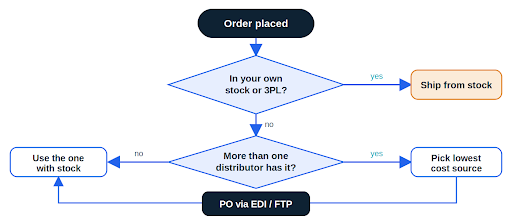
The same decision, on every order, without anyone opening a tab.
Want the full picture of how rules, triggers, and workflows fit together? Start with our complete guide to dropship order automation.
What is the order volume where spreadsheets give up
There’s no single magic number, and anyone who quotes you is guessing. The breaking point is a multiplication problem, not a threshold. Take your daily orders, multiply by the number of supplier feeds you reconcile, then by the number of channels you sell on.
One person can hold a small version of that in their head over morning coffee. Add a second distributor and a third channel, and the same routine stops fitting in a morning.
That’s usually when the oversells start, because the feed you didn’t get to is the one that quietly changed overnight. That moment is school supplies inventory management breaking in real time: stock that still looks available on your channel but isn’t.
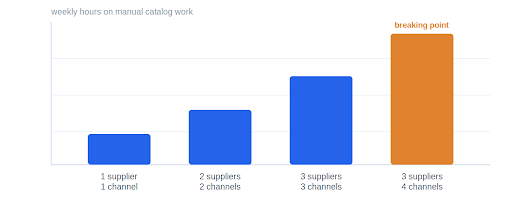
For most office supply dropshippers, the wall shows up not at a fixed order count but the week a manual catch-up stops being possible before lunch. Automation flattens that curve, because adding a fourth feed or a fifth channel is a configuration change, not another hour of hand-keying.
|
95 percent Flxpoint customer Screen Skinz reported saving 95 percent of the time they used to spend on manual tasks after automating their order flow and fulfillment. Source: Flxpoint case study |
Ready to automate your manual tasks like supplier integration, inventory sync, and order routing? Let Flxpoint handle the heavy lifting while you focus on growing your brand. Book your demo today.
Quick answers
What manual tasks can office supply dropshippers fully automate?
Feed ingestion, price and quantity sync to every channel, order routing, purchase order creation, and shipment and invoice write-back to your ERP. What stays manual is setup and strategy: category mapping, routing rules, margin floors, and exceptions.
How does automation keep school supplies inventory management accurate across distributors?
It builds one master SKU per item and reads live cost and quantity from every source behind it, so the platform always knows the real available stock. That single record is the backbone of school supplies inventory management when the same item lives on several feeds.
Does automated routing work with both EDI and API suppliers?
Yes. EDI distributors, EDI-over-FTP suppliers like Educators Resource, and API or XML feeds all run through the same catalog and order flow. Just confirm SFTP support up front, since Flxpoint’s EDI runs over SFTP rather than AS2.
|
This is one slice of a bigger rebuild If your primary supplier of 80% of your products suddenly exits, the full recovery walkthrough lives in The Office & School Supplier Playbook, which covers the multi-supplier stack and a 30-day plan to stand it up. For the mechanics underneath this post, see how Flxpoint handles EDI order management and how purchase order automation flows into NetSuite. Connect your distributors, dedupe the overlap, and stop hand-keying purchase orders before your next peak. That’s the whole job, and it’s one office supply dropshippers don’t need to do by hand anymore. |