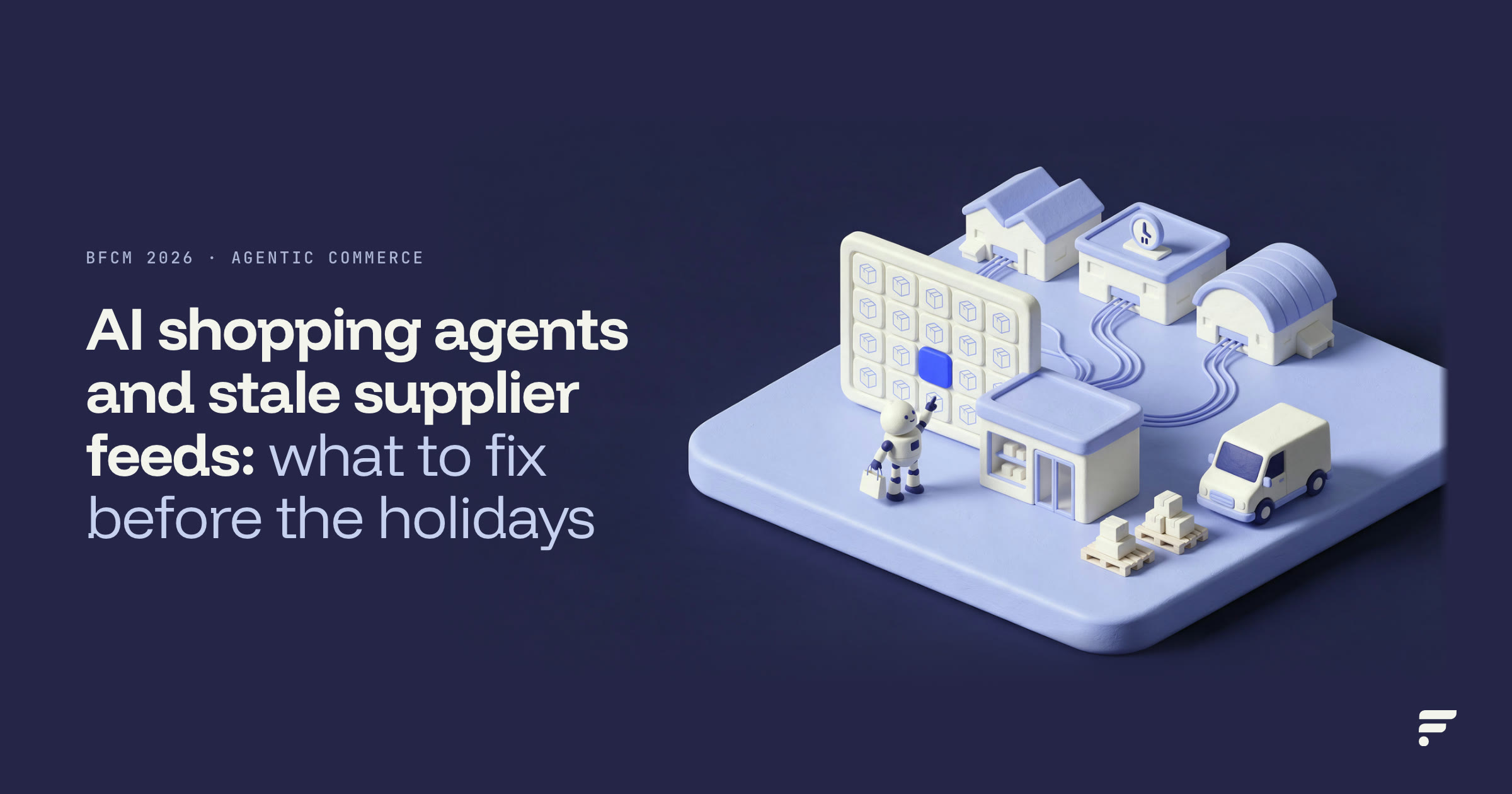
AI shopping agents now answer the questions a shopper used to answer by clicking around: is it in stock, what does it cost, and when will it arrive. Adobe expects AI traffic to US retail sites to rise 130% this holiday season, with the biggest jump on Thanksgiving. Salesforce goes further and predicts that 20% of all holiday ecommerce traffic will come from AI chat agents.
Those agents can only repeat the stock and price data you give them. If your catalog ships from distributors and dropship vendors, that data starts in a supplier feed that may be hours old by the time an agent reads it. An agent that confidently recommends an item your supplier sold out of this morning turns into a cancelled order, and the shopper blames you.
This post explains what agentic commerce reads, why multi-supplier catalogs are the most exposed, what to fix before Black Friday, and how Flxpoint keeps the data agents read accurate. It pairs with our BFCM readiness checklist for the rest of peak week.
+130% Adobe's forecast for AI traffic to US retail sites this holiday season. Adobe, Sept 2026 |
What AI shopping agents read in agentic commerce
Agentic commerce is the name for AI assistants that search, compare and sometimes buy on a shopper's behalf. They don't check your warehouse or your supplier's. They read three things you publish:
- Product feeds you send to AI surfaces. OpenAI's product feed for ChatGPT requires an availability value for every product, and its spec tells merchants to update current prices and availability in your feed when they change.
- Shopping feeds like Google Merchant Center. Google requires the availability in your product data to match your landing page and checkout, and says a mismatch will trigger a product disapproval.
- Your product pages. Agents that browse read the price and stock status on the page itself.
All three are only as current as the stock number in your store, and for a dropship catalog that number comes from your suppliers.
Why dropship and multi-supplier catalogs are the most exposed
A brand that ships from its own warehouse has one hop between the shelf and the agent. A seller that ships from suppliers has four, and each one can add delay.
SUPPLIER FEED Sent hourly, every few hours, or once a day | → | YOUR CATALOG Combines sources and applies buffers | → | STOREFRONT AND CHANNELS Listings update on their own sync schedule | → | AI AGENT Reads the feed or page and answers the shopper |
The agent's answer is only as fresh as the slowest hop. During normal weeks, a few hours of lag rarely matters. During Cyber Week, when Adobe expects the biggest jump in AI traffic on Thanksgiving, the same lag means an agent can keep recommending a product for hours after the last unit sold at the source.
Price is exposed too. Salesforce notes that part of the AI traffic it expects comes from bots that compare prices across sites. If a supplier changes cost or MAP and your listing doesn't follow, an agent will compare your old price, not your real one.
What a stale supplier feed costs you when an agent is selling
| 1 | Orders you can't fill The agent recommends the item, the shopper buys it, and you find out at the next feed that the supplier is out. A seller-cancelled order hurts marketplace metrics and loses the customer. |
| 2 | Disapproved products on Google If your feed says in stock and your page says out of stock, or the other way around, Google treats it as a mismatch and can disapprove the product, which removes it from shopping results during your busiest week. |
| 3 | Wrong prices in comparisons A price that lags your supplier's cost or a brand's MAP either loses the comparison or sells at a loss. |
| 4 | Lost trust in the recommendation Salesforce found that 74% of shoppers trust product recommendations from AI chat. A recommendation that ends in a cancellation teaches the shopper to stop trusting the answer, and the store. |
How to make supplier stock data agent-ready before Black Friday
None of this needs an AI project. It's the same feed hygiene that prevents overselling, applied with an agent in mind.
| 1 | Shorten the supplier feed window Ask suppliers for a light price and quantity feed as often as they can send it on your top sellers. Flxpoint's docs recommend running that Secondary inventory feed every 1 to 4 hours when the supplier supports it. |
| 2 | Sync listings at least as often as feeds arrive Fresh supplier data does nothing if your storefront and channels update once a day. Make your outbound listing sync run at least as often as your fastest inbound feed, so the number agents read follows the source. |
| 3 | Show out of stock early, not late An agent can't see your buffer, only the number you publish. Hold back a buffer on fast movers from slow suppliers, and set a threshold that drops a listing to 0 before the last units are gone. Saying "out of stock" a little early costs far less than a cancelled order. Our overselling guide shows how to size buffers. |
| 4 | Reserve units on open orders Committed stock subtracts units on open fulfillment requests, so the quantity you publish doesn't count units that are already sold but not yet reflected in the supplier's feed. |
| 5 | Match products on real identifiers Agents and shopping feeds match products on GTIN or UPC. Make sure each listing carries the right identifier, and that products from different suppliers are matched to one record on UPC, GTIN, EAN or MPN plus brand, so the same item doesn't show two different stock numbers. |
| 6 | Watch feed age, not just feed errors A feed that silently stops is worse than one that fails loudly, because the last number stays on your listings. Check each source's latest successful sync every morning in peak week. In Flxpoint, a job that keeps failing can be paused or stopped automatically, so look for paused schedules too. |
| 7 | Keep one source of truth for price Let one system set the price that goes to every channel, so an agent comparing your store against your Amazon listing sees the same number. Flxpoint does not monitor MAP automatically, so check discounted prices against brand minimums yourself. |
How Flxpoint keeps the data AI agents read accurate
Every fix above is a setting you have to maintain across every supplier and every channel, and by hand it falls apart at peak volume. Flxpoint runs it for you. It sits between your suppliers and the places you sell, so the stock and price that reach your storefront, your marketplaces and the feeds AI agents read come from fresh supplier data.
| What agents need | How Flxpoint handles it |
|---|---|
| Fresh stock from every supplier | Scheduled full and quantity-only imports per supplier, as often as each one allows |
| Listings that follow the source | Listing sync pushes quantity and price to your storefront and marketplaces on your schedule |
| Out of stock before it's gone | Source buffers and quantity rules, including zero-out thresholds per channel |
| No double-sold units | Committed stock reserves units on open orders |
| One record per product | Products from every supplier matched on UPC, GTIN, EAN or MPN plus brand |
| Early warning on stale feeds | Inventory from a source whose latest sync failed is left out of the total, and the Flxpoint MCP lets your team ask Claude or ChatGPT which listings are in error |
| One price everywhere | Pricing rules and List Price Protection, which blocks a listing that would sync below cost |
95% Time Screen Skinz saved on manual tasks after automating inventory and order workflows with Flxpoint. Read the case study |
AI agents will keep sending shoppers wherever your data says the product is. The sellers who win that traffic are the ones whose data is right, and a demo is the fastest way to see what that looks like for your suppliers and channels.
Frequently asked questions
What are AI shopping agents?
AI shopping agents are assistants such as ChatGPT that search, compare and recommend products for a shopper, and in some cases complete the purchase. They rely on product feeds, shopping data and product pages that merchants publish.
What is agentic commerce?
Agentic commerce is shopping where an AI agent does part of the work, from finding products to comparing prices or checking out. For merchants, it means product data has to be accurate and current, because the agent repeats it to the shopper.
How often should I update product availability for ChatGPT?
OpenAI's product feed spec asks merchants to update current prices and availability when they change. For dropship catalogs, that means your supplier feeds and listing sync need to run often enough that changes reach your feed within hours, not days.
Does Google penalize availability that doesn't match my website?
Yes. Google Merchant Center requires availability to match across your product data, landing page and checkout, and says a mismatch will trigger a product disapproval.
How does Flxpoint help with AI shopping agents?
Flxpoint keeps supplier stock and price accurate on the storefronts and marketplaces you sell on, which are the systems AI shopping surfaces read from. It doesn't submit feeds to ChatGPT itself, so your storefront or feed tool still sends the products, now with current numbers. Book a demo to see it with your suppliers.
Make sure the answer agents give is the right one.
Bring your supplier list and channels, and we'll show you how Flxpoint keeps stock and price current everywhere agents look.
Book a demo