Large retail corporations in 2026 face a major structural shift as consumers bypass traditional web search directories in favor of conversational systems. Standard keyword indexing is no longer sufficient to secure brand placement. To track product citations across multiple conversational assistants programmatically, developers need an API for AI visibility that delivers structured, daily performance datasets. We discuss the top 6 options for programmatically tracking GEO visibility in 2026:
- SE Ranking
- Otterly
- Peec.ai
- Clearscope
- Passionfruit Labs
- AIclicks.io
Finding the best API for AI search visibility is a standard task for digital agencies managing large eCommerce brands. We will help you with this task.
Key Takeaways
|
Tracking Metric |
2026 Observed Value |
Contextual Meaning |
Source |
|
Google AI Overview Trigger Rate |
~48% of queries |
Conversational replies dominate most high-volume product searches |
BrightEdge (Feb 2026) |
|
Search Engine Organic Overlap |
~12% of cited URLs |
Traditional first-page visibility does not transfer to chatbot recommendations |
Ahrefs |
|
ChatGPT vs. Perplexity Domain Overlap |
~11% |
Platforms rely on completely different index databases |
Profound |
|
Chatbot Referral Conversion Premium |
2x to 14x higher |
Conversational citation traffic displays much higher transaction intent |
WebFX |
|
Cited Source Freshness Shift |
+25.7% fresher |
Chatbots prioritize highly recent information over legacy authority |
Ahrefs |
Why the API for GEO Visibility Tracking Matters
Large eCommerce catalogs contain tens of thousands of dynamic product URLs. Tracking whether these products are cited by ChatGPT, Perplexity, Gemini, or Copilot requires a systematic, scalable data pipeline. Relying on manual browser checks on individual computers is a major mistake. Chatbot outputs are highly volatile. They change based on geographic IP blocks, prompt context, and model updates. Using an LLM visibility monitoring SaaS with API access protects catalog share of voice by capturing these patterns automatically. Deploying an enterprise AI visibility and tracking API keeps teams informed when competitors capture top slots.
Traditional optimization models fail in conversational retrieval systems. In standard search, web crawlers parse pages to build a static index. Chatbots use retrieval-augmented generation (RAG). The system generates specific sub-queries, retrieves small chunks of content from authoritative sites, and synthesizes a direct response. Deploying an AI search visibility API avoids the blind spots of tracking only Google ranks. It allows enterprise data systems to check brand presence across the entire retrieval layer. An AI search visibility tracking tools API provides structured metrics to analyze exactly which external forums, directories, and listicles get cited.
To trace back citations to high-authority source websites, brands require a dedicated API for LLM visibility. For example:
- Perplexity draws heavily from community platforms like Reddit (~6.6% of citations).
- ChatGPT prioritizes Wikipedia (~7.8% of citations) and displays a massive commercial (.com) domain bias.
A structured LLM visibility API maps the exact citation pattern across ChatGPT and Google AI Overviews. Concurrently, a programmatic AI search visibility API for reporting feeds business intelligence setups and custom databases. This keeps executive teams aligned.
For eCommerce brands, optimizing content format is a primary requirement. Chatbots prefer list formats, structured bullet points, and definition-first answers. Pages with structured lists, direct quotes, and statistics show a 30% to 40% visibility lift. To verify this alignment, data analysts measure how closely catalog pages mirror cited source documents.
Additionally, server-side configurations must remain accessible to chatbot web crawlers. Many eCommerce sites use JavaScript frameworks that require client-side rendering. This is a severe issue. Conversational crawlers often parse only the raw, server-returned HTML, leaving dynamic elements invisible. Deploying a reliable API for AI visibility enables engineers to connect catalog databases with retrieval systems. This ensures any sudden drops in chatbot crawl rates are spotted before visibility plunges.
Quick Comparison: Best APIs for GEO Visibility Tracking at a Glance
|
Tool Name |
Primary Use Case |
Best For |
Starting Price |
|
SE Ranking |
Combined SEO and GEO keyword rank tracking |
Large digital agencies and multi-client eCommerce sites |
$50 minimum deposit |
|
Otterly |
Multi-platform auditing and marketing automation |
Teams requiring extensive GEO parameter auditing |
$29/month |
|
Clearscope |
Semantic content optimization and topic mapping |
Content hubs focusing on editorial search alignment |
$129/month |
|
Passionfruit Labs |
Low-cost citation tracking and GA4 revenue mapping |
Brands seeking flat-rate tiers with unlimited user seats |
$49/month |
|
AIclicks.io |
10-model visibility monitoring and source discovery |
Multi-site operators seeking deep community source tracking |
$59/month |
|
Peec.ai |
Model Context Protocol and custom tagging analytics |
Technical teams using terminal-level Claude data queries |
$95/month |
How We Evaluated These Tools?
Our testing focused on evaluating each AI search visibility tracking tools API through simulated prompt tracking. Analysts evaluated each API for AI visibility on its programmatic reliability and visual evidence capture. We checked if each API for AI search visibility handles massive search volumes without dropping connection states. The review focused on selecting an enterprise AI visibility and tracking API capable of scale.
The selection of each API for AI visibility depended on performance across several primary factors:
- Data Gathering Reliability. We analyzed whether the tool uses raw developer APIs or browser automation. Browser automation is superior because it captures what actual users see on their screens.
- Model Footprint. We checked the number of conversational systems tracked. Top platforms must cover at least ChatGPT, Gemini, Perplexity, and Google AI Overviews.
- Revenue and Analytics Links. The ability to map conversational visibility to actual transaction dollars in Google Analytics 4.
- Developer Tooling. The availability of native REST endpoints, webhook triggers, and Model Context Protocol (MCP) connections.
- Competitive Analysis depth. How easily the platform tracks competitor share of voice and citation patterns.
The focus on developer access helped isolate which platforms offer a true AI visibility API over static tools. The evaluation measured the query speed and error rate of each AI search visibility API under load. We compared every available API for LLM visibility to find the platforms that offer multi-model tracking.
1. SE Ranking
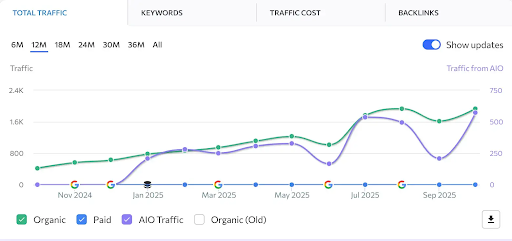
SE Ranking API is a top API for AI visibility tracking for enterprise eCommerce brands. It incorporates an LLM visibility API that handles competitive share of voice ranking calculations. It acts as an AI search visibility API for reporting to Looker Studio and other custom data lakes. SE Ranking features a powerful API for AI search visibility that feeds organic search metrics directly into databases. Key features of the SE Ranking AI search visibility tracking tool API:
- AI Overviews, AI Mode, Perplexity, Gemini, and ChatGPT trackers to monitor direct text citations.
- Google AI Mode Tracker that reports position trends and domain link presence.
- Data API delivering programmatic access to competitor leaderboards and domain performance.
- Model Context Protocol (MCP) server allowing developers to query SEO and GEO datasets using Claude.
- Workflow automation triggers via Make.com, n8n, and Zapier.
- Exhaustive country databases spanning 188 regions with over 5.4 billion keywords.
Pricing
The Core plan starts at $103.20/month billed annually ($129/month monthly) and includes 25,000 monthly Data API credits. The Growth tier begins at $223.20/month billed annually and includes 100,000 monthly API credits. You can also purchase the API Access Add-on for $159.00/month, which adds 1 million credits to any base subscription.
The standalone Data API starts at an effective rate of $318.00/month billed annually ($3,816.00 billed upfront), providing 24 million credits per year. For lower-volume projects, pay-as-you-go credit packs are available starting at $50.00 for 250,000 credits with no expiration.
Best For
Large eCommerce digital marketing agencies that need to manage traditional organic ranks alongside conversational citation tracking under a unified platform.
Pros
- Blending search tracking with chatbot citation metrics prevents information fragmentation.
- The Claude MCP server allows non-technical users to generate visibility reports with simple text prompts.
- Comprehensive competitor comparison options show automated leaderboards sorted by share of voice.
- 188 countries, 420M domains, 6B pages crawled daily.
- Free 14-day trial with 100K API credits and full endpoint access from day one.
- AI visibility tracking across AI Overviews, AI Mode, Perplexity, Gemini, and ChatGPT.
- Backlinks, keyword research, domain analysis, website audit, AI Search, and Project Management API run from a single credit balance under one subscription.
- Seamless white-label PDF and Looker Studio reporting capabilities.
Cons
- The data refresh cycle for the AI Search API is set to a monthly frequency, which is slow for active campaigns.
2. Otterly
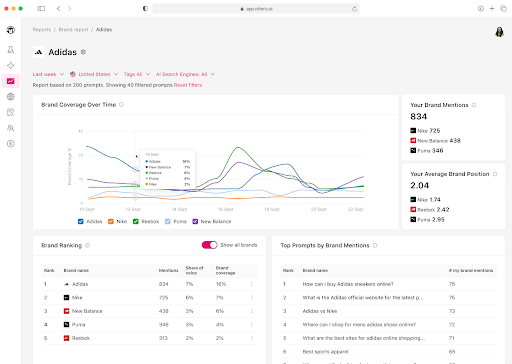
Otterly features an API for LLM visibility to pull citation data directly into reporting tools. Thomas Peham released the platform's Public API and Claude Skill to bridge the gap between dashboards and standard workflows. The brand delivers an AI search visibility API for reporting citation shifts to Slack and n8n pipelines. Key features of the Otterly AI search visibility tracking tool API:
- Continuous search prompt monitoring across ChatGPT, Gemini, Perplexity, Copilot, AI Mode, and AI Overviews.
- Brand Visibility Index providing a proprietary score representing overall presence.
- Link Citation Analysis to identify which specific URLs chatbots cite most frequently.
- Public REST API enabling teams to pull citation reports programmatically.
- Claude Skill allowing direct chatbot summaries within Anthropic's user interface.
- Comprehensive GEO Audit checking 25+ structural and content factors.
Pricing
Otterly uses a tiered, prompt-based pricing structure. The Lite plan is priced at $29 per month for 10 search prompts. The Standard tier costs $189 per month for 100 search prompts. The Pro plan is priced at $989 per month for 1,000 search prompts. Accessing the Otterly AI visibility API is restricted to the Standard and Pro tiers.
Best For
Marketing operations managers looking to automate brand audits across multiple conversational platforms.
Pros
- Excellent GEO audit checking over 25 on-page parameters to isolate visibility blocks.
- Direct n8n and Zapier connections simplify automated workflow setup.
- The pre-built Otterly Marketplace offers over 100 production-ready marketing workflows.
Cons
- Standard tracking refreshes on a weekly basis, meaning data can be up to 7 days behind.
- The platform lacks built-in content drafting or on-page editing tools.
3. Clearscope
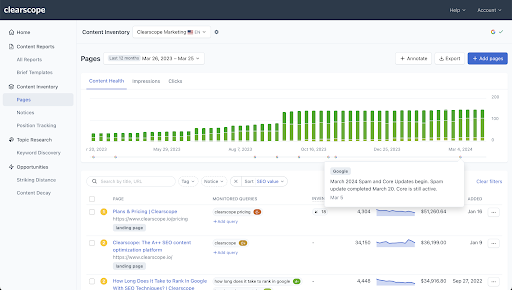
Clearscope is less of an LLM visibility monitoring SaaS with API access and more of an editorial grader. Clearscope does not operate a direct API for LLM visibility, choosing instead to optimize content relevance. Key features of the Clearscope AI search visibility tracking tool API:
- Content Reports detailing relevant headings, terms, and intent markers across competitors.
- Real-time Content Editor providing a letter-grade grading system and readability scores.
- Content Inventory and Monitoring to identify content decay across older URLs.
- Built-in integrations for Google Docs and WordPress to simplify writer workflow hookups.
- Topic Explorations to map topical authority and discover semantic clusters.
- Conversational visibility tracking for up to 50 topics on ChatGPT and Gemini depending on the plan.
Pricing
The Essentials plan starts at $129 per month and includes conversational tracking for 20 topics across two engines. Higher tiers like Professional and Enterprise cost $399 and higher.
Best For
In-house editorial departments and writing teams that need to construct highly competitive, search-optimized articles.
Pros
- Extremely clean editor interface that freelance writers can adopt without prior training.
- Strong focus on local SEO configurations and search intent matching.
- Content decay alerts tell editors exactly when older pages need updates to defend their ranks.
Cons
- Programmatic developer endpoints are not available on standard subscriptions.
- Conversational search monitoring is limited to ChatGPT and Gemini, leaving Perplexity and Copilot untracked.
4. Peec.ai
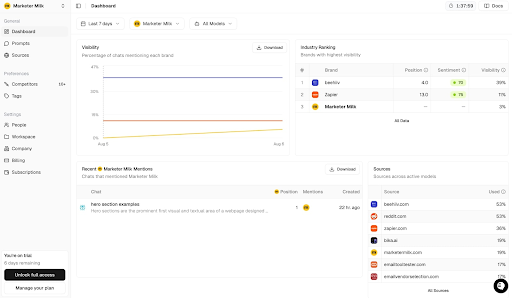
Peec.ai operates as an enterprise AI visibility and tracking API that can fetch parsed markdown content. Key features of the Peec AI search visibility tracking tool API:
- Native Model Context Protocol (MCP) server for direct plain-language queries in Claude or Cursor.
- Sophisticated browser automation simulating authentic user sessions.
- Segment tagging to group tracked search prompts by customer journey stage or product category.
- Markdown parser to analyze the structured layout of cited competitor pages.
- Agent Analytics tracking to monitor conversational scraper bot visits in server logs.
- Looker Studio connector and Excel export support.
Pricing
The Starter plan costs approximately $95 per month for 50 tracked prompts across 3 chosen models. Additional tracking engines cost an extra $25 per month each. The platform restricts its LLM visibility API to enterprise contracts while offering free-form MCP tracking. Developers requiring a raw AI visibility API must negotiate custom enterprise terms.
Best For
Highly technical SEO developers who want to manage citation datasets using Claude, terminal environments, or custom database pipelines.
Pros
- Peec.ai offers a highly detailed AI search visibility tracking tools API experience via its zero-cost MCP server on all paid plans.
- Excellent prompt segmentation tagging lets brands split metrics by user persona or brand line.
- Browser automation captures dynamic web grounding responses that standard APIs miss.
Cons
- Programmatic REST API endpoints are locked behind the custom Enterprise plan.
- Per-engine surcharges can cause subscription costs to scale quickly if multiple search engines are tracked.
- The software is purely analytics-focused, providing no built-in execution or content-writing features.
5. Passionfruit Labs
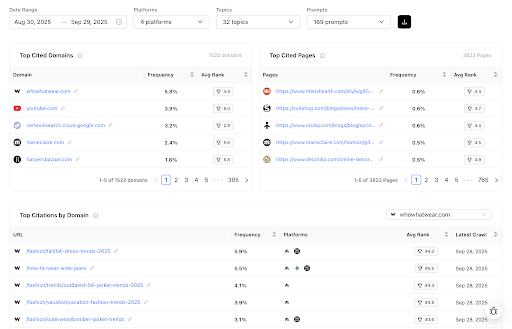
Passionfruit Labs is a simple GEO monitor that lacks an API for LLM visibility on its base tiers. It is a cheap tracker, though it is not a classic LLM visibility monitoring SaaS with API access. Key features of the Passionfruit Labs search visibility tracking tool API:
- Page-level citation tracking and domain citation breakdown.
- Native Google Analytics 4 and Google Search Console linking.
- Revenue attribution analytics mapping transactional values to conversational referral traffic.
- Prompt Genius AI tool to reverse-engineer successful citation layouts.
- Competitor benchmarking and regional simulation across 100+ countries.
- Unlimited team seats on all plans, avoiding seat-based cost escalations.
Pricing
Passionfruit Labs has positioned itself as a budget disruptor. The Lite plan is priced at $19 per month for 20 daily prompts (ChatGPT only). The Starter tier costs $49 per month for 70 daily prompts on ChatGPT, Perplexity, and Gemini. The Pro plan is priced at $99 per month for 150 daily prompts on four engines. Enterprise tiers require custom quotes, with custom database hooks carrying a monthly development fee.
Best For
eCommerce brands seeking to track conversational ROI and page citations without facing high per-user software fees.
Pros
- Unmatched pricing efficiency makes it highly accessible for smaller companies.
- GA4 transaction tracking displays clear financial performance metrics for conversational campaigns.
- Unlimited user seats encourage broad departmental cooperation.
Cons
- Programmatic API endpoints and MCP servers are completely absent on all standard tiers.
- Standard tiers restrict engine tracking, requiring custom enterprise deals to monitor Copilot or Grok.
- Mid-market teams often seek an enterprise AI visibility and tracking API to avoid services company conflicts, as Passionfruit is run by an active SEO agency.
6. AIclicks.io
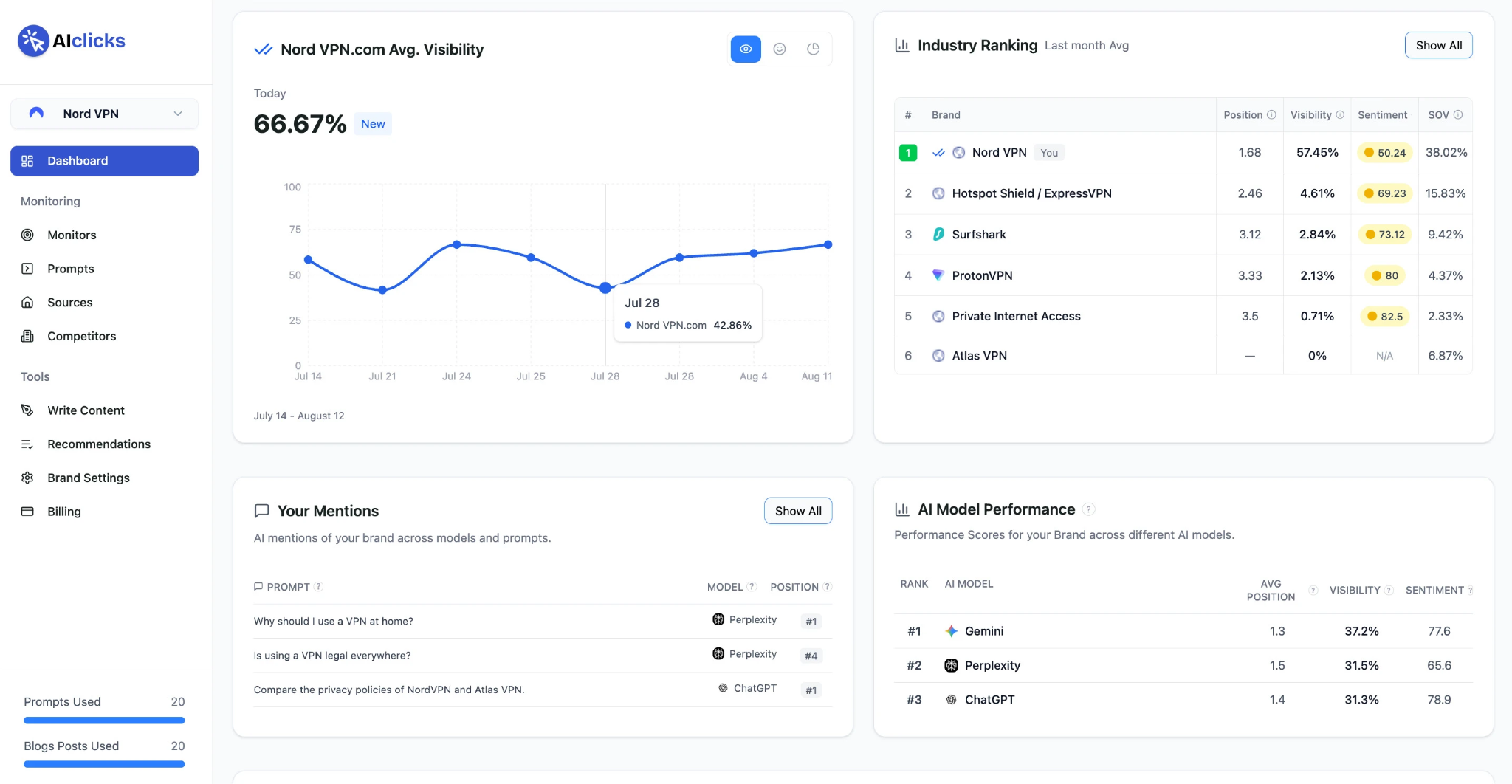
AIclicks.io operates as an AI search visibility API for reporting by piping user search metrics directly into GA4. This AI search visibility tracking tools API discovers which competitor brands appear in real-time answers. Key features of the AIclicks.io search visibility tracking tool API:
- Browser automation querying to capture true user-facing responses across 10+ models.
- Source Intelligence mapping to show exactly which Reddit threads and listicles get cited.
- Native Google Analytics 4 link to match conversational mentions with real sessions.
- "Get Mentioned" dashboard offering prioritized outreach recommendations.
- Sentiment and Sentiment Shift analytics included on all subscription tiers.
- Unlimited user seats and historical data storage.
Pricing
The Starter plan is priced at $59 per month for 30 prompts across 3 engines. The Pro tier costs $189 per month for 150 prompts across 4 platforms. The Business tier is priced at $499 per month for 300+ prompts. AIclicks.io exposes its AI search visibility API on its custom corporate tiers.
Best For
Multi-brand eCommerce portfolios and digital PR agencies requiring wide platform coverage and exact citation outreach opportunities.
Pros
- Tracks conversational performance across ten engines, including Grok, Meta AI, and DeepSeek.
- GA4 session matching turns vanity visibility scores into concrete traffic metrics.
- Browser emulation bypasses dry developer APIs, returning exactly what actual buyers see on screen.
Cons
- The integrated content writer module is relatively simple compared to advanced editing tools.
- Compared to standard seo software, this AI search visibility tracking tools API has a smaller user community.
FAQ
How do browser simulation trackers avoid the discrepancies of developer APIs?
Official model developer APIs often return sanitized, clinical outputs that fail to reflect the consumer search experience. Conversational systems modify their public displays using real-time web search grounding, regional IP blocks, and personalized search histories. By employing automated browser sessions, tools simulate the exact journey of a human shopper. This captures real-time layout structures, citation placements, and secondary questions that developer APIs completely omit. Connecting an AI search visibility API for reporting with database stacks is a standard strategy to maintain clean metrics.
What steps should an eCommerce enterprise take to handle zero-click search behaviors?
To combat high zero-click rates, eCommerce brands must pivot from classic organic rankings to active citation acquisition. This is done by auditing server setups to ensure conversational crawlers are not blocked in robots.txt. Next, engineering teams should implement schema markup (JSON-LD) to help engines extract product attributes cleanly. Finally, content teams should structure category descriptions using definition-first layouts, structured lists, and direct Q&A formats. Why? They are highly favored by conversational systems.
How does the Model Context Protocol (MCP) differ from a traditional REST API?
A traditional REST API requires writing custom extraction scripts, managing token handshakes, and formatting response payloads manually. The Model Context Protocol (MCP) operates as an open translator standard. It exposes external databases directly to conversational assistants like Claude or Cursor. Once the streamable server connection is established, developers can query, filter, and segment their citation data using plain language prompts without writing custom code. Enterprise developers can link their LLM visibility API with internal setups to parse scraped markdown directly.
Conclusion
Measuring performance inside conversational engines is mandatory for eCommerce brands wanting to protect their transaction pipelines. Standard keyword tracking no longer mirrors consumer purchasing behavior. Securely deploying a programmatic tracker is the initial phase in executing a competitive digital marketing strategy.
Rather than attempting manual database updates, you should take 3 actions:
- Audit server log files to verify that crawlers like ChatGPT-User are not getting blocked by server-level firewalls.
- Deploy JSON-LD schema across product collections to enable clean data extraction.
- Establish a daily tracking routine across ChatGPT, Perplexity, and Google AI Overviews to detect citation losses immediately.
Adopting a standard AI visibility API ensures real-time pipeline flows. Implementing AI visibility API helps enterprise teams preserve search market share.