.png?width=2240&height=1260&name=Office%20Supplies%20Inventory%20Management%20(4).png)
Introduction
For an office and school supply dealer, back-to-school is the one stretch of the year where most of the revenue arrives at once. The hard part isn't that the demand shows up.
It's that most office dealers don't have a reliable backend system they can lean on, and it always lands on the same small team that runs the business manually.
The orders don't wait for August anymore. They start landing in early July, weeks ahead of the actual back-to-school season. So now the real question is whether your back office can handle the sudden spike in order volume.
If not, all the marketing and outreach that brought those orders in goes to waste, and the season you counted on becomes the one that breaks your team. This blog will walk you through handling triple the order volume without adding headcount.
The rush is earlier and tighter than it used to be
Back-to-school is one of the largest consumer spending events of the year, and the bigger story for a lean operation isn't the size of the pool. It's how early it fills.
NRF's most recent back-to-school survey found that 67% of shoppers had started by early July, up from 55% the year before, and 82% planned to time their buying around July sales events.
The 2026 signals point the same way. Inmar found that 38% of parents start their shopping in July and another 26% in August, so most of the season is in motion before the calendar even reads back-to-school.
The demand behind that timing is deep. NRF's most recent survey put planned K-12 back-to-school spending at $39.4 billion, with back-to-college adding another $88.8 billion on top. That's a large, near-guaranteed pile of demand for the exact products you carry, and it's compressing into a shorter window as shoppers move earlier to chase deals.
For a dealer running Amazon, Walmart, and a storefront off the same few distributor feeds, that compression is the whole problem.
When the orders bunch up, your product listings have to be right and your purchase orders have to move on the first day, not the third. Miss by a day during peak and the sale goes to the competitor dealer whose stock count was accurate.
Without middleware, what are the odds the rush sends you back to square one?
Be honest about the odds. Without middleware sitting between your suppliers and your sales channels, the back-to-school rush isn't a test you pass on effort. It's a test you fail in small, expensive ways that add up fast.
Most of the back-to-square-one damage comes from the same handful of failure points:
- You oversell on your best sales channel. When your stock numbers lag behind what suppliers actually have, you sell items you can't ship. On Amazon, that means cancellations, metrics damage, and the kind of account risk that outlasts the season.
- You sell the wrong feed. A SKU sits on two or three supplier feeds at different costs and stock levels. Pick wrong and you either lose margin or promise inventory that's gone.
- Your purchase orders pile up. Every hand-keyed order is a few minutes you don't have in July. Multiply that across a tripled order count and the backlog becomes the bottleneck.
- A new supplier breaks your workflow. You add a distributor to replace lost volume, and now you're managing one more feed format and one more order method by hand, mid-rush.
- You burn your team to stay afloat. The "solution" becomes overtime and a temp who needs training during the busiest weeks of the year. That's the cost that buys you nothing for next season.
That last point matters because the channel where these failures show up most is the one you can least afford to lose.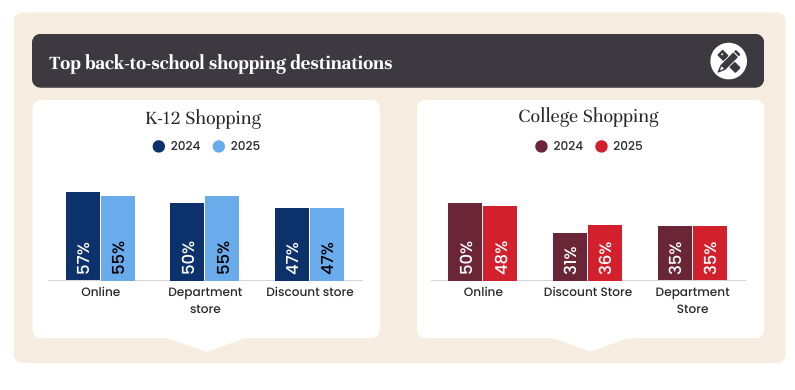
Source: NRF and Prosper Insights & Analytics.
Online is where the back-to-school rush concentrates, and online is exactly where overselling and stale listings do the most harm. The way out isn't more hands on the same manual work. It's a layer that sits between your suppliers and your sales channels and does the repetitive work on its own, so the volume gets absorbed by software instead of by new hires.
That's what a middleware platform like Flxpoint (Office & School Supplies Inventory Software) does, and below is how it plays out step by step.
How Flxpoint runs your back office during the rush
Flxpoint sits between your suppliers and your sales channels and runs the repetitive work on its own. When order volume spikes, the system absorbs it instead of your staff. Here is the order of operations:
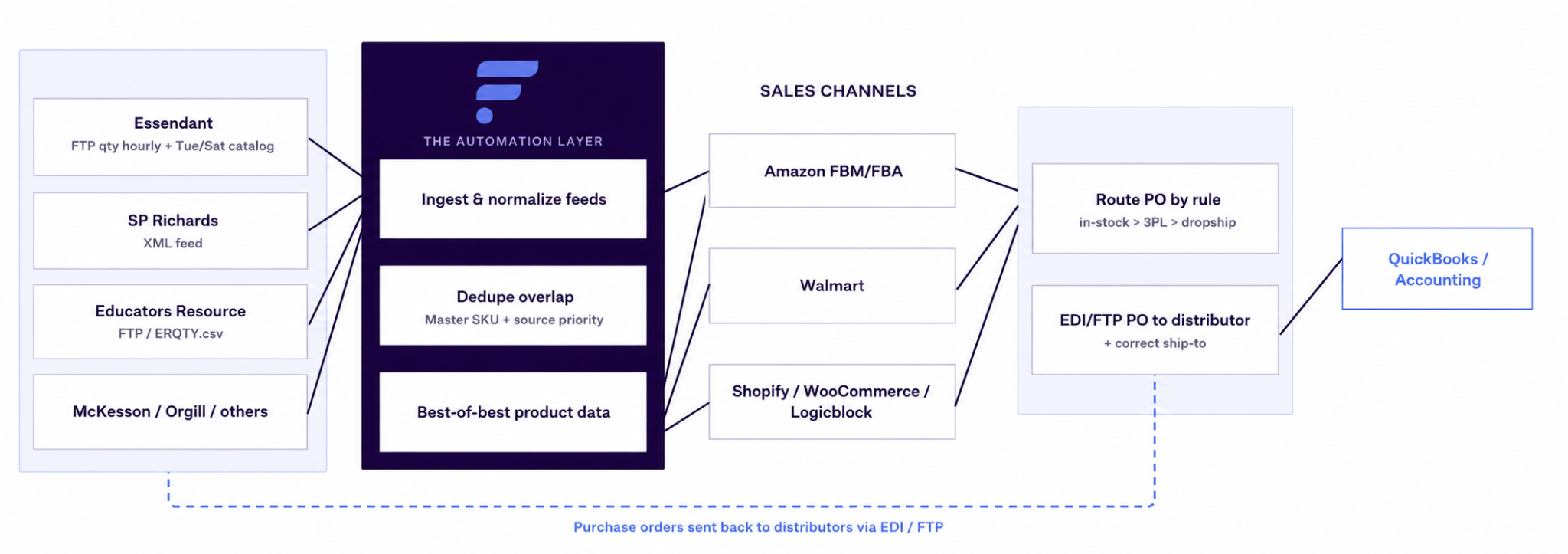
Step 1: Pull every supplier into one catalog
Flxpoint connects to each of your distributors and brings their product data into one place. It reads the formats your suppliers already send, including EDI, XML and API feeds, and FTP or CSV files. SP Richards arrives as an XML inventory and pricing feed. Educators Resource comes in over FTP. Whatever the format, it lands in one normalized catalog.
You stop juggling spreadsheets and supplier portals. When the back-to-school rush triples your volume, you work from one source of truth instead of a dozen tabs.
Step 2: Let one master record decide what to sell
When the same item shows up on more than one supplier feed, Flxpoint dedupes it onto a master SKU. You see cost and stock across every source on one record, and orders route by rule, prioritizing in-stock first, then your 3PL, then dropship.
You sell the item once and fulfill it from the source that can actually ship it for the least. On margins this thin, that routing decision is the difference between a profitable order and one that loses money.
Step 3: Keep every sales channel honest
Flxpoint pushes price, quantity, and status out to Amazon, Walmart, and your own cart on the schedule you set. As supplier stock changes, your listings change with it, in real time across every channel at once.
This is the step that stops overselling during the rush. Your listings reflect what's actually available, so you don't sell what you can't ship on the channel that drives most of your season.
Step 4: Automate the orders end to end
When an order comes in, Flxpoint routes it and fires the purchase order to the right distributor over EDI or FTP with the correct ship-to address. It pulls shipments and invoices back, and it syncs to QuickBooks.
This is the work you'd otherwise hire for. Automated order routing and supplier purchase orders absorb peak volume with no added headcount, which is the whole point of surviving the rush without hiring.
Step 5: Print labels and tracking without touching them
Flxpoint connects to your shipping carriers and generates the label and tracking number as each order moves through fulfillment.
Every order takes less hands-on time, so the same team clears more of them per day as the volume climbs. The work per order shrinks right when the number of orders grows.
Step 6: Watch the numbers and catch problems early
Flxpoint reports on fulfillment rates, supplier performance, and the metrics that show where orders are slowing down.
During peak, a small problem turns into a big one fast. Seeing a distributor fall behind on day two lets you reroute to another source before it costs you the week, instead of finding out from a pile of cancellations.
Put together, these six steps form one closed loop, from supplier feed to synced back office.
What this looks like for a dealer who isn't hiring
The dealers who handle the back-to-school rush calmly tend to share one trait. They set the back office up once, before the season, and then let it run.
The Pencil Grip is one example from our own roster, a multi-year customer on our Pro plan that runs its catalog and orders through the platform rather than through a growing back-office team. Toner Buzz is another, a toner wholesaler that's been with us since 2020 and treats the platform as its operations layer across channels.
The shared lesson isn't about size. It's about sequence. These dealers connected their suppliers, set their routing rules, and turned on channel sync before peak demand arrived. When the back-to-school rush came, the system carried the volume that a seasonal hire would have, without the hiring.
Ready to let software carry the rush instead of your team? Flxpoint connects your suppliers, dedupes your catalog, and keeps every channel synced before peak hits. Set it up once, then watch the back-to-school orders route themselves.
See how Flxpoint's office and school supplies inventory software handles your busiest season.
Common questions about handling the back-to-school rush
What operational bottlenecks cause office supply dealers to miss orders or delay fulfillment during the back-to-school rush?
The bottlenecks are almost always manual. Stock counts that lag behind what suppliers actually have, hand-keyed purchase orders that pile up, and the same SKU sitting on two or three feeds at different costs. When volume triples in July, those manual steps become the choke point, and orders slip or ship late.
How does automated order routing handle a 5x spike in daily order volume without manual intervention?
Routing doesn't care how many orders arrive. When an order comes in, the system reads your rules, picks the source that can ship it, and fires the purchase order to that distributor over EDI or FTP with the right ship-to address. Whether that's 50 orders a day or 250, the work per order for your team stays the same, which is none.
What happens to distributor inventory accuracy during peak season, and how do I prevent oversells when stock moves faster than feed updates?
During peak, supplier stock moves fast and feeds can lag, so a listing can show available when the item is already gone. Flxpoint pulls each supplier's inventory on the schedule you set and pushes the updated quantity out to every channel at once. You can also tie a SKU to more than one source, so if one distributor runs dry, the master record still reflects what the backup can ship.
How do I keep fulfillment SLAs intact across Amazon, Shopify, and Walmart simultaneously when order volume spikes?
You run one master catalog feeding all three channels, so price, quantity, and status update everywhere on the same schedule. Orders from any channel route by the same rules and fire to the right distributor on their own, so none of the three waits on manual processing. Labels and tracking generate as each order moves, which keeps ship times inside the windows Amazon and Walmart hold you to.
What is the real cost of hiring seasonal staff vs. investing in fulfillment automation for a mid-size office supply operation?
A seasonal hire is a recurring cost that resets every year. You pay to recruit and train someone during your busiest weeks, then they leave with the knowledge you built into them, and you start over next July. Automation is set up once and scales with volume, so it carries the same peak without overtime, temp wages, or retraining. The hire helps for a few weeks. The system pays off every season after.
Get your back office ready before the 2026 rush
The back-to-school rush rewards the dealers who prepared and punishes the ones who improvised. And the window keeps moving earlier. 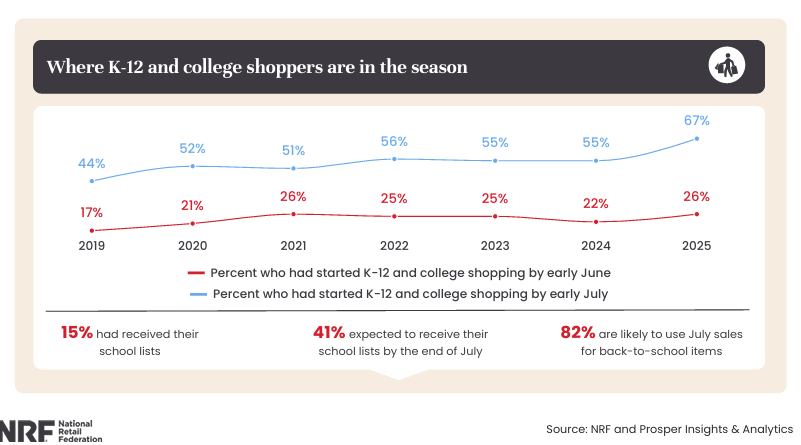
Source: NRF and Prosper Insights & Analytics.
NRF's most recent survey found that 82% of consumers said they were likely to use July sales for back-to-school items.
That's your deadline, not your buffer. If buyers are acting in July, your suppliers, catalog, and channels need to be connected and synced before then.
If you're rebuilding your distributor mix and figuring out the operations side, start with our office and school supplies playbook for the full picture.
From there, build a distributor-powered catalog before the season peaks and see how independent office supply dealers compete online using automation.
Together they cover the catalog and the competitive angle that sit on either side of this operations guide.
When you're ready to set the back office up so the back-to-school rush runs itself, take a look at Flxpoint's office and school supplies inventory software.