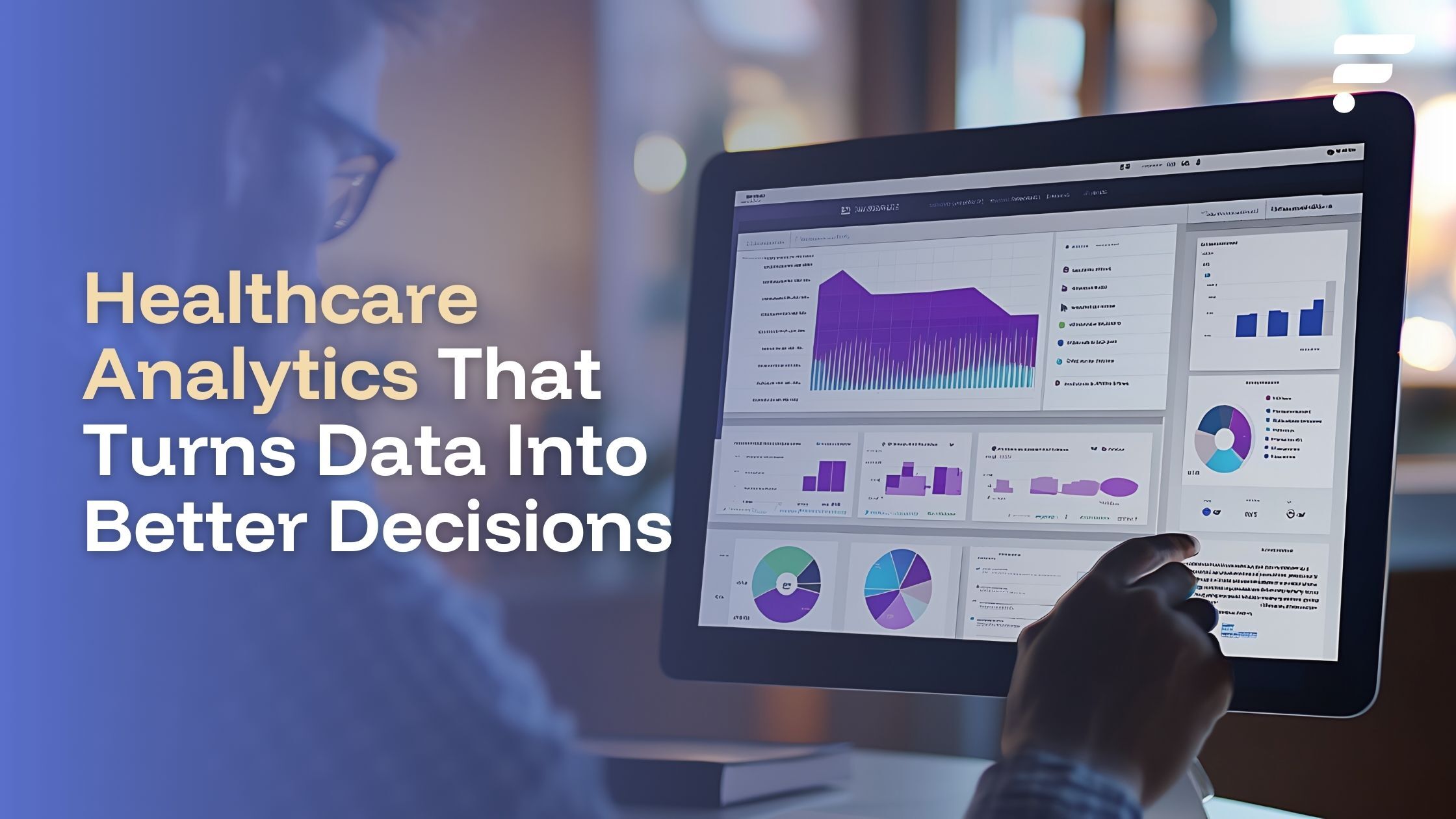
Healthcare organizations generate massive volumes of information, but the real challenge is turning that information into decisions that improve care, reduce friction, and control costs. Data comes from everywhere: EHRs, labs, imaging systems, claims, pharmacy, scheduling, call centers, and increasingly patient devices and remote monitoring.
Without a plan, it becomes noise: disconnected reports, conflicting numbers, and dashboards that don’t influence action. That’s why healthcare analytics services are valuable: they combine data engineering, governance, and practical insight delivery so organizations can see what’s happening, understand why, and act with confidence.
What healthcare analytics includes
Healthcare analytics is not one thing. It spans multiple layers of the business and clinical environment. Clinical analytics focuses on outcomes, safety, and adherence to guidelines. When integrated with specialty-focused systems like cardiology ehr software, healthcare organizations can better track cardiovascular patient data, monitor treatment outcomes, and support data-driven decision-making in cardiology care. Operational analytics focuses on throughput, capacity, staffing, and process bottlenecks. Financial analytics looks at reimbursement, denials, cost of care, and utilization patterns. Population analytics supports cohort management: risk stratification, prevention, chronic care performance, and gaps in care.
These layers overlap. A delay in discharge is operational, but it also affects outcomes and patient experience. A medication adherence issue is clinical, but it also impacts cost. The most useful analytics approach connects these layers rather than treating them as separate reporting projects.
Why healthcare analytics is hard in the real world
Healthcare data is fragmented. A single patient journey may span multiple systems, facilities, and providers. Even within one organization, different departments can record the same concept differently. Some data arrives in real time, while other data, especially claims, arrives weeks later.
Data quality varies widely: missing values, inconsistent units, duplicated patients, and unstructured notes. On top of that are privacy and compliance constraints that shape access, sharing, and auditability.
This complexity means analytics fails when it starts with dashboards and ends with a PDF report. Analytics succeeds when it starts with a reliable data foundation and ends in workflows that people actually use.
The data foundation: integration, standardization, and governance
The first step is integration: connecting data sources across clinical, operational, and financial systems. But integration alone is not enough. Data must be standardized so measures are consistent across sites and time. That includes mapping local codes, aligning units, normalizing date and time practices, and ensuring that key definitions match across departments.
Governance is equally important. Teams need shared metric definitions, lineage, and auditability. If one team defines “readmission” differently than another, the organization spends time arguing instead of improving. Strong governance turns analytics into a shared truth rather than competing narratives.
High-impact use cases for healthcare analytics
Readmission reduction remains one of the most common targets because it blends outcomes and cost. Analytics can reveal patterns in discharge planning, follow-up timing, medication reconciliation, and cohort risk factors. Quality and patient safety measurement is another high-value area: tracking guideline adherence, infection prevention metrics, adverse events, and care variation across sites.
Population health use cases scale quickly. Analytics can identify gaps in preventive screenings, segment cohorts by risk, and monitor chronic care performance. Operational analytics can improve ED flow, bed utilization, staffing alignment, and discharge efficiency, often producing measurable gains within months.
For payers and value-based programs, analytics supports risk adjustment, cost-of-care measurement, utilization analysis, and program performance monitoring.
From descriptive to predictive: maturity that earns trust
Many organizations start with descriptive analytics: what happened. The next step is diagnostic analytics: why it happened. Predictive analytics estimates what may happen next, like risk of readmission or likelihood of a no-show. Prescriptive analytics suggests actions: interventions, workflow changes, or resource allocation strategies.
The best programs do not jump straight to prediction. They build trust first by ensuring data consistency and explainability. In healthcare, a simpler model that clinicians understand can be more valuable than a complex model that no one trusts. Adoption is the multiplier.
Workflow integration: where analytics becomes real
Analytics that lives in a separate portal often gets ignored. The highest impact comes when insights are delivered inside existing workflows: care management queues, operational huddles, quality review meetings, or clinician-facing views that surface relevant context at the right moment.
Actionable insights have three qualities: timeliness, clarity, and specificity. Timeliness means the signal arrives when decisions are made. Clarity means users understand what the metric means and how it’s calculated. Specificity means the insight points toward a next step, rather than just describing a problem.
Just as important: analytics should reduce noise. Too many alerts create fatigue and reduce trust. Prioritization and role-based delivery make analytics usable.
Security, privacy, and responsible analytics
Healthcare analytics must be secure by design. Role-based access control, encryption, audit logs, and careful handling of sensitive information are baseline requirements. Privacy is not only compliance; it’s trust. Teams must know that data is used appropriately and transparently.
For advanced analytics, responsibility includes fairness and drift monitoring. Models can encode bias if historical data reflects unequal access, underdiagnosis, or inconsistent follow-up. A mature analytics program validates outputs across populations, monitors performance over time, and maintains clear accountability for how predictions are used.
Why interoperability and standards matter
Analytics becomes far easier when data is represented consistently. Standards-based approaches reduce the need for custom mapping and make measures more reusable across sites and partners. When data structures and terminology are aligned, organizations can build once and scale rather than rebuilding every time they add a new source.
This is also critical for collaboration across organizations (referrals, public health reporting, and multi-provider networks), where consistent data exchange supports more complete analytics and better continuity of care.
A note on Edenlab
Edenlab is known for building healthcare and healthtech solutions, including advanced EHR software, that often involve complex data workflows and sensitive information handling. That experience matters for analytics because impactful programs require more than visualizations: they require reliable pipelines, governance discipline, and integration into real operational and clinical processes. Teams that combine engineering strength with healthcare context can help organizations build analytics foundations that scale and deliver insights people actually trust.
How to start: a practical approach that avoids “analysis paralysis”
Start with one use case that has clear ownership, measurable outcomes, and accessible data. Examples include reducing no-shows, improving discharge efficiency, increasing screening rates, or improving chronic care control measures. Define the metric precisely and validate the data early.
Build a pilot that delivers insight into a workflow, not just a dashboard. Measure impact, gather feedback, and iterate. Once stakeholders trust the numbers and see value, expand gradually: add more sources, refine standardization, improve timeliness, and extend to additional cohorts and measures.
Over time, a strong analytics program becomes a strategic capability. It supports quality improvement, operational resilience, and financial sustainability, and it helps teams move from reactive reporting to proactive decision-making.
Healthcare is complex, but analytics can make it clearer. With the right foundation, governance, and workflow integration, healthcare analytics services transform disconnected data into decisions that improve care and strengthen the entire system.