The best distributed order management (DOM) system depends on where your inventory lives. For mid-market retailers, distributors and brands that fulfill from a mix of their own warehouses, 3PLs and dropship suppliers, Flxpoint is a strong fit because it routes each order by cost, location, inventory and supplier preference across all of those sources. Store-heavy enterprise retailers usually shortlist Manhattan ActiveOrder, IBM Sterling Order Management or Fluent Commerce, while DTC brands and marketplace sellers often look at Deck Commerce, Pipe17, Linnworks or Brightpearl.
This guide compares eight DOM and order management platforms for 2026, explains how we evaluated them, and gives you a short checklist for choosing the right one.
What is distributed order management (DOM)?
Distributed order management is software that decides where and how each order gets fulfilled when you have more than one place to ship from. A DOM system collects orders from every sales channel, checks real-time inventory across warehouses, stores, 3PLs and suppliers, then applies rules to pick the best fulfillment source for each line item.
A basic order management system (OMS) records and tracks orders. A DOM goes further by making the sourcing decision automatically. Typical DOM jobs include:
- Routing orders to the cheapest, closest or fastest location that has stock
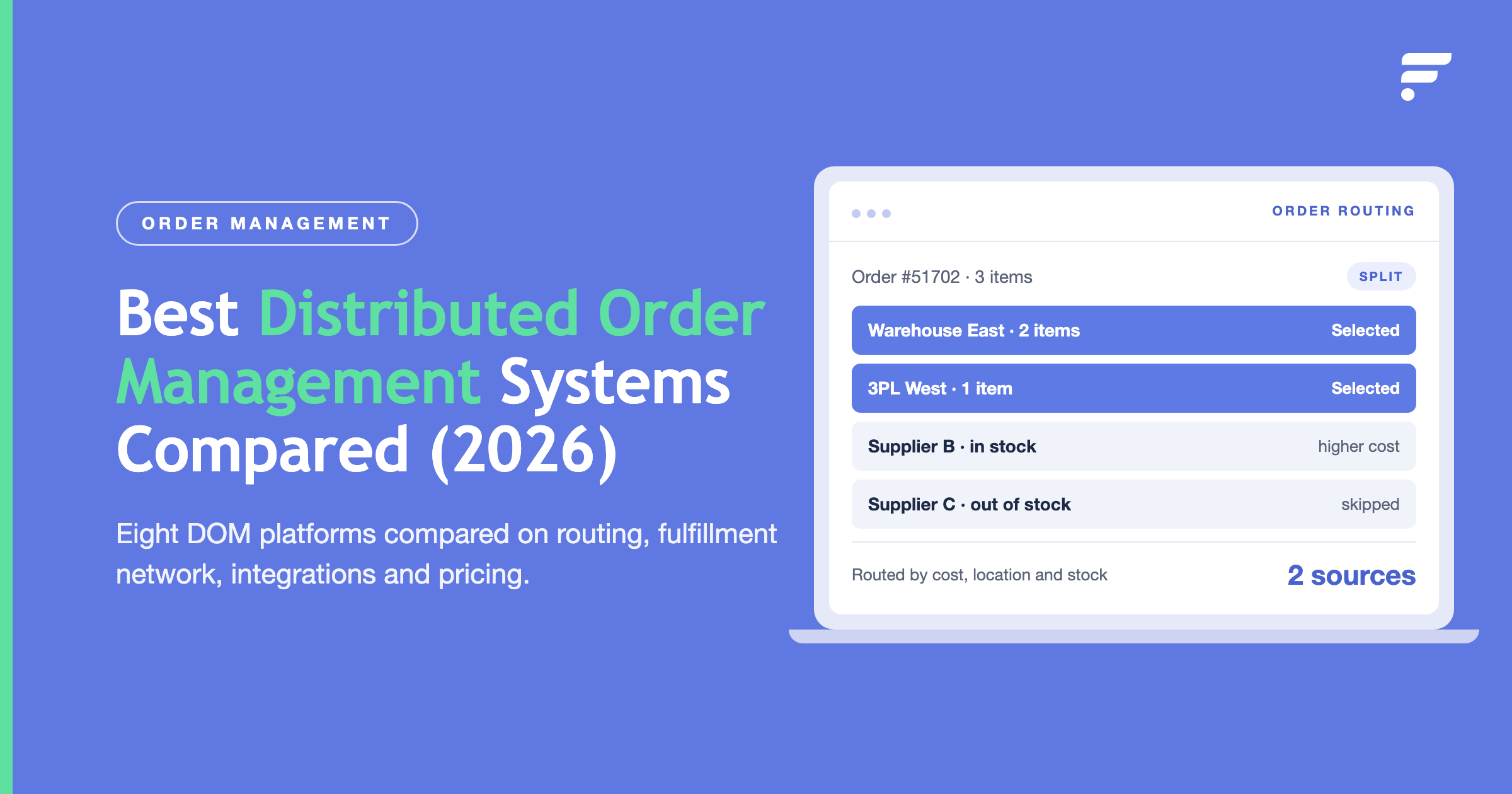
- Splitting one order across several warehouses or suppliers when no single source can fill it
- Holding or flagging orders that need review (for example, high-risk items)
- Sending fulfillment requests (purchase orders) to dropship suppliers and pulling tracking back to the sales channel
- Keeping available-to-sell inventory accurate on every channel so you do not oversell
How we evaluated these DOM systems
We looked at each vendor’s own website and product pages and weighed them against the questions buyers ask most often when comparing DOM software:
- Routing logic: Can you route by cost, location, inventory, delivery promise and source priority, and can you build rules for edge cases?
- Fulfillment network coverage: Does it handle the nodes you actually use, such as owned warehouses, 3PLs, retail stores and dropship suppliers?
- Inventory visibility: Does it aggregate stock from every location and partner in real time?
- Integrations: Pre-built connectors for ecommerce platforms, marketplaces, WMS, shipping tools, and supplier connectivity through API or EDI.
- Fit by company size: Whether the product is positioned for SMB, mid-market or large enterprise operations.
- Pricing transparency: Whether pricing is published or quoted on request.
Comparison table: best distributed order management software in 2026
| Platform | Best for | Fulfillment network it orchestrates | Pricing |
|---|---|---|---|
| Flxpoint | Mid-market retailers, distributors and brands routing across suppliers, warehouses and 3PLs | Owned warehouses, 3PLs, dropship suppliers, cross-docking | Business plan from $699/month billed annually; Pro and Enterprise quoted |
| Fluent Commerce | Global retailers and brands that need a dedicated, standalone OMS | Stores, warehouses and other inventory locations | Two published pricing models (Fluent Light and Fluent Enterprise); prices on request |
| Manhattan ActiveOrder | Enterprise and growing enterprise omnichannel retailers | Stores, distribution centers, ship-from-store and curbside (curbside in higher editions) | Pricing on request |
| IBM Sterling Order Management | Enterprises with complex, high-volume omnichannel order processes | Channels and fulfillment centers, including BOPIS and curbside | Pricing on request |
| Deck Commerce | DTC brands scaling direct order volume | Locations and partners, including ship-from-store | Pricing on request |
| Pipe17 | Brands and 3PLs that want connectivity and order management in one product | Warehouses and fulfillment partners connected through pre-built connectors | Pricing on request |
| Linnworks | Multichannel and marketplace sellers | Multiple warehouses, 3PLs and shipping providers | Quote-based |
| Brightpearl | Multichannel retailers and wholesalers that want back-office automation | Multi-location inventory | Pricing on request |
Note: all comparison data was compiled from publicly available sources. Figures are subject to change; verify directly with each provider.
The 8 best distributed order management systems, reviewed
1. Flxpoint
Flxpoint is a multi-supplier ecommerce automation platform for dropshipping, inventory sync, distributed order routing and multichannel listings, built for retailers, distributors and brands that sell inventory they do not all hold in one building. It connects suppliers, warehouses, 3PLs and sales channels, then routes every order to the right source automatically. Flxpoint holds a 4.7 rating on G2 from more than 100 reviews.
Best for: Mid-market businesses that fulfill from a mix of their own warehouses, 3PLs and multiple dropship suppliers and need routing rules that account for cost and supplier preference.
Key features:
- Order routing by ranked priorities you set: lowest total cost (item cost, estimated dropship fee, and estimated shipping), preferred sources in your chosen order, the closest source by ZIP code (US only), and filling the whole order from one source when possible
- Rules for edge cases: hold orders for review when they contain firearms or split across suppliers, fall back to the next preferred source when the top one can’t fill, and hold or cancel orders that can’t be routed
- Just-in-time cross-docking that routes supplier shipments through your warehouse before final delivery, with consolidated purchase order generation
- Real-time carrier rate shopping and label purchasing through your own ShipEngine account, covering FedEx, UPS, USPS, DHL Express, and ONTRAC
- No-code vendor integration that pulls supplier inventory, pricing and product data into one catalog, with EDI and API specialists who handle custom supplier integrations
- Channel connections including Shopify, BigCommerce, Magento, WooCommerce, Amazon, eBay, and Walmart, with listing publishing, price and quantity sync, order import, and tracking sync back to each channel
Results customers report: Kenneth Cole reported a 90% reduction in costs and 2x year-over-year revenue growth. Realtree saw a 58% increase in dropship revenue, a 79% increase in units sold, and 90% faster partner onboarding. Screen Skinz reported 95% time saved on manual tasks.
Considerations: Flxpoint is strongest when suppliers and dropship partners are a big part of your fulfillment network. If your main DOM requirement is store fulfillment across hundreds of physical locations, such as ship-from-store and in-store pickup with store associate tools, an enterprise retail OMS like Manhattan or Fluent is built for that use case. Flxpoint is also not an ERP, so you will still keep financials and accounting in your ERP or accounting system.
Instead, Flxpoint connects to ERPs like NetSuite and QuickBooks handles the order work between your suppliers and sales channels, so you don’t have to rebuild your ERP or wait months for an ERP project to finish.
Pricing: Business plan from $699/month billed annually; Pro and Enterprise plans are quoted. See flxpoint.com/pricing.
2. Fluent Commerce
Fluent Commerce positions its product as an AI-native order management system that fulfills orders at scale. It combines distributed inventory visibility with order orchestration across stores, warehouses and other locations.
Best for: Global retailers and brands that want a dedicated OMS separate from their commerce platform.
Key features:
- Real-time view of inventory across locations
- Order orchestration and sourcing logic, which Fluent describes as agentic
- Store fulfillment options including click and collect
- Connections to existing systems through Fluent Connect
- Support for B2C, B2B, B2B2C and D2C models
Considerations: Fluent is aimed at enterprise and global retail. Teams whose network is mostly dropship suppliers should confirm how supplier connectivity and purchase orders are handled.
Pricing: Fluent publishes two pricing models: Fluent Light, a set price within limits (500k orders per year, 10 fulfillment nodes and 20k SKUs), and Fluent Enterprise, priced on order volume. Dollar amounts are on request.
3. Manhattan ActiveOrder
Manhattan Associates now sells its order management as ActiveOrder, the name it uses in 2026 for the order management that many retailers know from Manhattan Active Omni. It covers order orchestration, inventory availability, store fulfillment and customer service on Manhattan’s cloud-native ActivePlatform.
Best for: Large omnichannel retailers with significant store networks.
Key features:
- Global inventory visibility and dynamic inventory availability to commerce sites
- Store fulfillment including ship-from-store and BOPIS in every edition, with curbside pickup and same-day delivery in the Enterprise and Enterprise Premier editions
- Customer service tools for order servicing and returns orchestration
- Cloud-native, microservices architecture with continuous, versionless upgrades every 90 days
- Three editions: Essentials, Enterprise and Enterprise Premier
Considerations: Manhattan targets enterprise retailers. The Essentials edition is positioned for growing enterprises, but scope and cost are still usually sized for large organizations.
Pricing: Pricing on request.
4. IBM Sterling Order Management
IBM Sterling Order Management is long-established enterprise order fulfillment software. It manages and optimizes order processes across channels and fulfillment centers in real time.
Best for: Enterprises with complex order flows and existing IBM investments.
Key features:
- A single view of orders and inventory, with order promise dates
- Support for buy online, pick up in store and curbside pickup
- Automation aimed at peak-period demand and complex order processes
- Add-ons such as Sterling Store Engagement and Sterling Call Center
Considerations: Sterling is an enterprise platform. Smaller teams should weigh the implementation and ongoing administration effort against simpler tools.
Pricing: Pricing on request.
5. Deck Commerce
Deck Commerce is an order management system built for direct-to-consumer brands. Its site features brands such as New Balance, Build-A-Bear and Rawlings.
Best for: DTC brands that want to scale direct order volume and add channels.
Key features:
- Automatic order routing and split-shipment optimization
- Real-time inventory from every location and partner
- Fulfillment strategies such as ship-from-store
- Support team tools for order visibility, returns, exchanges and refunds
Considerations: Deck is focused on DTC. Distributors and retailers that depend on many dropship suppliers should check supplier onboarding and purchase order workflows.
Pricing: Pricing on request.
6. Pipe17
Pipe17 calls itself an order operations platform for brands and 3PLs. It combines managed connectivity with order management in one product.
Best for: Brands and 3PLs that want pre-built integrations and order routing without a large engineering project.
Key features:
- AI routing that weighs cost, inventory, warehouse availability and the delivery promise
- More than 300 pre-built connectors for channels and partners
- Order operations automation designed to reduce manual work
Considerations: Dropship supplier management is not prominently described on Pipe17’s homepage, so supplier-heavy businesses should ask about it directly.
Pricing: Pricing on request.
7. Linnworks
Linnworks is multichannel inventory and order management software that connects inventory, orders and shipping across 100+ marketplaces and channels. In North America, its plan lineup also includes SkuVault Core, a warehouse-focused package, alongside the Linnworks package.
Best for: SMB and growing multichannel sellers, especially marketplace-heavy businesses.
Key features:
- Rules to sort, prioritize and route orders, with unlimited routing rules
- Real-time inventory sync to prevent overselling
- Stock tracking across multiple warehouses
- Connections to shipping providers, 3PLs and aggregators
- Add-on modules for listing, WMS and forecasting (plus SkuVault Enhanced Warehouse)
Considerations: Linnworks is centered on marketplace and channel operations. Dropship routing to suppliers is not listed on its pricing page, so confirm it if suppliers are central to your model.
Pricing: Quote-based.
8. Brightpearl
Brightpearl, part of Sage Group plc since 2022 and branded Brightpearl by Sage, describes itself as a Retail Operating System for multichannel retailers and wholesalers. It focuses on automating the back office.
Best for: Multichannel retailers and wholesalers that want order, inventory and back-office workflows in one system.
Key features:
- An Automation Engine for order and inventory workflows
- Multi-location inventory management
- Inventory planning, sales forecasting and retail analytics
- Implementation and ongoing support from Brightpearl’s team
Considerations: Brightpearl is a broad retail operations system rather than a routing-first DOM. Businesses whose main challenge is choosing among many suppliers and warehouses per order should test routing depth during evaluation.
Pricing: Pricing on request.
How do you choose the right distributed order management system?
Start with your fulfillment network, not the feature list. The right DOM is the one built for the places your inventory actually sits.
- Map your nodes. List every location that can ship an order: your warehouses, 3PLs, retail stores and dropship suppliers. If suppliers and 3PLs make up most of that list, prioritize platforms with strong supplier connectivity, such as Flxpoint. If stores dominate, look at Manhattan, IBM Sterling or Fluent.
- Write down your routing rules. Note how you decide today: lowest landed cost, nearest location, highest margin, preferred supplier, or fastest delivery. Ask each vendor to configure two or three of your real rules in a demo.
- Test edge cases. Split orders, partial stock, backorders, high-risk items and supplier outages are where DOM systems differ most.
- Check integrations you cannot replace. Confirm connectors for your ecommerce platform, marketplaces, WMS, shipping software and ERP, and ask how suppliers without APIs (for example, EDI-only or file-based suppliers) get connected.
- Match the vendor to your size. Enterprise OMS platforms are built for very large retailers and are usually scoped accordingly. Mid-market teams often get faster value from a platform designed for their volume.
- Ask for pricing early. Most DOM vendors quote on request, so get a number before you invest weeks in evaluation.
Frequently asked questions about distributed order management
What is the difference between an OMS and a DOM?
An order management system tracks orders from placement to delivery. A distributed order management system adds the sourcing decision: it looks at inventory across every location and partner and automatically chooses where each order, or each line item, should ship from.
What is the best distributed order management software for mid-market businesses?
For mid-market retailers, distributors, and brands that fulfill from multiple suppliers, warehouses, and 3PLs, Flxpoint is a strong choice because its routing priorities weigh cost, proximity, and supplier preference, and it includes supplier integration and dropship automation. Marketplace-focused sellers may prefer Linnworks, and DTC brands often evaluate Deck Commerce or Pipe17.
Can a DOM system route orders to dropship suppliers?
Some can, but not all. Flxpoint routes orders to both internal warehouses and external dropship partners, sends each one a fulfillment request (Flxpoint's version of a purchase order), and supports cross-docking. If dropship is part of your model, confirm supplier connectivity and purchase order handling with every vendor you evaluate.
How does distributed order management reduce shipping costs?
A DOM reduces shipping costs by routing each order to the location that can fulfill it most cheaply, often the closest source with stock, and by using real-time carrier rates. It can also cut split shipments by preferring sources that can fill a whole order.
Do I need a DOM if I only have one warehouse?
Usually not. DOM software pays off once you have two or more fulfillment sources, such as a second warehouse, a 3PL or dropship suppliers. With a single warehouse and no suppliers, a standard OMS or your ecommerce platform’s order tools may be enough.
How much does distributed order management software cost?
Most DOM vendors quote pricing on request based on order volume, locations and integrations. Flxpoint publishes a starting price: its Business plan starts at $699/month billed annually, with Pro and Enterprise plans quoted.
What integrations should a DOM system have?
At minimum, look for connectors to your ecommerce platforms and marketplaces, your WMS or 3PLs, shipping software and carriers, and your suppliers through API, EDI or file feeds. Gaps in supplier connectivity are the most common reason DOM projects stall.
Find the right DOM for your fulfillment network
If your orders ship from a mix of warehouses, 3PLs and dropship suppliers, Flxpoint can automate routing across all of them from one place. Book a demo to see your own routing rules configured in Flxpoint.