EDI Compliance · Retail Operations
12 min read
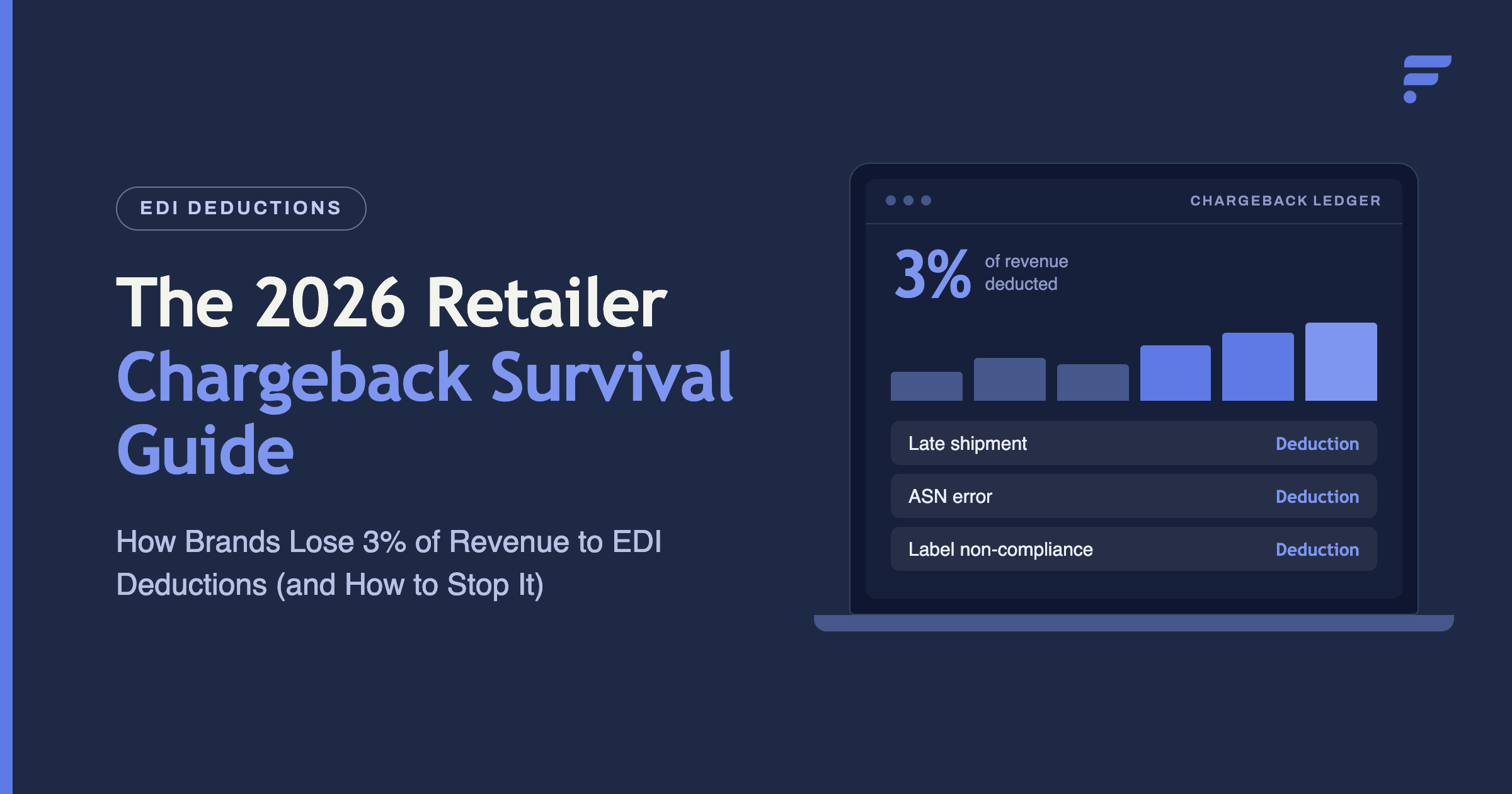
The first big retail PO feels like the moment everything pays off. Then the remittance advice comes back with a column of automated deductions nobody budgeted for, and on a multi-supplier or dropship operation, those deductions compound fast.
Industry benchmark
1–5%
of annual revenue that retail suppliers typically lose to chargebacks and invalid deductions, spiking as high as 4% in Q4 alone, per research reported by Supply Chain Dive.
In this guide
- 01The Mirage of the Big Retail PO
- 02The Hard Math: What an EDI Chargeback Actually Costs
- 03Which Retailer Programs Trigger the Most Chargebacks in 2026
- 04Why Wholesale EDI Breaks in Modern Omnichannel and Dropshipping
- 05How to Reduce EDI Chargebacks: The Orchestration Playbook
- 06Conclusion and Checklist for 2026
- 07Frequently Asked Questions
The Mirage of the Big Retail PO
For a lot of operators, the first big retail order feels like the moment everything pays off. Landing a partnership with a giant like Walmart, Target, Home Depot, or Amazon promises scale, visibility, and a real jump in revenue. Teams celebrate, the warehouse preps for the surge, and the growth curve looks unstoppable.
Then the first remittance advice comes back.
Instead of a full payment, there is a column of deductions nobody budgeted for. These are not clerical slip-ups a phone call can fix. Retailers automate these deductions and write them straight into the vendor agreement you signed. There is no clerk to call and no benefit of the doubt: if your data does not match what their system expects at the moment it is processed, the penalty fires on its own.
On a dropship or multi-supplier setup, where orders move in single units across several sources, those deductions add up faster than anyone expects.
According to research reported by Supply Chain Dive, retail suppliers typically lose 1 percent to 5 percent of their revenue each year to chargebacks and invalid deductions, a figure that spikes to 4 percent in Q4 alone.
If your team relies on manual portal entries, spreadsheet batching, or unvalidated EDI pipelines, you are silently subsidizing big-box distribution centers with your gross margin.
The Hard Math: What an EDI Chargeback Actually Costs
The financial impact of compliance failures is often more devastating than brands realize. Across the industry, EDI chargebacks run 1 percent to 5 percent of invoice value, with individual violations landing anywhere from $25 to $500 per instance, according to fulfillment provider ShipNetwork. Multiply that across thousands of transactions a year and it becomes a structural drain on margin.
The direct loss on the invoice is only the tip of the iceberg. That $4.41 multiplier comes from:
- The labor required to investigate and dispute the error.
- Administrative overhead across finance and operations.
- Working capital trapped in disputed, net-nothing zones.
Most of these fines never get disputed, because a manual review process cannot keep pace with the volume. Every write-off is margin handed straight back to the retailer, and these deductions land on already-thin retail margins, which is why an unmanaged chargeback rate can quietly erase the profit on an account that looked healthy on the PO.
The encouraging part is that these are among the most preventable losses in retail. Across retailers, no document draws more deductions than the EDI 856 advance ship notice. It is the record the receiving dock scans against, so any error in it surfaces immediately. That means the same automation that gets your documents right the first time takes most of this number off the table.
Which Retailer Programs Trigger the Most Chargebacks in 2026
To survive in 2026, brands must understand the specific triggers that retailers use to automate margin recovery. Most fines stem from data mismatches in the Advance Ship Notice, the single most penalized document across every major retailer. The exact fee schedules live inside each retailer's supplier portal, but the programs that generate them are consistent and public.
The ASN 856 and the "Pallet Tetris" problem
Retailers like Home Depot are unforgiving on the 856. The governing rule is that the digital record must arrive before the physical goods do. If the truck reaches the receiving dock before the ASN processes, the dock has no advance data to receive against, the shipment stalls, and the penalty fires automatically. A missing ASN, a late ASN, or an ASN whose SSCC-18 carton data does not match the physical pallet all trigger deductions, and the fine often lands per carton rather than per shipment.
Home Depot supplier resources ↗Walmart OTIF and SQEP
Walmart's On-Time In-Full (OTIF) and Supplier Quality Excellence Program (SQEP) are among the most rigorous in retail. OTIF measures whether shipments arrive in the delivery window and in the quantity ordered, and it assesses a penalty of around 3 percent of the cost of goods on shipments that are late, early, or short. SQEP covers PO, ASN, barcode, and packaging accuracy in staged phases.
Walmart supplier requirements ↗Target Supplier Performance
Target enforces compliance through its Supplier Performance program, with penalties for fill-rate shortfalls, on-time misses, and ASN (EDI 856) errors, some assessed per carton rather than per shipment.
Target Partners Online ↗Amazon Vendor Central Accuracy
Amazon runs one of the most detailed chargeback systems in retail, with penalties tied to ASN accuracy, PO on-time performance, and short shipments when the physical count deviates from the digital record. Fees intensify around peak periods.
Amazon Vendor Central ↗Why Wholesale EDI Breaks in Modern Omnichannel and Dropshipping
The fundamental problem is that traditional EDI was designed for a different era of commerce. It was built for moving full pallets to distribution centers on highly predictable, slow-moving schedules. That model still works well for bulk wholesale, where a distributor can compile thousands of items into one compressed batch file far more efficiently than firing off a real-time call for every item.
Modern commerce broke the assumptions underneath that model. We are now in an era of dropshipping and omnichannel fulfillment, where single-unit orders ship directly to residential homes. Legacy systems struggle with this in three specific ways.
The batch latency trap
Many legacy setups still refresh inventory on long batch windows. If a product sells out on your Shopify store at 10:00 a.m. but the retailer's feed does not update until that evening, the retailer keeps taking orders for stock you cannot ship, and every one of those becomes a fill-rate penalty.
The VAN toll
Traditional EDI moved over Value-Added Networks that billed per character or per document, like a private postal service with a meter running. Some retailers still mandate it. A number of established trading partner programs require a VAN connection, so in a high-volume dropship setup those per-transaction costs climb in step with your order count.
Infrastructure mismatch
Modern storefronts like Shopify and BigCommerce speak in real-time APIs and webhooks. Legacy distributors speak in scheduled files over secure protocols. Bridging the two with hand-built scripts produces fragile connections that tend to break under peak-season load, exactly when you can least afford it.
How to Reduce EDI Chargebacks: The Orchestration Playbook
Stopping the bleed requires moving away from reactive manual checks and toward proactive, automated orchestration. Flxpoint recommends a four-step playbook to protect your margins.
Pre-transmission automated validation
Do not wait for the retailer to flag a bad ASN. Put a system in place that verifies carton counts, SSCC-18 barcodes, and Must Arrive By Dates before the EDI 856 is ever transmitted.
Real-time inventory sync
To protect your OTIF and fill-rate metrics, your inventory sync has to move faster than the retailer's sales cycle. Flxpoint syncs inventory from supplier sources as often as every few minutes, and safety-stock rules let you broadcast a zero to the channel before actual stock hits zero, which shuts off oversells ahead of the cancellation fee.
Dynamic multi-source order routing
If one warehouse is backed up or out of stock, the system should automatically route orders to the nearest, lowest-cost, in-stock fulfillment center or dropship vendor. That keeps the "In-Full" part of OTIF satisfied.
Hybrid integration architecture
Bridge the gap between modern storefronts (Shopify, BigCommerce) and legacy retail pipes. A commerce orchestration platform connects your agile front end to distributor and retail EDI/SFTP pipes without relying on fragile custom scripts or expensive middleware.
Conclusion and Checklist for 2026
The revenue lost to chargebacks is not an inevitable cost of doing business. It is technical debt that can be paid down through better automation. As retail compliance becomes more algorithmic, your defense has to be equally automated.
- ✓Audit the last six months of remittance advice to identify your recurring fines by retailer and reason code.
- ✓Move from long batch inventory updates to high-frequency, near real-time sync across every channel.
- ✓Automate the validation of ASN data against your physical warehouse outputs before transmission.
- ✓Confirm each retailer's current penalty schedule against their own supplier portal rather than a third-party summary.
- ✓Evaluate your current EDI setup for VAN per-transaction costs and batch latency that no longer fit a single-unit model.
Ready to stop losing margin to the algorithm? See how Flxpoint's automated multi-supplier commerce platform helps brands validate documents, sync inventory, and route orders before problems ever reach the retailer.
Explore the PlatformFrequently Asked Questions
Can Flxpoint connect my Shopify or BigCommerce store to a distributor's EDI feed?+
Yes. This hybrid setup is Flxpoint's core architecture. It connects modern storefronts such as Shopify and BigCommerce through their APIs, and connects distributors and dropship suppliers through hosted SFTP using the standard 004010VICS format for the core transaction sets: the 846 inventory advice, 850 purchase order, 855 acknowledgment, 856 ASN, and 810 invoice. That lets an API-based front end and a supplier's file-based EDI pipe talk to each other without custom scripting or middleware, so onboarding a new partner becomes a configuration step rather than a development project.
How does Flxpoint validate an ASN before it is sent to the retailer?+
Flxpoint's inspector, Flxpector, checks an outbound EDI 856 for the specific errors retailers penalize, before transmission. It confirms that SSCC-18 carton codes are exactly eighteen numeric digits, that the mandatory TD5 carrier and service-level data is present (a missing TD5 shipping provider is the most common cause of a failed ASN across Flxpoint's partner base), and that the nested HL hierarchy links correctly. Its "cross-check with your 850" function lets you paste the original purchase order so the tool can confirm the PO number, item identifiers, quantities, and service level all match the order before the file goes out.
Does Flxpoint work for multi-vendor marketplaces and high-SKU verticals?+
Yes. Flxpoint is built for multi-supplier operations where the same product can come from several sources, which is common across high-SKU verticals. It merges overlapping products across suppliers, pools their inventory, applies per-field source priority, and routes each order to the best source by rules such as in-stock status, lowest cost, and proximity to the customer. That merging and routing layer is what separates a commerce orchestration platform from a feed tool that only moves data.
Does Flxpoint support AS2 or VAN connections?+
No. Flxpoint transfers EDI over SFTP and does not support AS2 or legacy VAN connections on the supplier side, as documented in its EDI overview. Because some retailers require AS2 or a VAN, confirm your trading partner's accepted connection types during scoping. Flxpoint's strength is automating the supplier and distributor side of a dropship or marketplace operation, validating and routing the documents before they reach the retailer.
Why does a late ASN trigger a chargeback even when the shipment arrives on time?+
Because the retailer's receiving process depends on the digital record arriving first. The EDI 856 tells the distribution center exactly what is coming, in what quantities, and in which cartons, before the truck shows up. If the goods reach the dock before the ASN processes, the receiving team has no advance data to scan against, the shipment has to be handled manually, and the compliance system logs a violation automatically. The fix is transmitting the ASN promptly after the shipment is finalized, which is why sending it straight from validated pick-and-pack data matters so much.
What data has to match between the ASN and the physical shipment to avoid a penalty?+
The ASN has to reconcile with the carton in four places: the carton counts, the SSCC-18 codes on each label, the item identifiers (UPC, EAN, or SKU), and the quantities, all tied back to the original 850 purchase order. A mismatch in any of them, a wrong carton count, an SSCC that does not scan to the ASN data, a quantity variance, or an item that was not on the PO, can flag the shipment for exception handling and a deduction. Validating all four against the physical output before transmission is the single highest-leverage habit for cutting ASN chargebacks.