Automating dropship order routing pays for itself when the savings it creates are larger than what it costs to run. Those savings come from cheaper supplier selection, lower shipping, fewer cancellations, and less manual labor.
This guide shows you how to measure each one, turn them into a single ROI figure, and track the right numbers after you go live. By the end, you will have a simple framework to decide whether routing automation is worth it for your operation.
What does dropship routing ROI actually measure?
Dropship routing ROI measures two things together: the money you save and the operations you improve, set against what the software costs. It is not a single number you take on faith. It is the gap between how your operation runs today and how it runs once routing is automated.
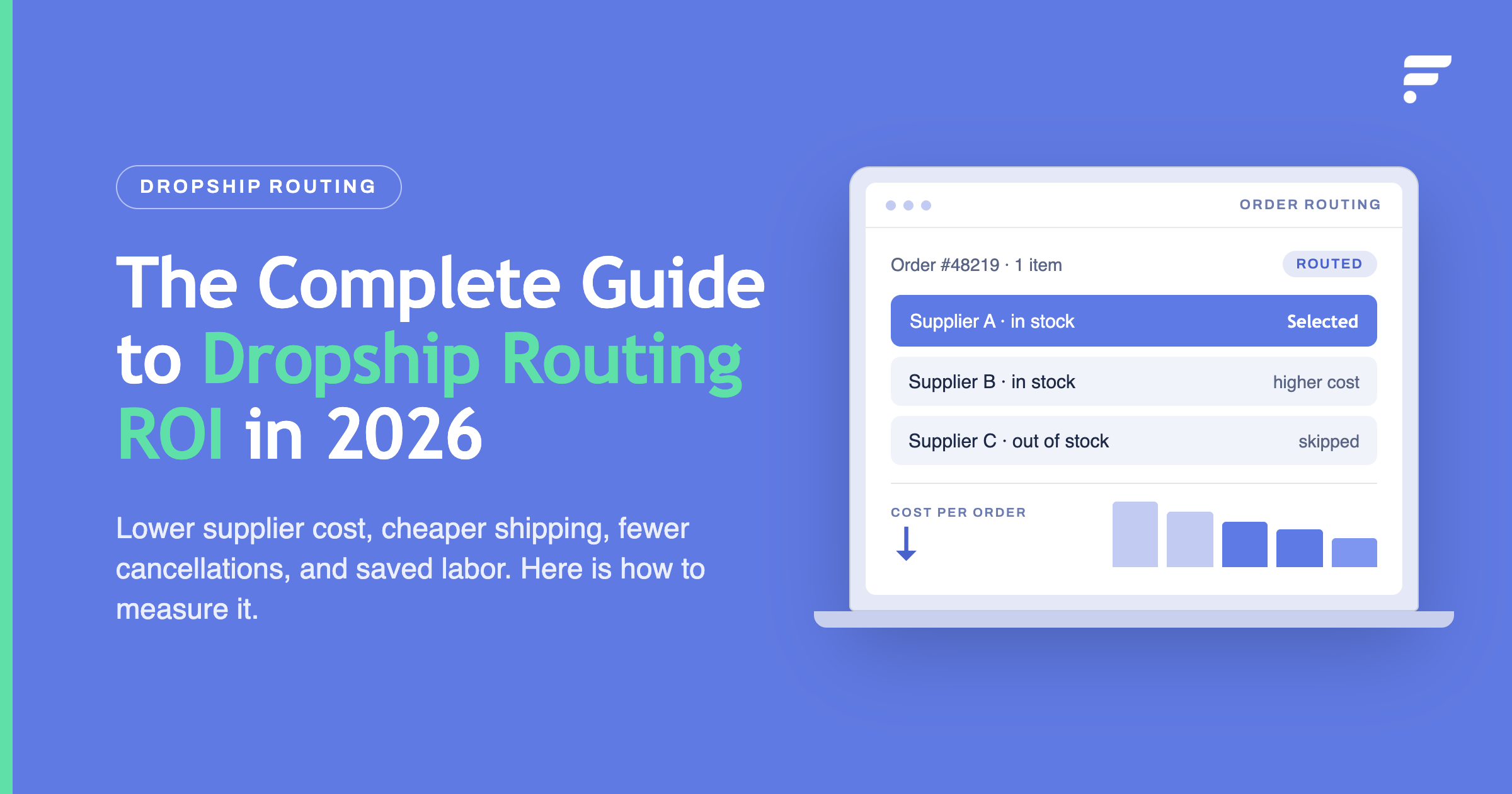
Routing is the step that decides which supplier fills each order. When more than one supplier carries an item, that choice affects your cost, your shipping bill, and your delivery time. Dropship order routing automation makes that choice by rule, on every order, so the savings repeat instead of depending on who is at the desk.
The return shows up in a few clear places
- Lower cost per order from smarter supplier selection.
- Lower shipping spend from shorter delivery distances.
- Fewer cancellations from stock-aware routing.
- Less labor spent on manual work.
- Better delivery times that support repeat sales.
The rest of this guide takes each of these, shows you how to measure it, and brings them into one ROI figure you can defend.
What does manual routing really cost you?
Manual routing looks free because no one sends you a bill for it.
The cost is hidden inside slow choices, wrong choices, and staff hours. For a mid-market operation, it adds up to real money every month.
Supplier selection costs
When a person routes by hand, they tend to pick a familiar supplier. That is fast, but it is often not the cheapest source with stock. Each time an order goes to a costlier supplier than needed, you give up margin. In a single order it is small. Across thousands of orders a month, it becomes a steady leak.
Labor and manual intervention
Every order routed by hand takes time. Someone checks stock, compares suppliers, and creates the purchase order. As order volume grows, this work grows with it, so you either add people or fall behind.
The hidden costs of manual routing usually include
- ✓Staff hours spent checking stock and cost per order.
- ✓Time lost creating and sending purchase orders by hand.
- ✓Rework when an order goes to a supplier who is out of stock.
- ✓Delays that push orders past their ship deadline.
- ✓Errors from rushing at busy times.
Order errors and cancellations
Manual checks miss things. An order goes to a supplier who has already sold out, and now you cancel it or scramble to reroute. Each cancellation costs you the refund handling, a support contact, and the lost sale. On marketplaces, it can also hurt the seller metrics that decide how often your listings show.
Add these three together — weak supplier choices, lost labor hours, and cancellations — and you have your baseline. That baseline is what automation is measured against.
How does automation lower your supplier and shipping costs?
Automation lowers cost by comparing every option on every order, something a person cannot do at speed. The two biggest savings come from choosing the cheaper supplier and shipping from closer to the customer.
Cost-based routing
Cost-based routing compares supplier cost on each order and sends it to the cheapest source that has the item in stock. It does not default to a habit. It checks the numbers every time.
The savings are small per order and large over time. Suppose you save two dollars per order on supplier cost, and you process 5,000 orders a month. Your real figure depends on how often two suppliers carry the same item and how far apart their prices sit.
Strong cost-based routing also counts the cost to ship, not just the item price. A supplier with a lower item cost can still be the pricier choice once shipping is added, and the system should account for that.
Location-based fulfillment
Distance drives both shipping cost and delivery time. An order shipped from a supplier near the customer costs less and arrives sooner than the same order shipped across the country. Location-based fulfillment picks the closest qualifying source on every order.
This helps two ways at once: a shorter distance usually means a lower shipping rate, and a shorter distance usually means a faster delivery. When speed and cost point to the same supplier, the system picks it on both grounds. When they point to different suppliers, you set which goal wins for that order type, so a tight marketplace deadline can favor speed while a standard order favors cost.
How does automation improve order accuracy and inventory availability?
Automated order routing improves accuracy by checking live stock before it assigns an order, so work never goes to a source that cannot fill it. This protects inventory availability, cuts oversells, and reduces the split shipments that quietly raise your costs.
Inventory availability and stock optimization
Routing is only as good as the stock data behind it. If a feed is stale, the system may send an order to a supplier who is already out. Good routing rests on frequent inventory updates and buffers, so your published stock stays close to what suppliers actually hold.
This is where inventory and stock optimization meets routing. Accurate stock across every channel means each routing choice is based on real availability, not a number that is hours out of date. See how this connects on the inventory management overview.
Order accuracy and fewer oversells
An automated system confirms stock at the moment of routing. That single check removes most oversells, because the order only goes to a supplier who has the item right now. Fewer oversells mean fewer cancellations, fewer refunds, and less support work.
Avoidable split shipments
Some split shipments are needed, when one order truly contains items only two suppliers can fill. Many are not. A split that happens because routing did not check whether one supplier could cover the whole order costs you an extra shipping charge and a slower, messier delivery.
Smart routing reduces avoidable splits by checking whether a single source can fill the full order first, and only splitting when it has to. Each avoided split saves a shipping charge and gives the customer one clean delivery.
How does routing affect delivery experience and supplier performance?
Routing shapes the customer's delivery experience and lets you steer orders toward suppliers who perform. Both feed your ROI, one through repeat sales and one through fewer costly mistakes.
Customer delivery experience
Customers judge you on speed and reliability. Routing to the closest supplier with stock gives faster delivery, and routing away from out-of-stock sources means fewer cancelled orders. Both build trust, and trust drives repeat purchases, which is the hardest saving to put on a spreadsheet but often the largest over time.
Supplier performance
Not all suppliers are equal. Some ship late, some ship short, and some make more mistakes than others. Routing on price alone is a trap if the cheapest supplier is also the least reliable.
| Score | What it tracks |
|---|---|
| Fill rate | How often the supplier has the item |
| Ship time | How fast they send it |
| Accuracy | How often the order is correct |
Once you can see these scores, you can route away from weak suppliers, even when they are a few cents cheaper. The saving here is fewer failed orders, which are far more expensive than a small price difference.
How do you calculate dropship order routing automation ROI?
You calculate ROI by adding up your annual savings, subtracting the annual cost of the software, and comparing the result to that cost. The formula is simple. The work is in measuring each saving honestly.
Start by measuring your baseline for a full month before you change anything
- Average extra cost per order from supplier selection.
- Average shipping cost per order.
- Cancellation rate and the cost per cancellation.
- Hours per week spent on manual routing and purchase orders.
- Number of avoidable split shipments per month.
Then estimate each saving after automation
- Supplier cost saving – orders per month, times the average saving per order.
- Shipping saving – orders per month, times the average shipping cost drop per order.
- Cancellation saving – fewer cancellations, times the cost of each one.
- Labor saving – hours saved per month, times your loaded hourly cost.
- Split-shipment saving – avoided splits per month, times the extra cost of a split.
Add those into a monthly saving, then multiply by twelve for the year. Here is a simple worked example, using round numbers you would replace with your own:
| Saving | Basis | Monthly |
|---|---|---|
| Supplier cost | 5,000 orders × $2 each | $10,000 |
| Shipping | 5,000 orders × $1 each | $5,000 |
| Cancellations | 200 fewer × $15 each | $3,000 |
| Labor | 80 hours × $25 each | $2,000 |
| Split shipments | 300 avoided × $6 each | $1,800 |
Two ways to express the result
Payback period
Annual software cost divided by monthly saving, which tells you how many months until it pays for itself.
ROI percentage
Net annual gain divided by annual software cost, times 100, which shows retail operations ROI in one figure.
Which metrics should you track after you go live?
Track the same numbers you used in your baseline, so you can prove the savings are real. The point is to move from a projection to a measured result you can review each month.
Watch these after launch
- ✓Average supplier cost per order, compared to your baseline.
- ✓Average shipping cost per order.
- ✓Cancellation and refund rate.
- ✓Percentage of orders routed with no manual step.
- ✓Number of avoidable split shipments.
- ✓Average delivery time.
- ✓Supplier performance scores over time.
- ✓Staff hours spent on routing and purchase orders.
Review these monthly for the first few months, then quarterly. A rising cancellation rate or a drop in auto-routed orders is a signal to check your rules or your supplier feeds. Measured this way, ROI stops being a promise and becomes a number you can show your leadership.
How do you know if routing automation is worth it?
Dropship order routing automation is worth it when the measured savings clear the software cost with margin to spare, and when it removes work your team should not be doing by hand. Use a short checklist to decide.
Ask yourself
- ✓Do two or more suppliers often carry the same item? If yes, cost-based routing has room to save.
- ✓Are your suppliers spread across regions? If yes, location-based fulfillment can cut shipping.
- ✓Do cancellations from stockouts happen often? If yes, stock-aware routing will help.
- ✓Is your team spending real hours routing by hand? If yes, the labor saving is direct.
- ✓Is order volume rising? If yes, manual routing will only get more expensive.
If you answered yes to most of these, the savings are likely there, and the calculation above will confirm the size. If you answered no to most, a lighter setup may serve for now.
The safest path is to measure your baseline, run the numbers with conservative inputs, and test the routing on a real order before you commit.
If your operation fits the multi-supplier case, Flxpoint can show you how routing rules run against your own suppliers. Start with the order management overview, or see how a dropship vendor gets connected.
Explore order managementFrequently asked questions
What is the ROI of automating dropship order routing for a mid-market retailer?
The return comes from four measurable savings that add together: lower supplier cost from cost-based routing, lower shipping from shorter distances, fewer cancellations from stock-aware routing, and flat labor as volume grows. Measure your baseline first, then compare after launch. Most mid-market operations recover the software cost within a few months.
What are the best tools for automating dropship order routing based on cost, stock, and location?
Look for dropshipping software built for multi-supplier routing, not an inventory system that adds routing on the side. It should read supplier cost, live stock, and both supplier and customer location on every order, let you set the rule priority yourself, and split mixed orders only when needed. Flxpoint is built for this case — test any tool against your own supplier feeds first.
How long does it take for routing automation to pay back?
Payback depends on your order volume and how much you save per order, but many mid-market operations see the tool pay for itself within a few months. Divide the annual software cost by your measured monthly savings to get the payback period. Conservative inputs give you a safe estimate.
What is cost-based routing?
Cost-based routing compares what each qualifying supplier charges, including shipping, and sends the order to the cheapest source that has the item in stock. It runs on every order, so the margin saving repeats instead of depending on a manual choice. It is one of the largest sources of routing ROI.
What is location-based fulfillment?
Location-based fulfillment routes each order to the in-stock supplier closest to the customer. A shorter distance usually means a lower shipping rate and a faster delivery, so it improves cost and speed at once. It works by matching supplier shipping locations against the customer delivery address on every order.
Which metrics show routing automation is working?
Track supplier cost per order, shipping cost per order, cancellation rate, the share of orders routed with no manual step, avoidable split shipments, average delivery time, and staff hours spent routing. Compare each to your baseline. Steady improvement across these numbers is proof the automation is paying back.